
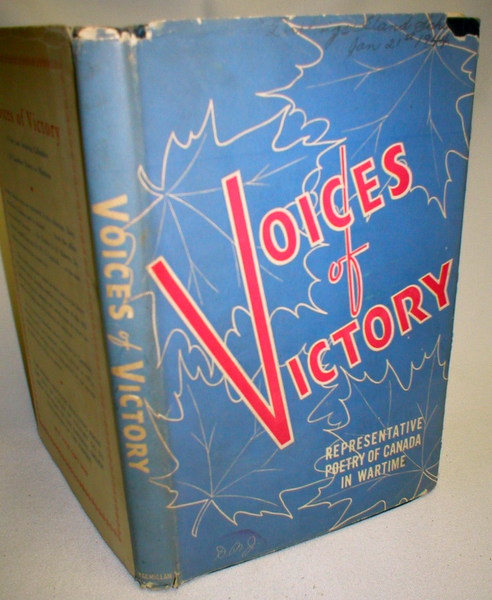
Three Kawartha Lakes writers were the judges for the 1941 anthology, Voices of Victory: representative poetry of Canada in wartime, a publication of the Canadian Authors Association, sponsored by the Seven Seas chapter of the IODE.
The anthology was the idea of the Poetry Group of Toronto. The project was taken on by the Canadian Authors Association, overseen by an editorial board with selection by a committee of judges. The final volume was compiled by Amabel King with a forward by Charles G.D. Roberts.
The purpose of the anthology was two-fold: to send the proceeds from sales to the Canadian Red Cross British Bomb Victims’ Fund, and “to let the poetic genius of Canada and of the Canadian people sound a spiritual challenge to the brutality of enemy despots and tyrants.”
The judges were A.M. Stephen, Watson Kirkconnell, E.J. Pratt, E.A. Hardy, S. Morgan-Powell, and V.B. Rhodenizer. The editorial board consisted of Nathaniel Benson, W.A. Deacon, John M. Elson, and Amabel King.
(Kirkconnell, Pratt, Hardy, and Deacon were all residents of Kawartha Lakes and active members of the Canadian Authors Association. Click on the links to see their pages for more details. Kirkconnell’s page is coming soon.)
The anthology featured poems from three Kawartha Lakes writers: Dorothy C. Herriman, Watson Kirkconnell, and E.J. Pratt.
Some writers were invited, some were included as sponsors (the Poetry Group of Toronto), and 766 others from every province and territory submitted their work to be judged for inclusion and for the chance at winning a prize. First prize was a silver medal donated by His Excellency the Earl of Athlone, Governor General of Canada, Alexander Cambridge, a patron of the Canadian Authors Association. The top three poems received prizes donated by Robert Young Eaton, Sir William Mulock, and the Poetry Group of Toronto. The prize for Honourable Mentions was being included in the anthology and went to 20 entries.
The male-to-female ratio of judges that made up the committee was somewhat controversial:
In addition, the volunteer work of the judges is acknowledged in print in the association anthologies, usually in a preface or foreword, whereas most editors are unnamed. Border Voices, edited by Carl Eayn in 1946, and Voices of Victory (1941), in which Livesay’s “The Child Looks Out appears, constitute the two exceptions to this rule. The editorial board of Voices of Victory consisted of three men and one woman and its judges were all male. The preponderance of female writers in association anthologies, including those both edited and judged by male writers, suggests the articulation of gender with democracy, that is, with the power of numbers; most of the submissions to the poetry contests of association anthologies were from women writers, a fact that reflects the female domination of the CAA’s membership lists.
https://www.collectionscanada.gc.ca/obj/s4/f2/dsk1/tape9/PQDD_0029/NQ46864.pdf
In fact, the prizes all went to women:
First place – Agnes Aston Hill for “Recompense”
Second place – Isobel McFadden for “Canadian Crusade”
Third place – Carole Coates Cassidy for “Chosen of Men.”
The editor, Amabel Reeves King, was a Volunteer Ambulance Driver oversees during the First World War. She was a neighbour of poet John M. Nelson, who also contributed to the volume.
The volume was published by McMillian Company, Toronto, 1941.
Resources:
Voices of Victory https://archive.org/details/voicesofvictory0000unse
Amabel Reeves King: https://cwrc.ca/islandora/object/ceww%3A2a0e1a5a-f471-4118-937e-b0f7051a7882
 kawarthalakeswriters.com