

Mary Milloy Harrington (1903-1982) was a poet from Downeyville. Her works were collected in the volume, The Heart of Emily: a history of Downeyville in poetry 1825-1960, with the first edition published in 1986 and the second in June 2000 by Shamrock Publishers.
Technically, this book has a second author, Marie Titus. As stated on the copyright page, “This book was published posthumously by the author’s daughter, Marie Titus, in memory of her parents Mary Milloy Harrington and Leo Harrington.” Mary Milloy Harrington was born in Downeyville in 1903. She was a fourth generation descendent of Patrick Milloy, an Irish immigrant who settled in Downeyville.
Also, technically, this isn’t strictly a poetry book. Although there are about 35 lengthy poems contained in the 200 pages, the book also presents a lot of history of the Downeyville area. The author’s note is dated 1 December 1960, and the book may have been intended to be part of the area’s history publications for the country’s centennial. It’s a shame it wasn’t published at that time.
Mary Milloy Harrington says, “The Heart of Emily is a history of that part of Emily Township which makes up the Downeyville district, a history of St. Luke’s parish, and a story of the first pioneers who came from Ireland and settled in this new land.” Among her sources, she thanks, “Honorable Leslie M. Frost, Prime Minister of Ontario, for his assistance in giving the names of the original Grantees in the Downeyville district, and also Dr. Watson Kirkconnell, President of Acadia University, Wolfville, Nova Scotia, for his kindness in allowing me to use all information concerning Downeyville pioneers contained in his book Victoria County Centennial History.” She also thanks her neighbours for allowing use of their books, Crown deeds, and photos.
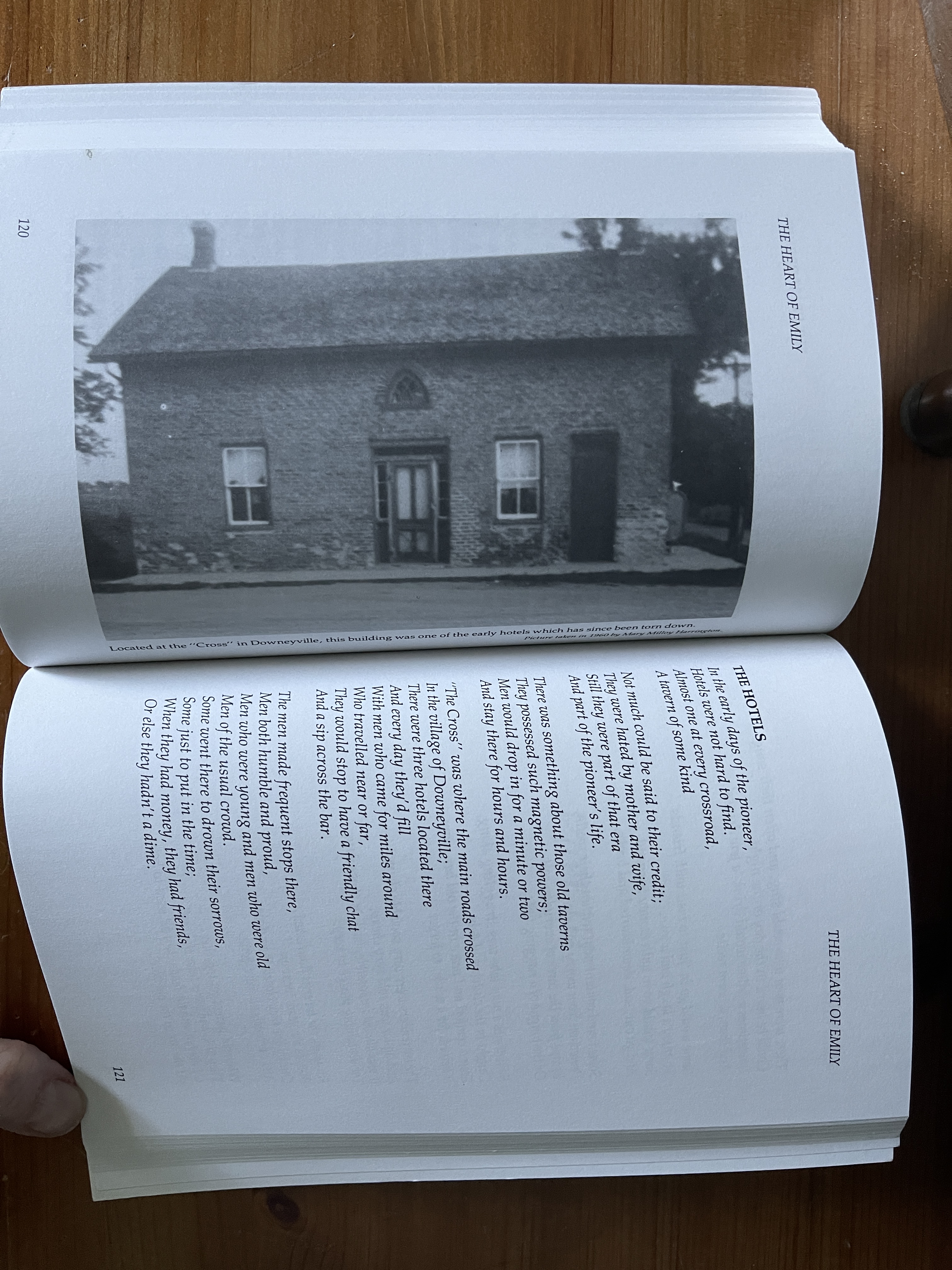
The local history comes alive through poems such as “The Great Fire” that tells the story of the summer of 1874 when “the earth was parched by the burning sun,/ The meadows seared and dry.” The lines describe a haze in the western sky, a fog that became billowing smoke; dark clouds riding on a strong wind; flames that crackled as they ate everything in their path; and the final tally of destruction.
There are also poems about “Grandma and her Quilting Bee” and other notable events. There are poems about individuals, such as “Judy” and “The Runaway.”
Although the book recounts much history of Downeyville, technically, part of the book is also fiction. As the author states, “Regarding Part III, the life of the O’Grady Family, all names used are fictitious.” This part of the book tells the story of an Irish family arriving in Canada and setting up life in Downeyville through a series of poems about characters Jack, Alice, and Father Tim.
Works:
The Heart of Emily (1986)
 kawarthalakeswriters.com