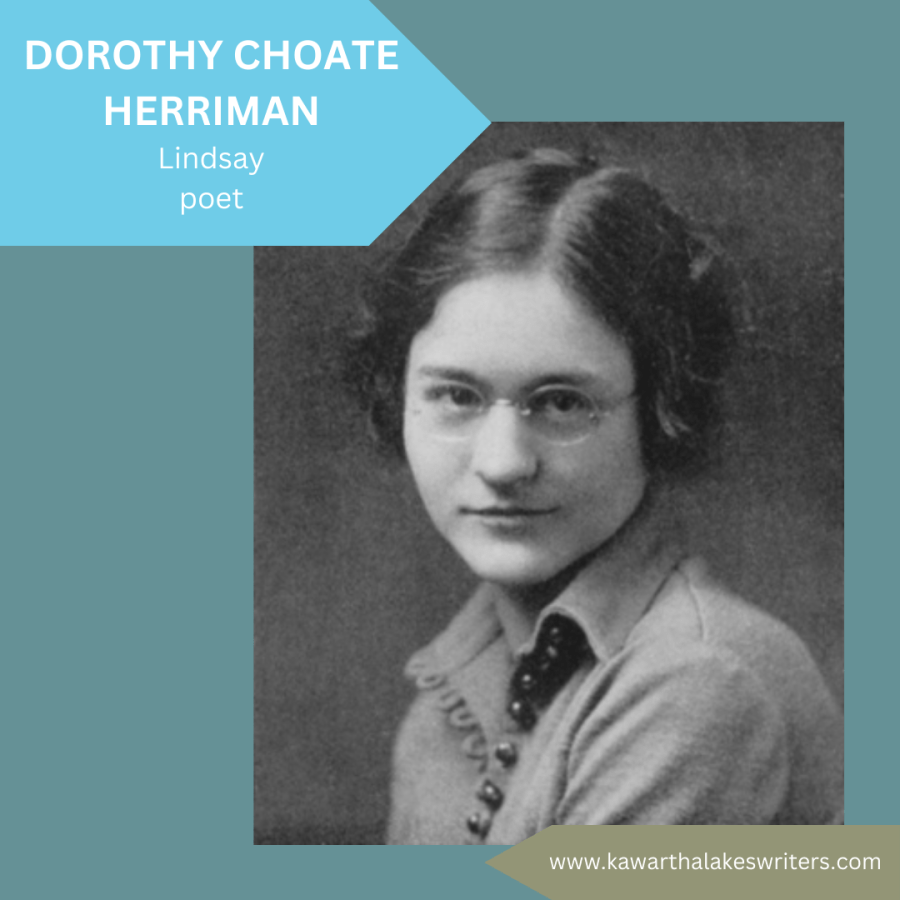
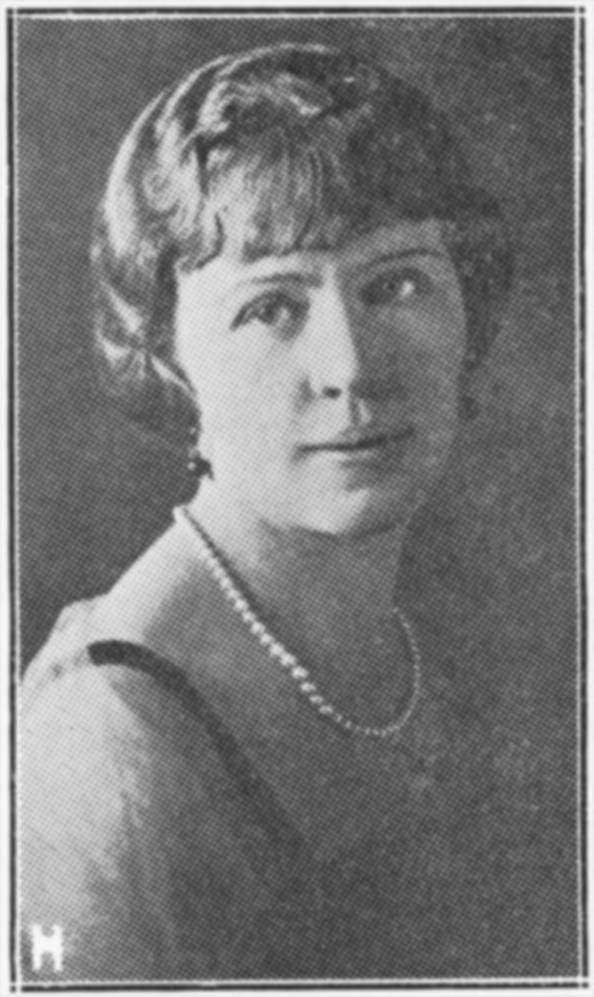
Image from John. W. Garvin, ed., CANADIAN POETS (2nd ed., Toronto: McClelland & Stewart, 1926).
Dorothy Choate Herriman (1901-1978) was born in Lindsay on 1 September 1901 to Nellie J. Williams and Dr. William Choate Herriman. She was an only child.
Her father, William Choate Herriman was a third generation doctor. His father, Weston Leroy Herriman, uncle, Elbridge Albert Herriman, and grandfather, Luther Herriman practiced in the Port Hope area.
Just days before the birth of Dorothy, her great-uncle was killed when his horse backed the rig over a bridge and fell on him. (Watchman Warder, 29 August 1901.) Asa Choate was the brother of Mary Augusta (Choate) Herriman, wife of Dr. Weston Leroy Herriman. His death notice appeared alongside Dorothy’s birth notice in the Lindsay Weekly Post.
Weston. L. Herriman was a member of Lindsay’s town council and an incorporating member of the Children’s Aid Society in Lindsay in 1895 and served as its first secretary. He was instrumental in the creation of the medical program at Queen’s University.
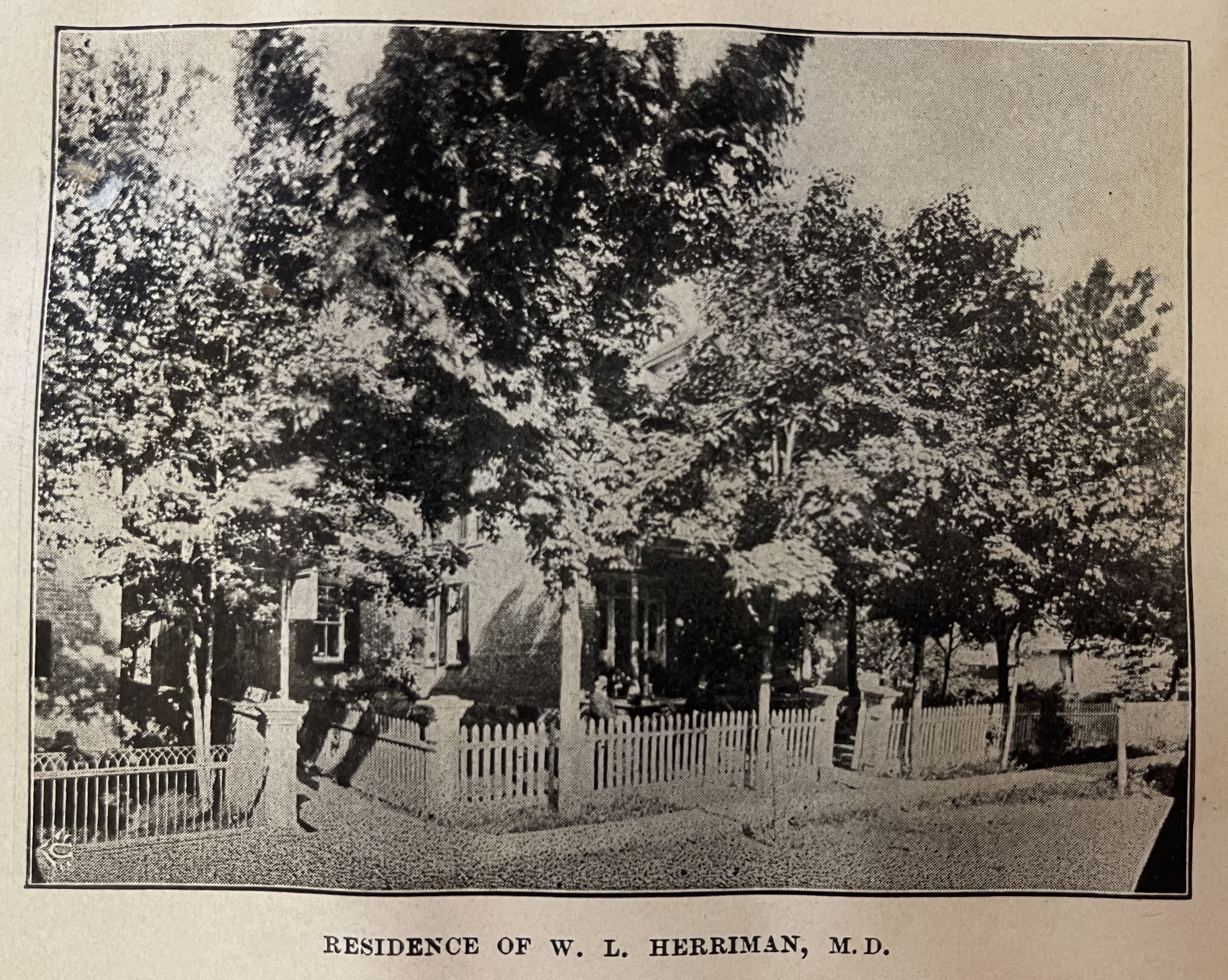
Weston Leroy Herriman and Elbridge Albert Herriman, brothers, went to the Washington, D. C. area and served as surgeons in the American Civil war. When they returned, they set up practices side-by-side on Cambridge Street North across from the Baptist church at what is now 35 Cambridge Street North.
Lindsay Past and Present: souvenir of old home week, 1924. Courtesy of Kawartha Lakes Museum & Archives.
Around 1903, Elbridge left Lindsay and went to the U. S. At that time, Elbridge’s son, Wilfred D. took ownership of the house next door to Weston Leroy. Wilfred was also a practicing physician at this location for a few years, before he followed his father to the U.S.
Weston Leroy remained in Lindsay, and at one point owned both houses, until 7 October 1908 when he passed away at his home. His funeral was held at the home in Lindsay with interment in Port Hope.
Lindsay Weekly Post, 6 September 1901.
The Choate family was one of the pioneer families to Lindsay. Aaron, Jacob, Nathan and Thomas Choate were original patentees in the former Mariposa township.
All of this is to show that Dorothy Choate Herriman has long roots in Kawartha Lakes, even if she was only born here because of her grandmother’s brother’s death.
At the time of her birth, Dorothy’s parents were living in Kingston, where her father was a physician, a pioneer of psychiatry. He became assistant superintendent for the Toronto Hospital for the Insane before he was appointed Chief of Medical Staff at the Orillia Institution.
Dorothy attended school in both Orillia and Toronto, including the Ontario College of Art.
Her relationship with her mother was strained, but amicable with her father.
Her father believed in literature therapy, advising his patients to read. He shared his substantial library with his daughter, and encouraged her to write.
In 1926, at the age of twenty-five, Herriman became the youngest contributor to the revised edition of John Garvin’s influential anthology Canadian Poets. Garvin himself praised her as a ‘genuine talent’ from whom ‘we may expect much good verse in the future.’
Albert Braz. The Small Details of Life. 2002.
And yet, Dorothy published only one volume of poetry, Mater Silva, which she illustrated herself.
The volume was positively praised by tough critic, William Arthur Deacon (another Kawartha Lakes writer). In his letter to her in 1929, he said Mater Silva took her out of the “junior ranks.”
Dorothy was an active member of the Canadian Authors’ Association and served a term as secretary.
From 1926 to 1944, she filled eleven volumes of her diaries. But she never published another book.
I still mistrust myself and fling barbed words that tear, sharp words that sting. Better to cower beneath a glancing shield? be like a tortoise in himself concealed? Not yet for me the all defenseless, meek and humble spirit of the martyr who turns the other cheek.
Dorothy Choate Herriman. Diary entry for 29 December 1932. The Small Details of Life. 2002.
Dorothy never married or had children. She passed away in 1978. She was buried in Port Hope. Her fonds are in the custody of Trent University, having been donated there by Dorothy’s friend.
Publications:
Windsor Magazine (July and August 1925)
Canadian Poets (1926)
Canadian Verse for Boys and Girls (1930)
Voices for Victory (1941)
Mater Silva (1929)
Further Reading:
“Dorothy Choate Herriman (1901-1978).” Albert Braz. The Small Details of Life: 20 diaries by women in Canada, 1830-1996. Ed. Kathryn Carter. (2002)
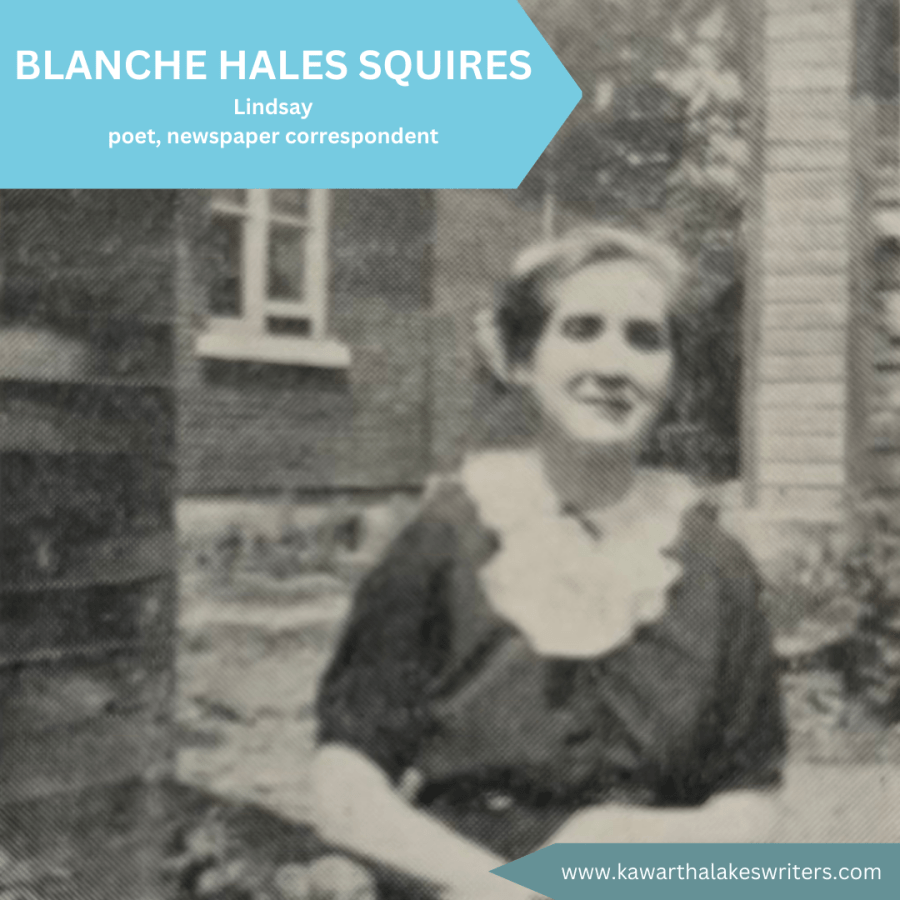
Born Mary Blanche Hales in Apsley, Ontario on 10 March 1892, at some point in her childhood, she moved to Lindsay, Ontario.
In a letter to the editor of the Canadian Statesman (Bowmanville), she remembers hearing about the newspaper “as a girl in Lindsay.”
Squires attended Lindsay Collegiate Institute. In fact, she was in the same class as Watson Kirkconnell, another Kawartha Lakes writer.
Watchman Warder, 1 July 1908, page 9.
Miss Hales was a teacher in Galway (Watchman Warder, 27 Oct 1911, p. 5) and Lindsay until 1913 when she left to take an assistant teaching position at Hampton public school (Watchman Warder, 5 Sep 1913, p.2.)
From there, she also taught in Hamilton and Parry Sound.
Blanche Hales Squires, A New Canadian Anthology, 1938.
On 6 August 1920, she married Elmer Francis Squires in Sudbury. Elmer was a telegrapher for Canadian Pacific Railway and stationed in North Bay and Algoma District in northern Ontario.
Blanche and Elmer had three children: Churchill Douglas Squires (1921-1989), Betty Squires (1923-2012) and Robert Hales Squires (1926-2002.)
Squires wrote poems and articles for the Globe and Mail, and for seven years she was a newspaper correspondent.
She died 2 June 1971 in Waterloo, Ontario.
Publications:
“The War Has Made Me Over,” The United Church Observer, 1 June 1944.
“Winter Night,” A New Canadian Anthology, edited by Alan Creighton and Hilda M. Ridley, 1938.
Watching the World Go By, edited by Robert Hales Squires, 1999.
Born Clara Flos Jewell (1889-1970) in Dundalk, Ontario, she completed school in Toronto, where at some point she preferred to use the name Flos as she’s listed in the newspaper honour rolls as Flos Clara Jewell.
At some point, she took a teaching position in Bobcaygeon, where she taught for at least five years.
Dorothe Comber‘s book, “Bobcaygeon History: Amy Ellen Cosh Memorial,” has this note in the section about the Rokeby School:
Miss McGuire taught in the Rokeby School. She was a lovely person and a splendid teacher. She and Mr. Simpson were united. Miss Floss [sic] Jewell was one of the assistants. About 1920, after she had gone away and married, she wrote a fiction story about Bobcaygeon which was published, “The Judgement of Solomon.” Of course the names were changed but some people thought that they recognized some of the characters.”
Bobcaygeon History: Amy Ellen Cosh memorial, Dorothe Comber with committee, 1972, page 72.
The December 3rd, 1908 edition of the Weekly Free Press notes, “Upon severing her connection with Rokeby school, Miss McGuire was presented with some valuable silverware by her pupils and ex-pupils in remembrance of her kindness and interest in their welfare.”
McGuire left in 1908. The 1911 census shows Flos single and living in Toronto.
Flos and David were married on 23 April 1915, therefore Williams must have taught at the Rokeby School between 1911 and 1915. The phrasing “gone away and married” would suggest that just like McGuire, Flos quit teaching to get married, but since she ran into E.J. Pratt, Arthur Phelps and others while she was in Bobcaygeon, and knew them well enough to characterize them into her first novel, she had to have remained living in the area until at least 1920.
The former Rokeby School. Image captured by Google May 2018.
The Rokeby School was the Verulam School Section (S.S.) No. 6 built in 1873 to move students out of the tavern lean-to where they’d been studying. (The school in the make-shift room attached to the tavern is thought to be Bobcaygeon’s oldest school.) The Rokeby School was constructed at 35 North Street, which became Pieter van Oudenaren’s Garage, an auto repair shop. Pieter took over the garage from his father, Harry van Oudenaren, a Kawartha Lakes author, until he left auto repair for cheesemaking.
By 1921, according to the 1921 census, Flos and David were living in Calgary.
After settling in Calgary, being separated from her Toronto-area friends and family, and with her salesman husband travelling, Williams took up writing. She was a member of the Canadian Authors Association, in the same Calgary chapter as Nellie McClung. In addition to writing four novels, Williams contributed a number of stories and poems to anthologies and periodicals to qualify for membership to the Canadian Womens’ Press Club.
A young woman and a brilliant one, and editors and critics who know her work prophesy that she will go far in the world  of letters. The very fact that this first book of hers was one of the runners up in the recent Hodder & Stoughton Canadian $2,500 contest, that this well established firm accepted it at once and sent it forth to the world, stamped with its approval, is no mean compliment to a young and new writer.

Mrs. Williams didn't write her book as one in search of fame, for commercial purposes, or in the beginning for the publishers. Once  the theme was conceived it was written, four thousand  words at a time, for the real enjoyment of writing, until it had developed itself into a full-length novel. It is a story that arose first in the heart and was committed to paper because of  that prime requisite of any author — the urge to write. It had never been seen by anyone. Then one day Mrs. Williams saw the advertisement of the Hodder & Stoughton contest. She submitted her manuscript, curious to see  how it  would come out. Immediately there came back a letter of warm commendation accompanied by an offer to publish it. It had been picked as one of the four runners up in the contest.

Mrs. Williams was born in Toronto [Dundalk] and educated in that city, being a graduate of the Jarvis Collegiate Institute, the old grammar school of Upper Canada, and of the Toronto Normal School.  Later she taught at Bobcaygeon in the Kawartha Lakes district, which she has woven in, as the beautiful setting of her book. Six years ago she came with her husband, David S. Williams, and her twin sons, to reside in Calgary, in which city her book was written.
“Calgary has four women authors” by Elizabeth Bailey Price; Canadian Bookman, March 1926.
The Globe review for Judgement of Solomon called the book “a well-written novel” with “a real plot, not a particularly pleasant one, handled with skill and delicacy and well sustained to the end.” (The Globe, December 5, 1925.)
The Judgment of Solomon is a work of fiction, following the story of Blake Lamon during his days as a medical student at the University of Toronto. He leaves school to run the family farm, acting on the promise he made to his dying mother. He marries Mary, the girl next door, and then has an affair with his wife’s cousin, Anne Thurston (a girl of 18 who’s living with them as their housekeeper). Anne gets pregnant, and Blake dies before his son, Blake junior, is born.
The setting for the family farm was “a four-mile drive over wretched roads, from Robson” with Robson being the pseudonym for Bobcaygeon, a place the main character, Blake Lamon does not love.
Blake hated the gossip and scandal-mongering of small villages, the almost consistent lack of charity, the eagerness with which the inhabitants put the worst construction on the actions of their neighbours. Robson was particularly disgusting in this respect. The town was situated between two lakes. A river and a canal cut through the town. On every side was unusual beauty, and the little village, with its ugly houses, with their wedding-cake verandahs jammed close to the sidewalks, buzzing from morning until night with scandal, was to Blake like a festering sore on the beautiful landscape.
The Judgment of Solomon, 1925, page 54.
By this description Robson is undoubtedly Bobcaygeon. When Blake marries, he agrees to move into his wife’s neighbouring farm, called Beehive Farm. This must be a nod at ‘The Beehive’ home to James Dunsford, built in 1839 between Bobcaygeon and Fenelon Falls, now part of Eganridge Resort, Golf and Spa.
Mary’s verandah commanded a gorgeous view of Sturgeon Lake, whose waters washed all the western boundary of the farm, its wooded shores curving around Green Bay, the favourite haunt of black bass for which the lake was famous.
The Judgment of Solomon, 1925, page 36.
Green Bay is on the Pigeon Lake side of Bobcaygeon, just off Riverside Drive, while The Beehive is on Sturgeon Lake at Hawkers Bay. Familiar territory, in any case.
After Blake’s death, Anne stays with Mary to help raise Blake Junior, whom they are raising as Mary’s child. Outside of Anne and Mary, only the doctor knows the truth. Once Junior is old enough to go away to school, Anne moves to a place of her own in Robson.
While she’s living in Robson, Anne meets some familiar characters. For anyone who knows that E.J. Pratt, Arthur Phelps, and Frederick Philip Grove spent every summer at their cottages in Bobcaygeon, they would instantly recognize them in the characters “Ned Andrews,” “Arthur Dawson,” and “George Groves.” Anne suddenly finds that “for the first time in her life this lonely woman felt that she was among her own people.” (p. 245.)
And they seem to respect her:
Ned Andrews marvelled at this women. She confessed to having lived almost entirely to herself, yet she had the appearance, the poise, of a woman of the world. She unhesitatingly acknowledged that she had been a housekeeper on a farm, yet good breeding and refinement were obvious.
The Judgment of Solomon, page 255.
Williams would have been a solitary woman, living on her own, while her salesman husband was away. Williams seems to have made herself the template for Anne.
Ned is a bachelor, whereas, E.J. Pratt was married. Nevertheless, Pratt was the template for Ned. Here’s Ned as described by another character:
“He is a Newfoundlander: a long, thin, good-looking, loose-jointed man, rather shabbily dressed. The cleverest man on the staff, with an almost uncanny ability in using his knowledge. He impresses one as living intensely every instant. He is much interested in questions of the day, and has influence in high quarters that would amaze the majority of his friends. Add to that the fact that he writes the most beautiful poetry in Canada to-day, and that he is a confirmed bachelor at forty, and you have the man.”
The characters ask to hear Ned’s poem titled, “Charlotte.” Is it coincidence that Pratt had a sister named Charlotte? Or that his first published poem had a woman’s name for the title? (Rachel, published in 1917.)
In the book, Anne and Ned fall in love, but Anne is unwilling to commit because of her history with Blake and because Blake Junior hasn’t fully accepted her as his mother.
During her time in Kawartha Lakes and as a member of the Canadian Authors Association, Williams became known to these “Bobcaygeon Boys.” Phelps, Pratt, and William Arthur Deacon had cottages where they stayed every summer, after completing their professor duties at the universities.
Two of Williams’s books were published by Graphic when Frederick Philip Grove was editor. Grove was friend to the Bobcaygeon Boys, spent time at their cottages, and corresponded with them on a regular basis. Graphic also published the words of Grove, Deacon, and Watson Kirkconnell (another Kawartha Lakes writer and Phelps’s colleague.) Deacon was a well-known book reviewer and critic for Saturday Night and the Globe and Mail, where Williams’ books were reviewed.
In 1926, Deacon asked Pratt to review Williams’s novel, New Furrows, for the Globe and Mail. In his letter to Deacon, Pratt said, “I had this review up to four hundred words but by a second pruning I managed to get it down to 335. I hope it will do though I don’t think it is ‘any great shakes,’ as I can only accomplish anything worth while when I have the impulse to let myself go.” (https://www.trentu.ca/faculty/pratt/letters/texts/260909dea.html)
His review was lukewarm at best. The review appeared in the October 16, 1926 edition and started out well with Pratt calling the book “a refreshing change from the usual run of “Western” novels.” After describing the premise of the book, Pratt says, “Beyond the love affair which develops between Marie and a handsome English “mountie,” the book has little plot. Nor are the obstacles to the courses of true love more than ordinary complexity–the war, absence, misunderstanding and hurt pride account for them.” He then goes on to say the value of her story “lies largely in the simplicity of its telling” and that “Mrs. Williams has not hesitated to make her people her mouthpiece on many vexed questions.” He ends the review not with words for the story itself, but by describing the book as “an attractive piece of book-making, done in the distinctive style of the Graphic Publishers.” Deacon was at the time editor for the Globe and Mail, and their friend Grove was editor at Graphic Publishers. Pratt’s evaluation of the novel would have carried a lot of weight.
Although he must have been flattered to be a character in Williams’s first book, he clearly reverted back to his default belief that women’s fiction wasn’t worthy, and one shudders to think what he might have said had he been able to “let himself go.” Perhaps he wasn’t flattered by Williams portrayal of him at all.
Williams was well-connected to the literary world in another way. Her salesman husband’s travelling partner was Stephen Leacock’s brother. (Butter Side Up, Gray Campbell, 1994.) No doubt she heard plenty of amusing tales.
In 1931, Williams had three books published along with short stories and poems, when her story “The Blue Bowl” was picked up for Chatelaine. The editor contacted her, asking for a photo and a brief write-up of her career to include with the story. Her response shows that imposter syndrome is not a modern construct and that for mothers, writing is a challenging career:
“Your letter fills me with despair for two reasons. First it reminds me of the time I asked an old Indian squaw to let me take her snapshot for a quarter, and she knocked the money out of my hand, saying that she wouldn’t be ugly all over Canada for a quarter! And second, because in the matter of my career- I haven’t had one!”
“I taught school in Toronto, married and have twin sons. My sons are my chief hobby as well as being my greatest creative effort. I have no convictions about anything- or rather I have to have a fresh bunch daily. To such an extent is this true that the only time I ever wrote a letter to a newspaper, I had to write an answer the next day, refuting all my arguments.”
Chatelaine, November 1931.
Her last novel, Fold Home, took second place in Ryerson’s Annual Canadian Book Contest in 1949.
Butter Side Up by Gray Campbell (1994) tells the story of the founding of his publishing company, Gray Publishing, the first publishing company in British Columbia. At the time, Williams was retired and living on her own on the waterfront a few houses down from Campbell. In his book, Campbell describes her as a “wise old owl” and “a witty raconteur, very much in tune with current literature and state affairs.” He began bringing her manuscripts to evaluate. He says “as a retired novelist, she had the ability to size up a writer’s potential by reading a few pages.” And while he acknowledges his company wouldn’t have succeeded if not for Williams, he makes no mention of paying her for her work.
Early settler in Lindsay, Ontario, William McDonnell is perhaps best known locally as the author of Manita, a poem he created about a local legend. The legend tells of young Iroquois chief Ogemah, who fell in love with Manita, a beautiful chief’s daughter of their rivals, the Heron peoples. Since the poem was written without the consent or input of indigenous peoples, it is an example of cultural appropriation.
While the poem spans 26 pages, the book opens with several pages describing the town of Lindsay, and with the last pages of the book consisting of advertising for local steamboats, it appears the book was created to draw tourism.
The controversy around Manita is not new.
Watson Kirkconnell asserts many of the facts from the original legend were changed. “From this era, too, dates the legend of Manita. In the version told me by Johnston Paudash, son of the Mississaga Chief at the Nanahazhoo Reserve, Rice Lake, Manita or Nomena (“light of love”) was the daughter of a great Mississaga chief who lived at Pleasant Point, Sturgeon Lake. Ogemah, an Iroquois chief, paddled alone from his own country to ask for her in marriage, but was murdered by a jealous Mississaga brave. About 1886 a poem on this theme was published in Lindsay by the late Mr. William McDonnell. This poem is a pretty little idyll, but as a portrayal of Indian psychology it is hopelessly sentimental and therefore unbelievable. It also substitutes Huron for Mississaga, Sturgeon Point for Pleasant Point and brings Ogemah on the stage by way of Lindsay, the wrong direction entirely.” (from Victoria County Centennial History, 1921 edition.)
The only known remaining copy of Manita, once belonging to local writer and historian Ford Moynes, is located in the archives of the Kawartha Lakes Public Library. They’ve recently digitized the book and made Manita available to view online.
Although he was known locally as Squire McDonnell and the author of Manita, outside of Kawartha Lakes (then Victoria County), he was the author of several books, which were published in the hundreds of thousands and read around the world, and a play that was performed in Toronto:
From the pen of Mr. George Beall, Albert Street, and from his scrap book comes a second interesting story: “Wm. McDonnell, 1814-1900, born Cork. Ireland. Wm. McDonnell went to Peterborough in 1830 and then studied law at Pennsylvania, U.S.A. He settled in Lindsay in the 1840’s and founded a tannery, and later a store about 1852. He was in the Lindsay Customs Office and also a Lieut. Colonel in the Militia. He was a good musician and composed both libretts and music for the 3-act opera “The Fisherman’s Daughter”, which was put on at the Princess Theatre, Toronto.
He very successfully wrote several books the sales of which ran into hundreds of thousands. He published two narrative poems – “Manita” and “Cleope”. Manita was based on an Indian legend of Sturgeon Point, and later a steamer, owned by Charles Burgoyne of Fenelon Falls, and ran daily trips between Lindsay and Coboconk was named “Manita” after the heroine of this poem.
Wm. McDonnell was always known in Lindsay as “ Squire” McDonnell. He built two houses on the north end of York Street on the river bank. The first was burned in the fire of 1861 and the second is with some additions, the present Canadian Legion Hall.
After his father brought young McDonnell to Canada, business reverses compelled the father to return to Ireland, but he died on the way home and young McDonnell was left alone in Canada to fend for himself at the age of 16 years.
His indomitable energy, intelligence and uprightness won for him the place which he was to hold until the day of his death, a place in the hearts; of all who knew him. His record was an exceptionally good one. He was chosen as clerk of the Division Court and appointed Justice of the Peace. He was a member of the County Council, was Reeve and for many years a member of the Council of the Town of Lindsay. He was a frequent contributor to the Public Press and wrote a series of articles on “ Government” for the Toronto Globe.
It is interesting to note that he supervised the taking of the first census in Victoria County and appointed Census Commissioner by a warrant issued the 2nd of January, 1852, by his Excellency James Earl of Elgin and Kincardine, Governor General of Canada.
Wm. McDonnell was a member of King Hiram Lodge A.F. and A.M. He was interested in education and for many years held the position of chairman of the Grammar School Board. Up to the time of his death he maintained a keen interest in public affairs. He died at the age of 81 and is buried in Riverside Cemetery.”
(Note: the above quote from an article by Ford Moynes published in the Lindsay Daily Post, no date known, cites McDonnell’s biography as written by George Beall and taken from the Beall scrapbook. Upon searching the digitized copy of the Beall scrapbook, made available online by the Kawartha Lakes Public Library and courtesy of the Kawartha Lakes Museum & Archives, it appears the McDonnell biography pages are missing. Perhaps they will turn up in the Ford Moynes fonds.)
Although the publication of A Man from Mars was announced in The St. Louis Republic (St. Louis, Missouri, USA) of Saturday 5th December 1891, it appears it never made it to print:
A theosophical novel by Mr. W. McDonnell, author of the very successful “Exeter Hall,” and of “Heathen of the Heath,” is announced for early issue by John A. Taylor & Co. of New York. The title selected for the forthcoming book is “A Man from Mars,” and the story is said to run on the lines of Edward Bellamy’s sociological “Looking Backward.” * The work purports to describe a visit to the planet Mars by two adepts in theosophy by occult powers. They find a perfect social system in operation amongst the inhabitants of Mars—society being organized on the same principles as those laid down in Mr. Bellamy’s story.
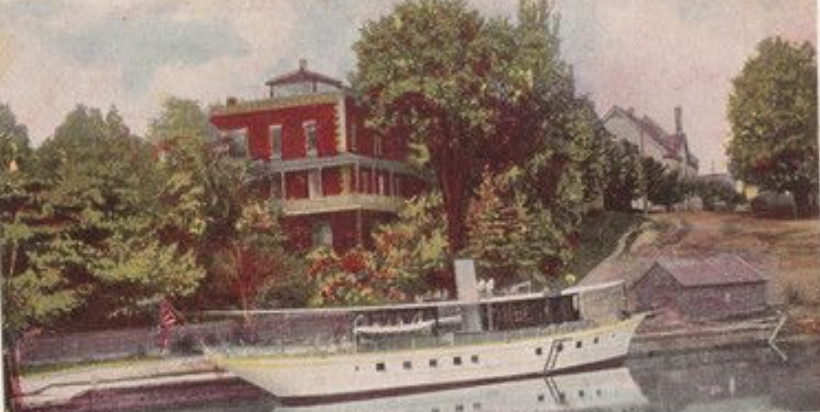
McDonnell’s house, now the Royal Canadian Legion branch 67. The riverbank is now McDonnell Park. This postcard is from the Beall scrapbook (from the Beall collection at the Kawartha Lakes Museum & Archives)
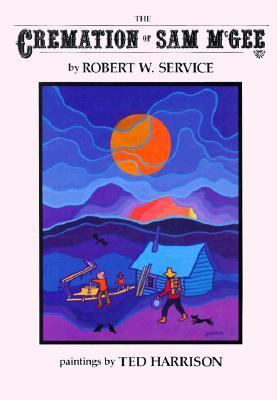
You’ve probably heard of the poem, “The Cremation of Sam McGee” by Robert W. Service. If not, enjoy this version read by Johnny Cash with paintings by Ted Harrison:
Here’s what you might not know: the titular character, “Sam McGee” was from Kawartha Lakes.
Robert Service was a clerk for CIBC in Whitehorse, when a form crossed his desk with Sam McGee’s name on it. The rhythm of the name captured Service, and he knew it would fit a ballad. So he wrote to Sam McGee, a prosperous builder of roads in the Klondike, to ask about using his name. McGee said yes, and the rest is poetry. (https://archiveofourown.org/works/139140)
William Samuel McGee married in Peterborough in 1901:
William Samuel McGEE, 32, miner, Cameron – Victoria Co., Whitehorse Yukon, s/o Joseph McGEE & Ellen McCULLOUGH, married Ruth WARNER, 20, Liverpool England, Harvey twp., d/o James WARNER & Betsy JENKINSON, witn: George WARNER & Mrs. Annie EARL, both of Harvey twp., 5 June 1901 at Peterborough (http://homepages.rootsweb.ancestry.com/~maryc/peter01.htm)
J. Stephen Thompson is a retired public health microbiologist, born in Toronto, raised in Parry Sound, Ontario, and now living with his wife in Kawartha Lakes, Ontario at the edge of the Carden Plain.
His science background continues to inform his writing. He published more than three dozen papers in peer-reviewed scientific journals. Lincoln Cathedral is his second novel. His first novel, The Aftermath, was researched while working in post-war Kosova.
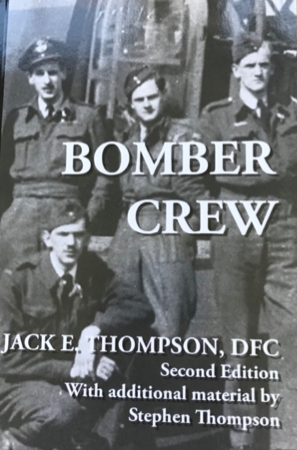
Following his father’s death in 2003 he published a book of his father’s photography, Reflections Through a Special Lens and republished his father’s short World War II memoir, Bomber Crew.
Thompson coauthored several collective projects with other local writers, Tales from the Raven Café, a collaborative novel, and The Kawartha Soul Project,The Kawartha Imagination Project, story anthologies with Canadian Authors – Peterborough, and contributed to Kawartha Lakes Stories: Autumn. A short story, Aubergine, was published in the on-line magazine overtheredline.com in 2013.








 kawarthalakeswriters.com