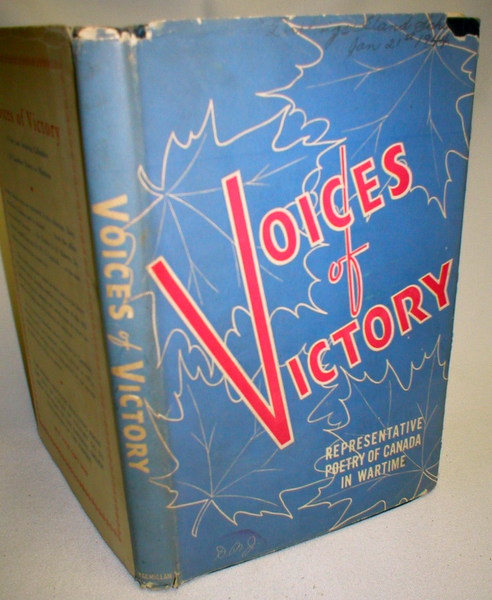
Three Kawartha Lakes writers were the judges for the 1941 anthology, Voices of Victory: representative poetry of Canada in wartime, a publication of the Canadian Authors Association, sponsored by the Seven Seas chapter of the IODE.
The anthology was the idea of the Poetry Group of Toronto. The project was taken on by the Canadian Authors Association, overseen by an editorial board with selection by a committee of judges. The final volume was compiled by Amabel King with a forward by Charles G.D. Roberts.
The purpose of the anthology was two-fold: to send the proceeds from sales to the Canadian Red Cross British Bomb Victims’ Fund, and “to let the poetic genius of Canada and of the Canadian people sound a spiritual challenge to the brutality of enemy despots and tyrants.”
The judges were A.M. Stephen, Watson Kirkconnell, E.J. Pratt, E.A. Hardy, S. Morgan-Powell, and V.B. Rhodenizer. The editorial board consisted of Nathaniel Benson, W.A. Deacon, John M. Elson, and Amabel King.
(Kirkconnell, Pratt, Hardy, and Deacon were all residents of Kawartha Lakes and active members of the Canadian Authors Association. Click on the links to see their pages for more details. Kirkconnell’s page is coming soon.)
The anthology featured poems from three Kawartha Lakes writers: Dorothy C. Herriman, Watson Kirkconnell, and E.J. Pratt.
Some writers were invited, some were included as sponsors (the Poetry Group of Toronto), and 766 others from every province and territory submitted their work to be judged for inclusion and for the chance at winning a prize. First prize was a silver medal donated by His Excellency the Earl of Athlone, Governor General of Canada, Alexander Cambridge, a patron of the Canadian Authors Association. The top three poems received prizes donated by Robert Young Eaton, Sir William Mulock, and the Poetry Group of Toronto. The prize for Honourable Mentions was being included in the anthology and went to 20 entries.
The male-to-female ratio of judges that made up the committee was somewhat controversial:
In addition, the volunteer work of the judges is acknowledged in print in the association anthologies, usually in a preface or foreword, whereas most editors are unnamed. Border Voices, edited by Carl Eayn in 1946, and Voices of Victory (1941), in which Livesay’s “The Child Looks Out appears, constitute the two exceptions to this rule. The editorial board of Voices of Victory consisted of three men and one woman and its judges were all male. The preponderance of female writers in association anthologies, including those both edited and judged by male writers, suggests the articulation of gender with democracy, that is, with the power of numbers; most of the submissions to the poetry contests of association anthologies were from women writers, a fact that reflects the female domination of the CAA’s membership lists.
Second place – Isobel McFadden for “Canadian Crusade”
Third place – Carole Coates Cassidy for “Chosen of Men.”
The editor, Amabel Reeves King, was a Volunteer Ambulance Driver oversees during the First World War. She was a neighbour of poet John M. Nelson, who also contributed to the volume.
The volume was published by McMillian Company, Toronto, 1941.
In the 1920s in Bobcaygeon, there arose a constellation of writers, including some of Canada’s most decorated poets and influential newspaper editors. At the heart of this constellation was a group of men who cottaged together and were at the forefront of defining Canadian culture. And they seemed to have a hate on for Lucy Maud Montgomery.
It all started with Arthur L. Phelps, who came to Bobcaygeon as a youth, again as a minister, and finally bought a cottage in 1919. He invited the friends he’d made at Victoria College in Toronto to visit him during the summers. They fell in love with the area on the banks of the Sturgeon Lake, and some bought cottages of their own, while others became regular visitors.
[Arthur L. Phelps] was part of a group of men who spent their summers in cottages at Bobcaygeon, Ontario, where their families socialized and the men themselves talked over their ideas about the state of Canadian literature, world literature, and politics. This group included other academics, journalists (like [William Arthur] Deacon), and writers invited to join them (like Frederick Philip Grove).”
Lucy Maud Montgomery: the gift of wings. Mary Henley Rubio. 2008.
The next to snap up a cottage was E.J. Pratt, the three-time winner of the Governor General’s Award for Literature for his poetry. After visiting Phelps, Pratt fell in love with the place. Pratt had a grand old time in Bobcaygeon. He established a garden, built a writer’s shed on the shore where he composed most of his poetry for the time while he owned the cottage, and hosted many guests.
The next to buy a cottage was William Arthur Deacon, who became Canada’s first full-time book reviewer, fulfilling one of his life’s ambitions, as editor of Saturday Night magazine and the Globe and Mail.
“ln 1925, for $400 in easy instalments, they also acquired a piece of land at Bobcaygeon, in the Kawartha Lakes district near Peterborough, a part of the summer colony that included the Pratts and the Phelps.” (“William Arthur Deacon: A Canadian Literary Life.” Clara Thomas and John Lennox. 1982)
In those days, writers and poets alike joined the Canadian Authors’ Association (CAA), where membership afforded connections to other writers, along with workshops and other learning options, to say nothing of publishing opportunities in the organization’s anthologies and magazines.
For many, writing is a solitary profession, and organizations such as CAA are a lifeline, giving writers the chance to get out and commiserate and network with other people who can immediately empathize, no explanation needed.
Where a chapter of the CAA did not exist, many writers opted to create one, as Deacon did when he lived in Winnipeg.
At the same time, the sources of literature and radio in Canada were primarily Britain and America, and there arose a need to produce and promote Canadian content. This became a highly debated topic, as no definition of “Canadian” had been made, but in very short order, a plethora of Canadian literature was produced and the CBC was created.
In addition to his professorship duties, Phelps became host to a number of CBC programs that debated and defined Canadian culture, broadcasting throughout his career, even from his deathbed in 1970.
Deacon, in his editorial positions, decided which books got reviews and which were passed over. And Deacon was instrumental in the creation of the Governor General’s Award for Literature, and which Pratt won three times. Other visitors to the cottages also won this prestigious prize and cash award.
When it came to Lucy Maud Montgomery, this crew from Bobcaygeon did not feel her work was worthy of inclusion as part of the nation’s culture, nor as being worthy of winning a prize.
They excluded Montgomery’s work because it was written for children and well-loved by girls and women all around the world. They were jealous of her sales numbers– which none of them had achieved more than a fraction in comparison.
Their jealousy and misogyny frustrated Montgomery. When she ran for president of the Toronto branch of the Canadian Authors Association and learned she was up against Deacon, she withdrew because she knew of his connection to the Bobcaygeon crew and how vast this network extended.
It does not matter in the least to me that I am not on the executive. Deacon has always pursued me with malice and I am glad I will have no longer to work with him. He is exceedingly petty and vindictive and seems to be detested by everybody who knows him.
L.M. Montgomery (Rubio, 2008)
On the occasion of Canada’s National Book Week in September 1935, the Toronto branch of the CAA hosted an event to celebrate those who had received the Most Excellent Order of the British Empire (OBE) that year; advertising stated the occasion would honour “three knights and two OBEs”: Sir Ernest MacMillan, Sir Wyly Grier, Sir Charles G. D. Roberts, L.M. Montgomery, OBE, and Dr. E. A. Hardy, OBE. It was a hugely important event for Canada’s literary scene.
One of the organizers was Pelham Edgar, a professor, and at that time, president of the national level of the CAA. Pelham was a good friend of Pratt and the other Bobcaygeon boys, had been invited to the cottage, and was no friend to Montgomery. Pelham proposed a toast to each of the five honourees. He spent considerable time delving into the accomplishments of the first three, and then finished with “The other two who are included in this toast are Dr. Hardy and Mrs. Macdonald.”
Montgomery’s biographer, Mary Rubino, supposes Maud could have been overly sensitive since a knighthood is a higher award than an OBE, but Montgomery was certain that it was a snub and that if Edgar had stopped to sing the praises for Hardy, he would have had to admit that she was of literary merit. She believed Edgar “would have died any death you could mention rather than admit I represented Canadian literature.”
A write up in the Globe corroborates Montgomery’s version of the event. After being toasted, each of the five made replies, but the write up by Deacon in the The Mail and Empire omits any mention of Hardy’s and Montgomery’s replies. It’s as though the Bobcaygeon boys had decided Montgomery simply didn’t exist.
By this time, Montgomery had shifted to writing books for adults, including A Tangled Web and The Blue Castle, sales had slowed, and her work was called “provincial” at a time when books were prized for being “cosmopolitan” and favoured for having “universal” themes. For a while, The Blue Castle was banned.
This was the beginning of Montgomery’s descent from publishing. She was a victim of the Bobcaygeon boys’ bullying that became cultural programming that ascribed “literary” works as better than “commercial” works.
Had any of them even read her work?
No.
At least not while she was alive.
When Phelps wrote his book, Canadian Writers (1951), he included a chapter about Montgomery, but proceeded to call her work “naïve” and “easy reading” that “lacks realism and penetration.” In fact for most of the chapter, he didn’t mention her work much at all, but wrote about other writers: Robert W. Service, who had his own chapter, and Mazo de la Roche. He said Montgomery’s readers were “nostalgic” and “sentimental” and only for “the uncultured and unsophisticated.” Finally, the last two pages of the chapter covered Montgomery and her work. He checked out her books from the library, where he was told not to keep them too long as they were in high demand. He finally read the Anne novels, and decided “there may still be a place for the stories of L.M. Montgomery.” He ended the chapter with “get a copy of Anne of Green Gables by L.M. Montgomery and read it.” Unfortunately, Montgomery had passed away in 1942, wanting to believe she had a place in Canadian literature, but never actually achieving it until after the deaths of the Bobcaygeon boys.
But even today, the idea that “literary” fiction is superior to “commercial” fiction lingers. The literary community still has much work to do to detangle this particular net cast by the Bobcaygeon boys and their constellation of friends.
Further Reading:
Phelps, Arthur L. Canadian Writers. McClelland and Stewart Limited. 1951.
Rubio, Mary Henley. L.M. Montgomery: The Gift of Wings. Doubleday Canada. 2008.
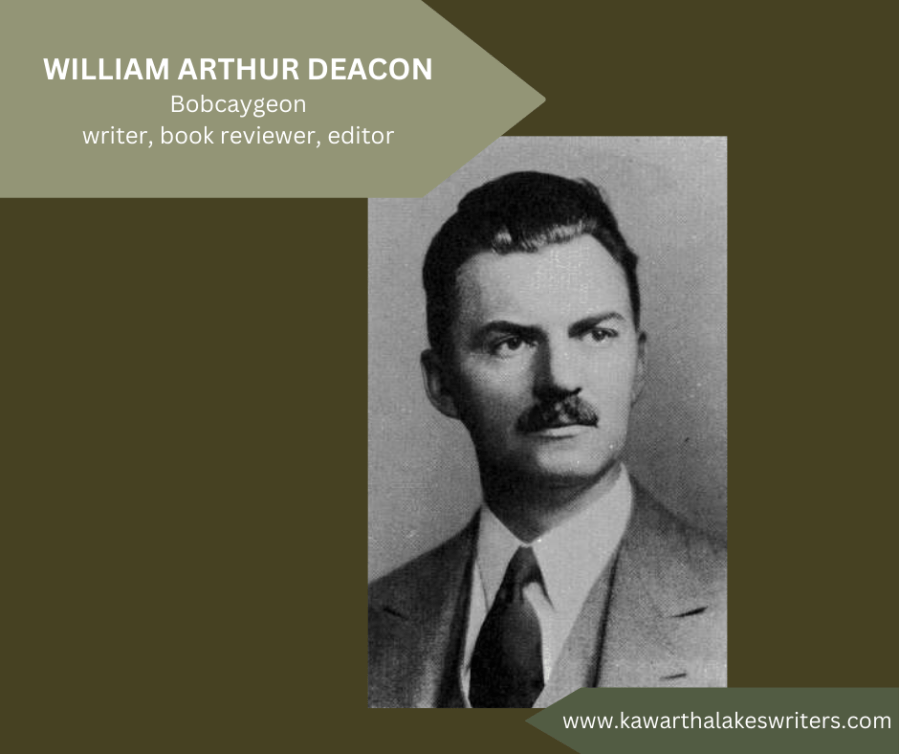
William Arthur Deacon (1890-1977) was one of the most powerful and influential writers/editors in Canada from 1922-1961. He could make or break authors’ careers. And he did.
Image source: Trent University
Born in Pembroke on 6 April 1890, the son of William Henry Deacon, a lawyer, and Sarah Ann Davies, daughter of a printer. His father died when he was very young. His mother moved in with her parents.
Deacon studied law at Stanstead College, but while there, two things happened that changed his intended career path, both literary readings, and each inspiring to Deacon. And then in 1905, he read his own first paper to the college literary society and from that moment, never lost the desire to write– or get a reaction from an audience.
In 1907, Deacon entered Victoria College in Toronto, where he met E.J. Pratt, and wrote for the campus magazine, of which Viola Whitney (future Mrs. E.J. Pratt) was the editor. He also met another life-long friend in Arthur L. Phelps, who went on to become Canada’s foremost culture critic. But Victoria College wasn’t working for Deacon, and he left during his second year.
Deacon drifted through various jobs until finally deciding to marry Gladys Coon of Weston, Ontario, and return to Dauphin, Manitoba, where he could article in law. Later in life, Deacon would look back on these years as ‘the ten lost years’ of his life, given to the law career he ended up not pursuing.
Around 1916 Deacon and Gladys discovered theosophy, and eventually founded Winnipeg’s second lodge. Deacon felt theosophy and Methodism converged nicely in their teaching responsibilities.
He truly believed that the printed word could change the world. He held as axiomatic the belief that Canadians were a vital and dynamic people who would require, demand, and produce a correspondingly dynamic literature. He came to see himself as herald, prophet, preacher, and custodian of that literature.
Clara Thomas and John Lennox. William Arthur Deacon: a Canadian literary life. (1982)
He found law boring and frustrating; theosophy convinced him that he was destined to write.
In 1921, the Manitoba Free Press employed Deacon as a contributing editor to their newly established monthly literary and book review section. They called him their ‘Honorary Literary Editor.’ This was novel; up until 1921 Canadian newspapers didn’t care about books. Only about a dozen printed book reviews.
Deacon submitted book reviews and editorials to The New York Times, The Stairway, the New York Evening Post, and The National Pictorial, to name a few.
He helped found the Winnipeg branch of the Canadian Authors’ Association.
But his big break came in 1922 when he joined Saturday Night magazine and achieved his dream of becoming ‘the first full-time, professional book reviewer that Canada had ever seen.’
It also coincided with the end of his marriage to Gladys. In 1918 he met fellow theosophist, Mrs. Sally Townsend Syme, and the two believed they were destined for each other, despite both already being married. They continued to correspond with each other until 1922 when Sally joined Deacon in Toronto.
After Deacon moved to Toronto, he and Sally became frequent guests at his friends’ cottages in Bobcaygeon. Phelps was the first to establish a cottage there, followed by Pratt in 1921. Finally, in 1925, in $400 instalments, Deacon acquired his own Bobcaygeon land, and by 1928 had built a cabin on it.
Phelps helped Deacon make connections in their literary circles. He helped Deacon get the job with Saturday Night magazine. He introduced Deacon to Lorne Pierce of Ryerson Publishing, who then picked up Deacon’s books, Pens and Pirates and Peter McArthur. Phelps took Deacon to the Arts and Letters Club, bringing him to a wider literary network.
Deacon gave up his Bobcaygeon cottage by 1932, when he heard about the Canadian Institute on Economics and Politics held annually at Geneva Park, Lake Couchiching, and began spending summer vacations at Wilson’s Point, Orillia, merely four miles from Geneva Park– he gave up the Bobcaygeon cottage to continue to pursue his belief that he could change the world.
Deacon and Pratt family in Bobcaygeon. c 1930.
Deacon was now professionally placed where he could make or break an author’s career.
His friend, Arthur Phelps wrote to him: “I’ve backed three horses, Deacon, Pratt, and Grove. Place ’em in Canadian Literature, will you?” (William Arthur Deacon, page 67)
His reviews of Pratt’s work was favourable.
And same for Grove. When Grove’s book, Settlers of the Marsh, became the subject of a book ban and the author poise to go bankrupt, Phelps asked Deacon to find speaking engagements for Grove in Toronto. Two years later, Deacon sent Grove on a speaking tour across the country, using his contacts with the Canadian Club and the publicity department for the Canadian National Railway.
Grove is just one example of a Deacon-made career. But not all authors got the white glove treatment.
Deacon had a particular problem with Lucy Maud Montgomery. Jealousy, likely. His books sold only a few hundred copies, while hers were being translated and sold around the world. In his essay on Canadian literature in his book, Poteen, he says, “As for the ‘girls’ sugary stories begun with Anne of Green Gables... Canadian fiction was to go no lower.” He had a set idea of what Canadian literature should be and Montgomery was not it.
Lucy Maud Montgomery received a similarly misogynist response when she was running for the executive of the Toronto Branch. Montgomery’s biographer Mary Henley Rubio notes that “The Canadian Authors Association had been very important to Maud after [her] move to Toronto. The CAA was a lifeline, in fact, that pulled her out of her personal stress at home” (p. 529). On April 8, 1938, however, at an election for a new executive, Montgomery was pushed out by Deacon. She writes in her journal: “The election of a new executive was held and I was elbowed out. It is not worthwhile going into details. Deacon had it all planned very astutely and things went exactly as he had foreseen. I at once withdrew my name from the list of candidates” [Mary Henley Rubino, Lucy Maud Montgomery: the gift of wings. 2008. p. 530]. …. If this is the treatment received by authors of their stature, one can only imagine the treatment accorded to amateur writers in the association
Christopher M. Doody. “A Union of the inkpot: the Canadian Authors’ Association, 1921-1960.” 2016.
Deacon was completely dedicated to his non-commercial, literary and democratic principles.
He played a primary role in the establishment of the Governor General’s Awards for Literature and had influence over the judges and titles selected. His friend E.J. Pratt won three times. His friend Fredrick Philip Grove won once. E.K. Brown, another of the Bobcaygeon Boys’ visitors, won once. Arthur R.M. Lower, who was Arthur L. Phelps’s biographer, won a couple times. Laura Salverson, who corresponded with Deacon for years, won once. His personal friend Stephen Leacock won in 1937. Bertram Booker, Franklin Davey McDowell– the list goes on of Deacon’s friends who took home Canada’s top literary prize.
Deacon loved leadership and the feeling of power to influence events; he also loved to be seen to be leading.
He recruited his friends to write book reviews, including his wife writing as Sally Townsend, E.J. Pratt, Viola Pratt, Arthur Phelps and many others.
His review philosophy was solid and many of today’s reviewers could stand to learn a thing or two:
But NEVER put on a [heading] which will keep readers from reading your article. The chief function of man may be to glorify God; but the chief function and aim of a writer is to get himself read. Put on a [heading] which will entice your reader, rouse his curiosity, tempt him to plunge into the text below. Don’t drive him away by proclaiming that the whole thing is a bore. You break that gently to him later.
William Arthur Deacon, page 220.
In 1967, Sally was diagnosed with Parkinson’s Disease. She passed away two years later. Deacon was unable to do any serious writing after Sally’s illness, even withdrawing his centennial grant application. Over the next years, he suffered small strokes until he passed away in August 1977.
Editor:
Saturday Night (1922-1928)
Toronto Mail and Empire (1928-1936)
The Globe and Mail (1936-1961)
Books:
Pens and Pirates (1923)
Poteen and other essays (1926)
The Four Jameses (1927)
My Vision of Canada (1933)
Further Reading:
William Arthur Deacon: a Canadian literary life. Clara Thomas and John Lennox. University of Toronto Press. 1982.
E.J. Pratt: the truant years. David Pitt.
photo source of Deacon and Pratt family: Trent University:
Arthur Leonard Phelps (1887-1970) was born in Columbus, Ontario on 1 December 1887, and in his lifetime moved around, but for a number of years he had a Bobcaygeon cottage. His ‘chap-book’, “Bobcaygeon: a sketch of a little town,” was published in Lindsay in 1922. Through his editing work and hosting a CBC radio show, Phelps influenced the development of a Canadian identity and was well-known as a critic of Canadian culture.
Phelps studied at Victoria College at the University of Toronto, where he met fellow writer, E. J. Pratt, and they became life-long friends.
Sometime within the next few years, he bought a cottage in Bobcaygeon and lived there permanently. The April 1919 edition of Canadian Bookman described Phelps as “permanently a denizen of Bobcaygeon, Ont., but his ministerial function in connection with the Methodist Church keeps him supplied with a temporary address, which happens just now to be Bath, Ont.”
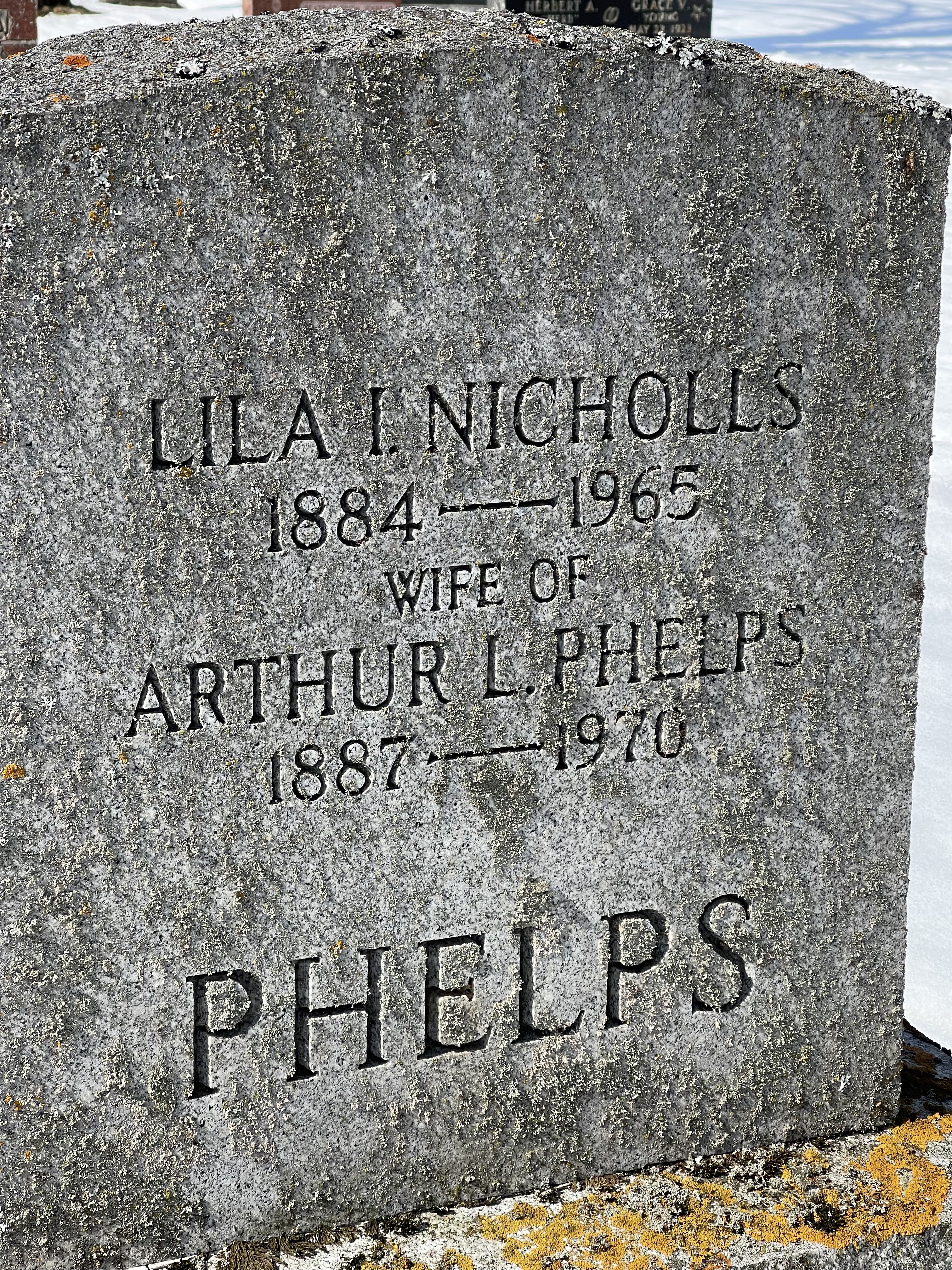
On 18 September 1914, Phelps married Lila Irene Nicholls, daughter of Thomas Henry Nicholls, a farmer in Verulam township, and Margaret Staples. Phelps and Lila were wed in Peterborough, Ontario.
In 1921 Phelps accepted a professorship at the Wesley College at the University of Manitoba where he was head of the English department. A year later, he asked his friend, and fellow KL writer, Watson Kirkconnell to work with him. At first Kirkconnell refused because English wasn’t his field of study. He studied the Classics at university. But then he changed his mind and accepted the position. Together they were the entire English department, with Kirkconnell teaching anything Phelps didn’t want.
During this time, Phelps kept the cottage at Bobcaygeon and spent his summers there. (Kirkconnell, A Slice of Canada: memoirs (1967).)
A visitor to the Bobcaygeon cottage crew was friend and fellow writer, Fredrick Phillip Grove. Grove named his son Leonard after Phelps and made Phelps the boy’s godfather. (“Afterword: genesis of a boys’ book.” Mary Rubino, 1982)
While at Wesley College, Phelps started the English Club, a discussion group for senior students, one of whom was Margaret Laurence. (Later, Laurence would move to Lakefield and become Chancellor to Trent University.)
Phelps stayed at Wesley College until 1945. He was awarded Fellowship in 1967.
Starting around 1940, Phelps was a radio broadcaster for the CBC, serving as a culture critic, trying to define a cultural identity for Canada. It was around this time when Canada was trying to define its own cultural identity as separate from Britain and the U.S.
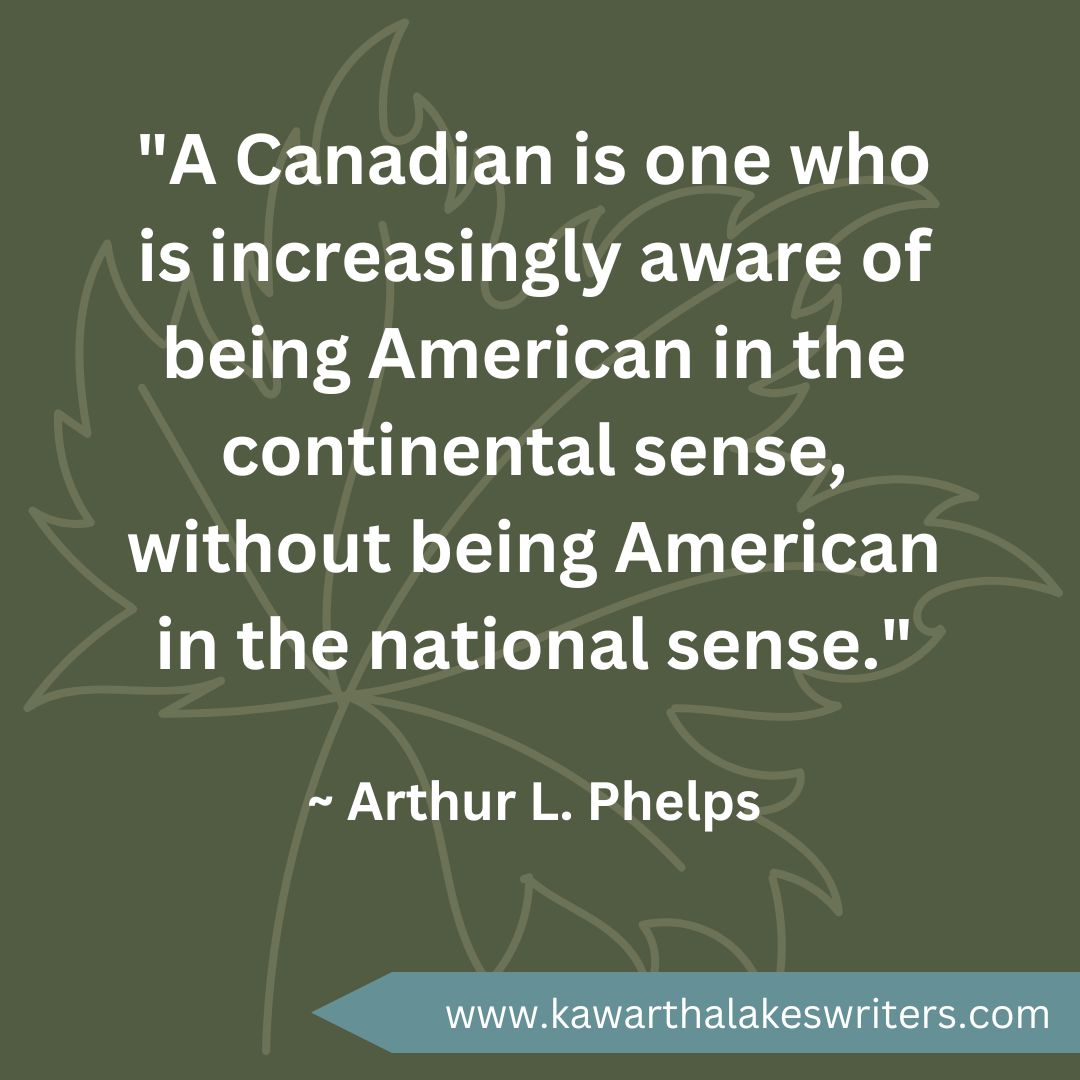
Phelps has been widely quoted for saying, “a Canadian is one who is increasingly aware of being American in the continental sense, without being American in the national sense.” (The quote is from an article he wrote for The Listener, a BBC magazine, titled, “A Canadian looks back on the Royal Visit,” published in the 46th volume on Thursday, November 15, 1951.)
In 1947, Phelps became an English professor at Queen’s University, and while in Kingston, he hosted a radio show.
In the summer of 1955, Phelps hosted a television program called “Cabbages and Kings.” Phelps moderated the panel discussion show from Vancouver. Participants and subjects included Northrop Frye on Canadians’ reading habits; CJOR newsman Jack Webster and lawyer Bill McConnell on television and radio; and McConnell, writer Roderick Haig-Brown, and Hugh Christie, warden of Oakville Prison Farm on crime and society.
Unfortunately, Phelps did not include the work of the iconic Lucy Maud Montgomery as significant to the culture and identity of Canada. At least not while she was alive to be included. Nine years after her death, Phelps included Montgomery in his book, Canadian Writers, listing her accomplishments alongside other writers as E.J. Pratt, Robert W. Service, Frederick Philip Grove, Archibald Lampman, Stephen Leacock and other notables. The first half of his Montgomery article discusses other “popular” fiction writers and their place in “respectable artistic achievement,” indeed, the entire issue with Montgomery’s work until now was that it was commercially successful and written for girls. In this article, Phelps admits he’d not read Montgomery’s work before and when he checked out four of her books from the library, he was reassured to find her work was still popular. Phelps finally gets around to writing about Montgomery and her work in the last two pages of the article.
Phelps missed the mark on the draw of Montgomery’s work, though. He called her writing old fashioned, sentimental, nostalgic, and said, “L.M. Montgomery’s stories have qualities of range and subtlety and fine comprehension which make them relatively worthy.” He said, “the Island, the sea, the people of the Island, come alive in the telling. All this came about because L.M. Montgomery knew her Island– its places, its people– and, with direct unpretentious simplicity, through her an, was able to communicate something of what she knew.” (Canadian Writers, 1951.)
But Montgomery does not remain commercially successful even today because of nostalgia or because she knew the Island and its people. She remains popular because she gave girls a hero in Anne. She remains popular because Anne showed girls that it was okay to be angry and to feel alone.
It’s unfortunate that the fight between “commercially successful” and “literarily relevant” remains today.
Phelps’s first wife, Lila died in 1965. Phelps remarried in 1968 to Margaret Duncan. The 1921 census shows Phelps and Lila living with his parents in the Toronto area. They didn’t have children at that time. His obituary mentions his daughter Ann, married to John David Hamilton. The University of Manitoba notes the Phelps fonds were donated by his granddaughters, Meg and Kate Hamilton in 1997.
After Phelps was diagnosed with cancer, he was allowed to continue his radio show from his sick bed. He passed away April 27, 1970 at his home at 47 Earl Street in Kingston and was buried in Bobcaygeon. (Globe & Mail, 29 April 1970 page 41.)
Works:
Poems (1921)
Bobcaygeon: a chap-book (1922)
The Poetry of Today. (1917)
This Canada: A series of broadcasts. (1940)
These United States: A series of broadcasts. (1941)
Community and culture. (1947)
Canadian Writers. (1951)
“Introduction” for Habitant Poems by William Henry Drummond (1961)
There’s a wealth of Phelps’s work at Canada’s Library and Archives, particularly in the archived Film, Video and Sound collection.
In 1971, Arthur R. M. Lower published a brief biography of Phelps, “Arthur Leonard Phelps (1887-1970),” a chapter in the book, Proceedings of The Royal Society of Canada, series IV, volume IX, 1971, pages 94-96.
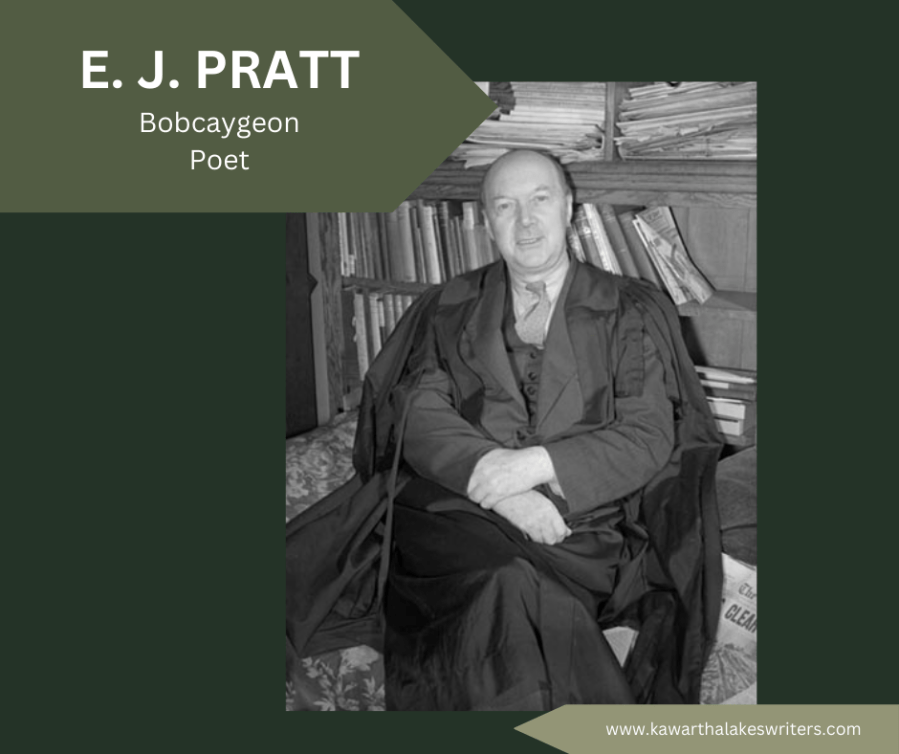
Edwin John Dove Pratt (1882-1964) was primarily Torontonian, but had a cottage in the Bobcaygeon area. He was a three-time winner of the Governor General’s Award for poetry and winner of many other awards, including in 1946, Companion of the Order of St. Michael and St. George by King George VI.
In 1935, the Montreal branch of the Canadian Authors Association had been running a successful annual poetry contest. They appointed a committee to see if publishing a periodical would be financially feasible. Disappointed by the results, they decided to not go through with the project.
One member of the CAA’s executive, another local Kawartha Lakes writer, E. A. Hardy heard about the end of the project and urged the national executive to take it on as a means of doing something for the entire membership. They agreed and the first issue of Canadian Poetry magazine was published in 1936. Pratt was appointed editor and served in that role until 1943.
EJ Pratt and Clare Pratt in Bobcaygeon, c 1931.
Pratt was born in Newfoundland on 4 February 1882, where he also trained to be a minister like his father, but instead went on to study psychology and theology at Victoria College at the University of Toronto. Themes of religion and psychology would thread his poetry.
While at Victoria College, Pratt met Viola Whitney, where they both worked for the college newspaper, of which Viola was the editor. Viola was also a writer and would go on to be a magazine editor. After four years of engagement, they married 20 August 1918.
Their daughter Claire was born in 1921. At just four years old, Claire contracted polio. The disease would affect the rest of her life, but not prevent her from becoming a publishing editor and author.
While at Victoria College, he met life-long friend, Arthur L. Phelps, another Bobcaygeon cottager and writer.
The Pratts visited Phelps and his wife Lila at their new Bobcaygeon home, and were immediately taken with it. Pratt almost bought a Bobcaygeon cottage in September 1918, but it didn’t work out. It wasn’t until 1921 when Pratt finally bought the Bobcaygeon cottage where he would do most of his writing during his summer vacations from his work at the University of Toronto.
Viola Pratt said, “Ned loved the place, which surprised me at first, because he wasn’t the type who ordinarily enjoyed ‘roughing it in the bush.’ He hated the mosquitoes — and we surely had lots — but he devised ways to combat them, and after a while he didn’t mind so much… It was really a delightful spot, right on the lake, surrounded by trees, mostly cedars, with a clearing out back that we called the Glade.” (Pitt. E.J. Pratt: the truant years. p. 199)
The Pratts financially extended themselves to acquire the cottage. They didn’t have a car; they took the train from Toronto to Bobcaygeon.
Pratt started a backyard garden, growing corn, beans, tomatoes, and squash. He’d hoped to grown enormous squash.
Pratt built himself a small cabin away from the cottage, where he went to write.
Pratt became a weekend host to his friends. He even picked them up at the train station– in a canoe. Weekend pastimes included canoe trips to Nogie’s Creek, a cookout at the stone fireplace by the lakeshore, and poetry readings.
The Bobcaygeon summers, especially the early ones were golden times for Pratt, among the happiest he would ever know… halcyon days.
Pitt. E.J. Pratt: the Truant years.
Among his guests were William Arthur Deacon, who also bought a cottage nearby, Fredrick Philip Grove, Pelham Edgar, E.K. Brown.
Pratt was known to lend the cottage, as he did to Deacon in 1926 when Deacon and family were looking to get away from the city. Pratt wrote to Deacon, “From the 15th of June until July 20th it is at your disposal. Why not send Mrs Deacon and the Kiddies up there on the earlier date, you going, say, week ends till your vacation starts. The Phelpses are next door and will give her all the advice re food and other desirables. By then the lettuce will be up and by July the peas ought to be forming. The strawberries look promising.” (https://www.trentu.ca/faculty/pratt/letters/texts/260603dea.html)
Pratt family with Deacon family, c. 1930.
Frederick Varley, one of the founding members of the Group of Seven, was the artist for E.J. Pratt’s Newfoundland Verse (1923). When Varley and his family were evicted from their Toronto house, Pratt let Varley, his wife Maud and their four children camp in a tent on the lot next to the Pratt’s cottage. “A large army tent pitched on a wooden platform supplied them with at least a shelter from the elements, and the Pratt cottage the necessary domestic facilities. Not infrequently too the grocery bill to feed five extra mouths was paid out of Pratt’s meagre pocket.” (Pitt. E.J. Pratt: the truant years. p. 226.)
During that time, Varley made a charcoal sketch of his wife Maud with their youngest son, Peter, curled up in her lap. The tent can be seen in the upper left corner. The sketch, titled Bobcaygeon, 1923 (private collection), was sold in 1926 by Maud to raise enough funds for her to travel with the children to Vancouver. Varley painted a similar picture, Evening in Camp, 1923 (private collection.) (Katerina Atanassova, F.H. Varley: portraits into the light, Dundurn Press. 2007.)
Sometimes Pratt’s summer retreats involved golfing in Lindsay with Watson Kirkconnell.
[Pratt] needed a little relaxation before completing his preparations for what he was already planning to make a ‘triumphal progress.’ Having promised Kirkconnell a few games of golf on the course at nearby Lindsay, where ‘Kirk’ usually spent his summers, Pratt took his clubs with him and during the first week or so of his holiday pleasantly indulged himself in his favourite sport for almost the first time since the previous autumn.
David G. Pitt. E.J. Pratt: the master years (1927-1964), page 22.
As he was closing the cottage in the autumn of 1925, Pratt asked a local handyman to build a swimming dock, using the wood from Varley’s tent platform. Pratt wanted “an enclosure in which little Claire might paddle, safe from the remnants of submerged tree stumps and the danger of going beyond her depth.” He suggested if the the handyman needed more lumber he could get it from the local lumber ‘magnate’ and building contractor (i.e. Mossom Boyd Lumber Company.)
What Pratt found the following spring was “a leviathan of a wharf.” It seems the handyman placed an order in Pratt’s name with the contractor for an “Ontario dock,” or pier. It was built by half-a-dozen carpenters and “vast quantities of the best materials.” Arthur Phelps described it as big enough “to tie up an ocean liner at if one ever came into the Kawartha region.”
The bill was equally as enormous. Pratt, feeling he’d been tricked into the large pier, chose to fight. He wrote his tale in full to a lawyer. The lawyer agreed to appear in court in Lindsay, if the case went to trial, which it did not. Both parties agreed to compromise. Pratt ended up paying $200 and the “magnate” withdrew his suit for further payment. (Pitt. E.J. Pratt: the truant years. page 298-299.)
The summer of 1935 was the last summer in Bobcaygeon for Pratt. Financial reasons due to Claire’s numerous operations and the economy of the times, forced Pratt into one of the hardest decisions he had ever made. The cottage was in need of numerous repairs, but ultimately the decision to sell was due to Claire: “her condition was unlikely to permit her ever again to take full advantage of the natural amenities, swimming in particular,” which Pratt felt was the best thing about Bobcaygeon. (Pitt. E.J. Pratt: the master years. page 164-165.)
That last summer at the cottage, Pratt wrote The Titanic, a dark, tragic poem that he found depressing and was glad when he finished it.
Pratt never returned to Bobcaygeon, though he missed the cottage days and would reminisce with his friends of his halcyon days there.
Pratt’s cottage was featured in John Robert Columbo’s Canadian Literary Landmarks (1984.) At the time of printing, the cottage was still standing. Overlooking Sturgeon Lake, the cottage had a verandah and a green den, according to the brief write-up.
Arthur Phelps said, “One of the best things that ever happened to Ned Pratt was his marrying Viola Whitney. Up until then he was just drifting hither and yon with every tide that rose and fell. He had no settled way of life, no regular job, not actual goal in life. And this was bound to militate against any real creativity. But after he got married all that began to change…” (Pitt. E.J. Pratt: the truant years. p. 172)
But without his cottage, it seems Pratt became untethered.
In the summer of 1937, Pratt went to teach summer school at the University of British Columbia where he began an extramarital affair with a graduate student. She transferred to Victoria College (Toronto) in the fall and the affair continued until the spring of 1938. Although his college friends knew about the affair and encouraged him to end it, his wife and daughter never knew and the affair never affected his career. (http://www.trentu.ca/faculty/pratt/letters/texts/38springdea.html)
Pratt is internationally famous for his epic poems of national significance. He won the Governor General’s Award three times: in 1937 for The Fable of the Goats and other Poems; in 1940 for Brébeuf and his Brethren; and in 1952, for Towards the Last Spike.
His biographer, David Pitt writes, Pratt had been a “faithful if less than zealous member [of the Canadian Authors’ Association]. But he had no wish to be anything more, partly one gathers, because a large proportion of the Toronto membership was made up of ‘literary females,’ a species of which he was not particularly fond.” (Pitt, E.J. Pratt: the truant years. pages 312-313.)
Pratt and his friends Deacon and Edgar were not at all kind to women authors, even if the women were incredibly successful, as seen these notes about how they treated Madge Macbeth and Lucy Maud Montgomery:
Although it did have slightly more women members, the association was continually run by men, some of whom fought against female leadership. Carole Gerson, for example, points to an example of this “gendered subtext to Canadian literary politics” in Kathryn Colquhorn’s description of Madge Macbeth’s reception at a C.A.A. convention. Macbeth went to Toronto to make a speech at the Annual C.A.A. dinner:
[Macbeth] had a pretty mean reception here . . . Pratt was in the chair and he, and Prof. De Lury, spoke so long, that she didn’t get a chance to say a word. A lot of people thought that it was a put up job, as Pratt had charge of things as chairman. Then, when she was elected National President, none of the Executive, Pratt, Deacon, or Edgar, attended the Convention. (Kathryn Colquhorn qtd. in Gerson “The Canon” 54)
Christopher M. Doody. “A Union of the inkpot: the Canadian Authors’ Association, 1921-1960.” 2016.
E. J. Pratt died 26 April 1964 in Toronto.
He was designated a Person of Historical Significance in 1975.
The library at Victoria College in Toronto was named after him and contains his fonds. The university also awards the E.J. Pratt Medal and Prize for poetry and past winners included Margaret Atwood and Michael Ondaatje.
The University of Toronto created the E.J. Pratt Chair in Canadian Literature, which since its founding has been held by George Elliot Clarke.
In 1983, Canada Post issued an E.J. Pratt commemorative stamp.
Poetry
Rachel: a sea story of Newfoundland, (1917)
Newfoundland Verse (1923)
The Witches’ Brew (1925)
Titans (“The Cachalot, The Great Feud”) (1926)
The Iron Door: An Ode (1927)
The Roosevelt and the Antinoe (1930)
Verses of the Sea (1930)
Many Moods (1932)
The Titanic (1935)
New Provinces: Poems of Several Authors (1936)
The Fable of the Goats and Other Poems (1937)
Brebeuf and his Brethren (1940)
Dunkirk (1941)
Still Life and Other Verse (1943)
Collected Poems of E. J. Pratt (1944)
They Are Returning (1945)
Behind the Log (1947)
Ten Selected Poems (1947)
Towards the Last Spike (1952)
“Magic in Everything” [Christmas card] (1956)
Collected Poems of E. J. Pratt (1958)
The Royal Visit: 1959 (1959)
Here the Tides Flow (1962)
Prose
Studies in Pauline Eschatology (1917)
“Canadian Poetry – Past and Present,” University of Toronto Quarterly, VIII:1 (Oct. 1938)
Edited
Thomas Hardy, Under the Greenwood Tre. (1937)
Heroic Tales in Verse (1941)
Further Reading:
E. J. Pratt: The Truant Years 1882-1927. David G. Pitt. (1984)
E. J. Pratt: the Master Years 1927-1964. David G. Pitt (1987)
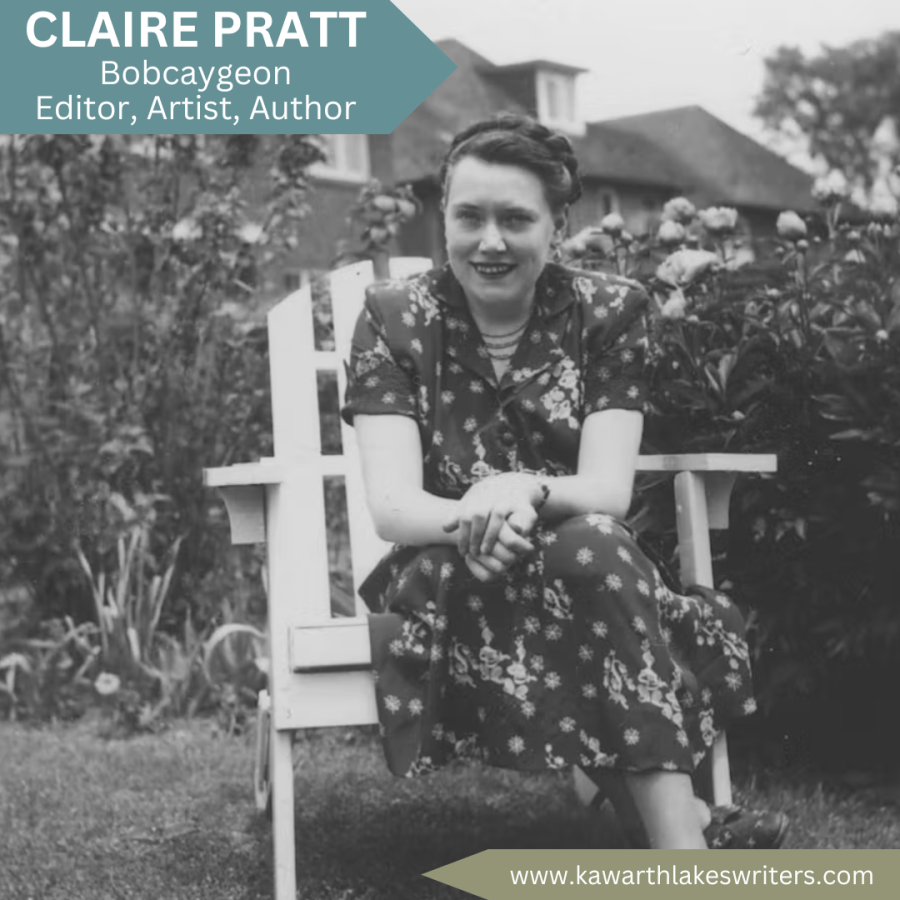
Born Mildred Claire Pratt (1921-1995), daughter of two writers/editors, E.J. Pratt and Viola Whitney Pratt, Claire became a “vanguard of mid-twentieth century Canadian publishing.”
At age four, Claire contracted polio in her right leg. For the next 11 years, she wore a leg brace and underwent operations to try to straighten it. When she was eight, one of these operations resulted in a staphylococcus infection and osteomyelitis. At the time, antibiotics were unheard of and she barely survived the winter. Within the year, the osteomyelitis travelled to her left arm and left hip. Numerous operations and infections followed, leaving Claire with a truncated hip.
By 1944, Claire had undergone over 40 operations.
From 1920 to 1936, Pratt’s parents kept a cottage in Bobcaygeon on Sturgeon Lake, where the family spent their summers.
After graduating from the University of Toronto, Pratt pursued graduate work at Columbia University. She returned to Toronto, where she, and Olive Smith, started the Claire Pratt Book Service. Their company was a “specialized book shipping and addressing service.”
As a child, Claire was around prominent writers, including those who she saw every summer when they returned to their cottages, the Bobcaygeon Boys (Arthur L. Phelps, Frederick Philip Grove, William Arthur Deacon) and many others.
Also among her parents’ friends were famous artists.
Frederick Varley, one of the founding members of the Group of Seven, was the artist for E.J. Pratt’s Newfoundland Verse (1923). When Varley and his family were evicted from their Toronto house, Pratt let Varley, his wife Maud and their four children camp in a tent on the lot next to the Pratt’s cottage.
Claire would have been two at the time, but when art became her pastime, this wasn’t her last encounter with Varley or other members of the Group of Seven.
The Pratts owned at least four pieces of Varley’s art. All now housed at the McMichael Gallery.
Claire Pratt, 1950. Box 46, file 8, MCP fonds, Special Collections, E.J. Pratt Library, Victoria University in the University of Toronto.
In 1952 Claire became an editor for Harvard University Press, but the need for further surgeries forced her to leave the position in 1954– the year she was forced to make the toughest decision of her life: to have the experimental spinal fusion surgery or die.
The surgery was performed in New York at the Hospital for Special Surgery, where John F. Kennedy was a patient in the next room, Jackie Kennedy walked the corridors, movie stars arrived for cosmetic surgery, and one of her surgeons had a stroke in the middle of her operation.
She spent two years in a body cast fighting pain, depression and despair. Turning to art for refuge.
Following her recovery, Claire joined McClelland and Stewart as an editor, where she took on major responsibilities. She travelled out of town to meet authors, and regularly worked through evenings and weekends to meet publishing deadlines.
Claire worked alongside Jack McClelland and Malcolm Ross for the development of the New Canadian Library. This line of paperbacks reissued the works of notable Canadian authors with introductions by contemporary notable authors. The series launched in 1958 and continues today.
The Bobcaygeon Boys were well represented. NCL printed many of the works of Frederick Philip Grove, the biography line included a volume on Claire’s father, E.J. Pratt. But not all of her father’s friends were so easy to work with. Claire “performed a near feat of magic when she managed to expand W.H. Drummond’s Habitant Poems to 110 pages. When editor Arthur J. Phelps stubbornly refused to include more than twenty-two judiciously selected poems, [Claire] Pratt devised to spread out the verse and pad the slender 1960 NCL edition with indexes.” (Toronto Trailblazers. page 117.)
Other notable writers that Claire worked closely with during her time at McClelland & Stewart: Leonard Cohen, Peter C. Newman, Margaret Laurence, and Irving Layton.
The following note Claire wrote to Margaret Laurence shows Claire’s editing style and handling of writers. As a result of this note, Claire won Laurence’s trust and Laurence sent her work-in-progress, The Stone Angel, which went on to launch Laurence’s career.
One of the best things that has happened to me in a long time is your manuscript of short stories. I wish there were some way in which I could put across to you you how really enthusiastic I feel about them, Margaret. Depth of compassion and insight, combined with stylistic beauty and the use of the word or phrase that is exactly right, make each of them a pure gem, a true union of the artist and the craftsman. In short they are marvellous.
Claire Pratt to Margaret Laurence, 20 February 1963, series Cae, box 12, file 7, M&S fonds, Mills Memorial Library, MU. (Toronto Trailblazers, Ruth Panofsky, 2019. p. 123.)
Layton’s work, under Claire’s editorialship, won the Governor General’s award in 1959.
In 1970, Claire received a Canada Council grant to support her genealogical research of her father’s ancestry. The result landed on Jack McClelland’s desk and the manuscript was published the following year as The Silent Ancestors: the forebears of E.J. Pratt.
Books:
The Silent Ancestors: the forebears of E.J. Pratt (1971)
Further Reading:
“Claire Pratt: Art and Adversity.” The Devil’s Artisan: A journal of the printing arts, issue 46. Robert C. Brandeis. (2000) (This article contains many examples of Claire’s art.)
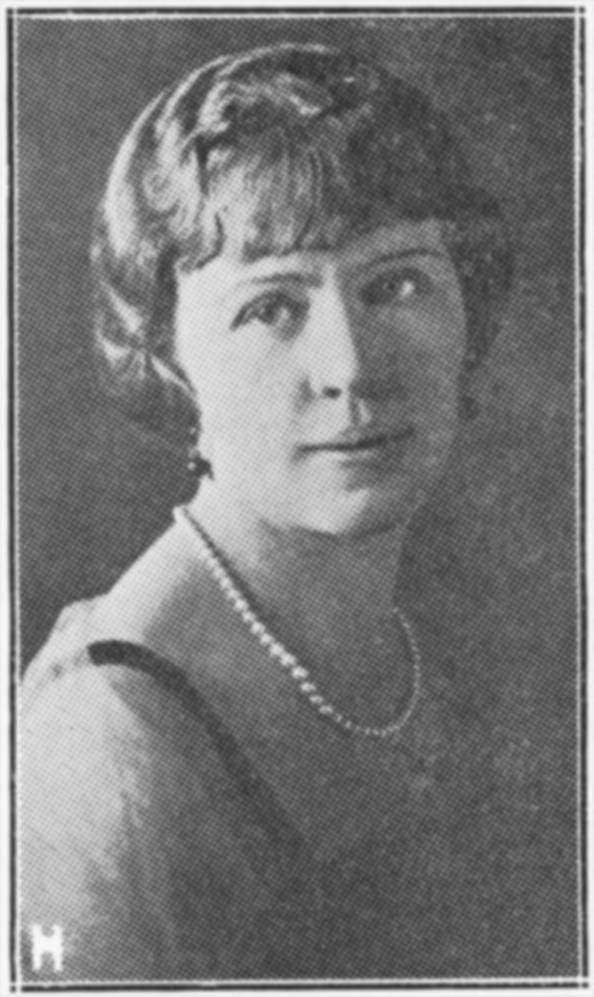
Born Clara Flos Jewell (1889-1970) in Dundalk, Ontario, she completed school in Toronto, where at some point she preferred to use the name Flos as she’s listed in the newspaper honour rolls as Flos Clara Jewell.
At some point, she took a teaching position in Bobcaygeon, where she taught for at least five years.
Dorothe Comber‘s book, “Bobcaygeon History: Amy Ellen Cosh Memorial,” has this note in the section about the Rokeby School:
Miss McGuire taught in the Rokeby School. She was a lovely person and a splendid teacher. She and Mr. Simpson were united. Miss Floss [sic] Jewell was one of the assistants. About 1920, after she had gone away and married, she wrote a fiction story about Bobcaygeon which was published, “The Judgement of Solomon.” Of course the names were changed but some people thought that they recognized some of the characters.”
Bobcaygeon History: Amy Ellen Cosh memorial, Dorothe Comber with committee, 1972, page 72.
The December 3rd, 1908 edition of the Weekly Free Press notes, “Upon severing her connection with Rokeby school, Miss McGuire was presented with some valuable silverware by her pupils and ex-pupils in remembrance of her kindness and interest in their welfare.”
McGuire left in 1908. The 1911 census shows Flos single and living in Toronto.
Flos and David were married on 23 April 1915, therefore Williams must have taught at the Rokeby School between 1911 and 1915. The phrasing “gone away and married” would suggest that just like McGuire, Flos quit teaching to get married, but since she ran into E.J. Pratt, Arthur Phelps and others while she was in Bobcaygeon, and knew them well enough to characterize them into her first novel, she had to have remained living in the area until at least 1920.
The former Rokeby School. Image captured by Google May 2018.
The Rokeby School was the Verulam School Section (S.S.) No. 6 built in 1873 to move students out of the tavern lean-to where they’d been studying. (The school in the make-shift room attached to the tavern is thought to be Bobcaygeon’s oldest school.) The Rokeby School was constructed at 35 North Street, which became Pieter van Oudenaren’s Garage, an auto repair shop. Pieter took over the garage from his father, Harry van Oudenaren, a Kawartha Lakes author, until he left auto repair for cheesemaking.
By 1921, according to the 1921 census, Flos and David were living in Calgary.
After settling in Calgary, being separated from her Toronto-area friends and family, and with her salesman husband travelling, Williams took up writing. She was a member of the Canadian Authors Association, in the same Calgary chapter as Nellie McClung. In addition to writing four novels, Williams contributed a number of stories and poems to anthologies and periodicals to qualify for membership to the Canadian Womens’ Press Club.
A young woman and a brilliant one, and editors and critics who know her work prophesy that she will go far in the world  of letters. The very fact that this first book of hers was one of the runners up in the recent Hodder & Stoughton Canadian $2,500 contest, that this well established firm accepted it at once and sent it forth to the world, stamped with its approval, is no mean compliment to a young and new writer.

Mrs. Williams didn't write her book as one in search of fame, for commercial purposes, or in the beginning for the publishers. Once  the theme was conceived it was written, four thousand  words at a time, for the real enjoyment of writing, until it had developed itself into a full-length novel. It is a story that arose first in the heart and was committed to paper because of  that prime requisite of any author — the urge to write. It had never been seen by anyone. Then one day Mrs. Williams saw the advertisement of the Hodder & Stoughton contest. She submitted her manuscript, curious to see  how it  would come out. Immediately there came back a letter of warm commendation accompanied by an offer to publish it. It had been picked as one of the four runners up in the contest.

Mrs. Williams was born in Toronto [Dundalk] and educated in that city, being a graduate of the Jarvis Collegiate Institute, the old grammar school of Upper Canada, and of the Toronto Normal School.  Later she taught at Bobcaygeon in the Kawartha Lakes district, which she has woven in, as the beautiful setting of her book. Six years ago she came with her husband, David S. Williams, and her twin sons, to reside in Calgary, in which city her book was written.
“Calgary has four women authors” by Elizabeth Bailey Price; Canadian Bookman, March 1926.
The Globe review for Judgement of Solomon called the book “a well-written novel” with “a real plot, not a particularly pleasant one, handled with skill and delicacy and well sustained to the end.” (The Globe, December 5, 1925.)
The Judgment of Solomon is a work of fiction, following the story of Blake Lamon during his days as a medical student at the University of Toronto. He leaves school to run the family farm, acting on the promise he made to his dying mother. He marries Mary, the girl next door, and then has an affair with his wife’s cousin, Anne Thurston (a girl of 18 who’s living with them as their housekeeper). Anne gets pregnant, and Blake dies before his son, Blake junior, is born.
The setting for the family farm was “a four-mile drive over wretched roads, from Robson” with Robson being the pseudonym for Bobcaygeon, a place the main character, Blake Lamon does not love.
Blake hated the gossip and scandal-mongering of small villages, the almost consistent lack of charity, the eagerness with which the inhabitants put the worst construction on the actions of their neighbours. Robson was particularly disgusting in this respect. The town was situated between two lakes. A river and a canal cut through the town. On every side was unusual beauty, and the little village, with its ugly houses, with their wedding-cake verandahs jammed close to the sidewalks, buzzing from morning until night with scandal, was to Blake like a festering sore on the beautiful landscape.
The Judgment of Solomon, 1925, page 54.
By this description Robson is undoubtedly Bobcaygeon. When Blake marries, he agrees to move into his wife’s neighbouring farm, called Beehive Farm. This must be a nod at ‘The Beehive’ home to James Dunsford, built in 1839 between Bobcaygeon and Fenelon Falls, now part of Eganridge Resort, Golf and Spa.
Mary’s verandah commanded a gorgeous view of Sturgeon Lake, whose waters washed all the western boundary of the farm, its wooded shores curving around Green Bay, the favourite haunt of black bass for which the lake was famous.
The Judgment of Solomon, 1925, page 36.
Green Bay is on the Pigeon Lake side of Bobcaygeon, just off Riverside Drive, while The Beehive is on Sturgeon Lake at Hawkers Bay. Familiar territory, in any case.
After Blake’s death, Anne stays with Mary to help raise Blake Junior, whom they are raising as Mary’s child. Outside of Anne and Mary, only the doctor knows the truth. Once Junior is old enough to go away to school, Anne moves to a place of her own in Robson.
While she’s living in Robson, Anne meets some familiar characters. For anyone who knows that E.J. Pratt, Arthur Phelps, and Frederick Philip Grove spent every summer at their cottages in Bobcaygeon, they would instantly recognize them in the characters “Ned Andrews,” “Arthur Dawson,” and “George Groves.” Anne suddenly finds that “for the first time in her life this lonely woman felt that she was among her own people.” (p. 245.)
And they seem to respect her:
Ned Andrews marvelled at this women. She confessed to having lived almost entirely to herself, yet she had the appearance, the poise, of a woman of the world. She unhesitatingly acknowledged that she had been a housekeeper on a farm, yet good breeding and refinement were obvious.
The Judgment of Solomon, page 255.
Williams would have been a solitary woman, living on her own, while her salesman husband was away. Williams seems to have made herself the template for Anne.
Ned is a bachelor, whereas, E.J. Pratt was married. Nevertheless, Pratt was the template for Ned. Here’s Ned as described by another character:
“He is a Newfoundlander: a long, thin, good-looking, loose-jointed man, rather shabbily dressed. The cleverest man on the staff, with an almost uncanny ability in using his knowledge. He impresses one as living intensely every instant. He is much interested in questions of the day, and has influence in high quarters that would amaze the majority of his friends. Add to that the fact that he writes the most beautiful poetry in Canada to-day, and that he is a confirmed bachelor at forty, and you have the man.”
The characters ask to hear Ned’s poem titled, “Charlotte.” Is it coincidence that Pratt had a sister named Charlotte? Or that his first published poem had a woman’s name for the title? (Rachel, published in 1917.)
In the book, Anne and Ned fall in love, but Anne is unwilling to commit because of her history with Blake and because Blake Junior hasn’t fully accepted her as his mother.
During her time in Kawartha Lakes and as a member of the Canadian Authors Association, Williams became known to these “Bobcaygeon Boys.” Phelps, Pratt, and William Arthur Deacon had cottages where they stayed every summer, after completing their professor duties at the universities.
Two of Williams’s books were published by Graphic when Frederick Philip Grove was editor. Grove was friend to the Bobcaygeon Boys, spent time at their cottages, and corresponded with them on a regular basis. Graphic also published the words of Grove, Deacon, and Watson Kirkconnell (another Kawartha Lakes writer and Phelps’s colleague.) Deacon was a well-known book reviewer and critic for Saturday Night and the Globe and Mail, where Williams’ books were reviewed.
In 1926, Deacon asked Pratt to review Williams’s novel, New Furrows, for the Globe and Mail. In his letter to Deacon, Pratt said, “I had this review up to four hundred words but by a second pruning I managed to get it down to 335. I hope it will do though I don’t think it is ‘any great shakes,’ as I can only accomplish anything worth while when I have the impulse to let myself go.” (https://www.trentu.ca/faculty/pratt/letters/texts/260909dea.html)
His review was lukewarm at best. The review appeared in the October 16, 1926 edition and started out well with Pratt calling the book “a refreshing change from the usual run of “Western” novels.” After describing the premise of the book, Pratt says, “Beyond the love affair which develops between Marie and a handsome English “mountie,” the book has little plot. Nor are the obstacles to the courses of true love more than ordinary complexity–the war, absence, misunderstanding and hurt pride account for them.” He then goes on to say the value of her story “lies largely in the simplicity of its telling” and that “Mrs. Williams has not hesitated to make her people her mouthpiece on many vexed questions.” He ends the review not with words for the story itself, but by describing the book as “an attractive piece of book-making, done in the distinctive style of the Graphic Publishers.” Deacon was at the time editor for the Globe and Mail, and their friend Grove was editor at Graphic Publishers. Pratt’s evaluation of the novel would have carried a lot of weight.
Although he must have been flattered to be a character in Williams’s first book, he clearly reverted back to his default belief that women’s fiction wasn’t worthy, and one shudders to think what he might have said had he been able to “let himself go.” Perhaps he wasn’t flattered by Williams portrayal of him at all.
Williams was well-connected to the literary world in another way. Her salesman husband’s travelling partner was Stephen Leacock’s brother. (Butter Side Up, Gray Campbell, 1994.) No doubt she heard plenty of amusing tales.
In 1931, Williams had three books published along with short stories and poems, when her story “The Blue Bowl” was picked up for Chatelaine. The editor contacted her, asking for a photo and a brief write-up of her career to include with the story. Her response shows that imposter syndrome is not a modern construct and that for mothers, writing is a challenging career:
“Your letter fills me with despair for two reasons. First it reminds me of the time I asked an old Indian squaw to let me take her snapshot for a quarter, and she knocked the money out of my hand, saying that she wouldn’t be ugly all over Canada for a quarter! And second, because in the matter of my career- I haven’t had one!”
“I taught school in Toronto, married and have twin sons. My sons are my chief hobby as well as being my greatest creative effort. I have no convictions about anything- or rather I have to have a fresh bunch daily. To such an extent is this true that the only time I ever wrote a letter to a newspaper, I had to write an answer the next day, refuting all my arguments.”
Chatelaine, November 1931.
Her last novel, Fold Home, took second place in Ryerson’s Annual Canadian Book Contest in 1949.
Butter Side Up by Gray Campbell (1994) tells the story of the founding of his publishing company, Gray Publishing, the first publishing company in British Columbia. At the time, Williams was retired and living on her own on the waterfront a few houses down from Campbell. In his book, Campbell describes her as a “wise old owl” and “a witty raconteur, very much in tune with current literature and state affairs.” He began bringing her manuscripts to evaluate. He says “as a retired novelist, she had the ability to size up a writer’s potential by reading a few pages.” And while he acknowledges his company wouldn’t have succeeded if not for Williams, he makes no mention of paying her for her work.











 kawarthalakeswriters.com
