Hollay Ghadery. Image from author’s facebook profile.
On the afternoon of Saturday, April 22, 2023, Hollay Ghadery launched her poetry collection, Rebellion Box, at the Kawartha Lakes Museum & Archives.
The occasion was a drop-in event, allowing guests to arrive anytime between 1pm and 4pm to visit with the author, buy her books, and enjoy the refreshments she brought.
My visit with the author was brief, but included chatting about women’s issues and the ghosts that haunt the old jail that houses the museum.
The museum is an excellent location for the launch since the title poem, “Rebellion Box,” was inspired by small wooden boxes made at Fort Henry by prisoners from the Rebellion of 1837.
The collection includes 63 poems of various types, and presents a portrait of the author as she pushes against the limitations of gender roles, race, bodies and minds.
That portrait is at times intimate, as in “Postcard, Santa Maria,” where the author writes,
I'm  not that girl
anymore. I
have the
conviction
of dust and

the cervix
of a fifteen-year-old,
my doctor says.
Not bad
for four kids

so I believe
in anything
so I can
belive
at all.
Other poems like “Search History” and “Fight like a Girl” feel universal and vast. The collection conveys many relatable experiences.
What follows is my interview with Hollay Ghadery about Rebellion Box.
KLW: What made you first take up writing poetry?
HG: I started writing poetry because it seemed the most fitting way to process my understanding of the world. I live with OCD and anxiety and from the time I was a young child, I needed someway to make sense of the way I experienced life, which I recognized was at odds with what most people experienced. Poetry—this small, exacting form—gave me a manageable way to try to make sense of the enormity of what I was feeling, as I was feeling it, without having to have the vocabulary to analyze it—which I didn’t have as a kid.
Poetry is, for me, a way to take control of something, but also, to let it go—very important when living with OCD.
KLW: As someone who also lives with high anxiety, I very much understand the need to find something that can be controlled or managed. How do you keep anxiety and OCD from turning into paralyzing perfectionism or otherwise preventing you from publishing and sharing your work?
HG: My OCD and anxiety centre around existential dread that I may not have time to do and say everything I want to, so I definitely don’t have an issue sending my work out there into the world.
KLW: Some of your poems feel like they come from a deeply personal place, while others have a clearly separate voice to them. Do you write all of your poetry from your own self, or do you adopt a point of view or persona when you write?
HG: Everything I write is from my own experience; my own self. Even if I am writing through another persona, it’s because I’ve seen something in that individual that resonates with me; I’ve found a connection. Usually, a connection that makes me feel less alone in something I struggle with. For instance, I wrote a poem for Thomas Foster–the former mayor of Toronto and a businessman. On the surface, we have little in common but Foster also created (or had created), The Foster Memorial: a Byzantine-inspired mausoleum located outside Uxbridge, Ontario. It was erected1936 in honour of his daughter, Ruby, who died just before her tenth birthday of pneumonia, and his wife, Elizabeth, who died a few years later of an undocumented cause. Living with existential OCD, I understand the very existential impulse to create art as a means to immortality.
KLW: One last question: what advice do you have for someone just starting to write poetry?
HG: Great question! I’d say to read poetry and read it widely. There are so many different types and styles and I find many people new to writing it have a relatively narrow understanding of the scope, and as a result, can really stunt their own development. Also, read interviews with poets. Read reviews of books of poetry. Really immerse yourself on the more technical side of the art. It’s not glamorous but I think it’s necessary to write well.
In the 1920s in Bobcaygeon, there arose a constellation of writers, including some of Canada’s most decorated poets and influential newspaper editors. At the heart of this constellation was a group of men who cottaged together and were at the forefront of defining Canadian culture. And they seemed to have a hate on for Lucy Maud Montgomery.
It all started with Arthur L. Phelps, who came to Bobcaygeon as a youth, again as a minister, and finally bought a cottage in 1919. He invited the friends he’d made at Victoria College in Toronto to visit him during the summers. They fell in love with the area on the banks of the Sturgeon Lake, and some bought cottages of their own, while others became regular visitors.
[Arthur L. Phelps] was part of a group of men who spent their summers in cottages at Bobcaygeon, Ontario, where their families socialized and the men themselves talked over their ideas about the state of Canadian literature, world literature, and politics. This group included other academics, journalists (like [William Arthur] Deacon), and writers invited to join them (like Frederick Philip Grove).”
Lucy Maud Montgomery: the gift of wings. Mary Henley Rubio. 2008.
The next to snap up a cottage was E.J. Pratt, the three-time winner of the Governor General’s Award for Literature for his poetry. After visiting Phelps, Pratt fell in love with the place. Pratt had a grand old time in Bobcaygeon. He established a garden, built a writer’s shed on the shore where he composed most of his poetry for the time while he owned the cottage, and hosted many guests.
The next to buy a cottage was William Arthur Deacon, who became Canada’s first full-time book reviewer, fulfilling one of his life’s ambitions, as editor of Saturday Night magazine and the Globe and Mail.
“ln 1925, for $400 in easy instalments, they also acquired a piece of land at Bobcaygeon, in the Kawartha Lakes district near Peterborough, a part of the summer colony that included the Pratts and the Phelps.” (“William Arthur Deacon: A Canadian Literary Life.” Clara Thomas and John Lennox. 1982)
In those days, writers and poets alike joined the Canadian Authors’ Association (CAA), where membership afforded connections to other writers, along with workshops and other learning options, to say nothing of publishing opportunities in the organization’s anthologies and magazines.
For many, writing is a solitary profession, and organizations such as CAA are a lifeline, giving writers the chance to get out and commiserate and network with other people who can immediately empathize, no explanation needed.
Where a chapter of the CAA did not exist, many writers opted to create one, as Deacon did when he lived in Winnipeg.
At the same time, the sources of literature and radio in Canada were primarily Britain and America, and there arose a need to produce and promote Canadian content. This became a highly debated topic, as no definition of “Canadian” had been made, but in very short order, a plethora of Canadian literature was produced and the CBC was created.
In addition to his professorship duties, Phelps became host to a number of CBC programs that debated and defined Canadian culture, broadcasting throughout his career, even from his deathbed in 1970.
Deacon, in his editorial positions, decided which books got reviews and which were passed over. And Deacon was instrumental in the creation of the Governor General’s Award for Literature, and which Pratt won three times. Other visitors to the cottages also won this prestigious prize and cash award.
When it came to Lucy Maud Montgomery, this crew from Bobcaygeon did not feel her work was worthy of inclusion as part of the nation’s culture, nor as being worthy of winning a prize.
They excluded Montgomery’s work because it was written for children and well-loved by girls and women all around the world. They were jealous of her sales numbers– which none of them had achieved more than a fraction in comparison.
Their jealousy and misogyny frustrated Montgomery. When she ran for president of the Toronto branch of the Canadian Authors Association and learned she was up against Deacon, she withdrew because she knew of his connection to the Bobcaygeon crew and how vast this network extended.
It does not matter in the least to me that I am not on the executive. Deacon has always pursued me with malice and I am glad I will have no longer to work with him. He is exceedingly petty and vindictive and seems to be detested by everybody who knows him.
L.M. Montgomery (Rubio, 2008)
On the occasion of Canada’s National Book Week in September 1935, the Toronto branch of the CAA hosted an event to celebrate those who had received the Most Excellent Order of the British Empire (OBE) that year; advertising stated the occasion would honour “three knights and two OBEs”: Sir Ernest MacMillan, Sir Wyly Grier, Sir Charles G. D. Roberts, L.M. Montgomery, OBE, and Dr. E. A. Hardy, OBE. It was a hugely important event for Canada’s literary scene.
One of the organizers was Pelham Edgar, a professor, and at that time, president of the national level of the CAA. Pelham was a good friend of Pratt and the other Bobcaygeon boys, had been invited to the cottage, and was no friend to Montgomery. Pelham proposed a toast to each of the five honourees. He spent considerable time delving into the accomplishments of the first three, and then finished with “The other two who are included in this toast are Dr. Hardy and Mrs. Macdonald.”
Montgomery’s biographer, Mary Rubino, supposes Maud could have been overly sensitive since a knighthood is a higher award than an OBE, but Montgomery was certain that it was a snub and that if Edgar had stopped to sing the praises for Hardy, he would have had to admit that she was of literary merit. She believed Edgar “would have died any death you could mention rather than admit I represented Canadian literature.”
A write up in the Globe corroborates Montgomery’s version of the event. After being toasted, each of the five made replies, but the write up by Deacon in the The Mail and Empire omits any mention of Hardy’s and Montgomery’s replies. It’s as though the Bobcaygeon boys had decided Montgomery simply didn’t exist.
By this time, Montgomery had shifted to writing books for adults, including A Tangled Web and The Blue Castle, sales had slowed, and her work was called “provincial” at a time when books were prized for being “cosmopolitan” and favoured for having “universal” themes. For a while, The Blue Castle was banned.
This was the beginning of Montgomery’s descent from publishing. She was a victim of the Bobcaygeon boys’ bullying that became cultural programming that ascribed “literary” works as better than “commercial” works.
Had any of them even read her work?
No.
At least not while she was alive.
When Phelps wrote his book, Canadian Writers (1951), he included a chapter about Montgomery, but proceeded to call her work “naïve” and “easy reading” that “lacks realism and penetration.” In fact for most of the chapter, he didn’t mention her work much at all, but wrote about other writers: Robert W. Service, who had his own chapter, and Mazo de la Roche. He said Montgomery’s readers were “nostalgic” and “sentimental” and only for “the uncultured and unsophisticated.” Finally, the last two pages of the chapter covered Montgomery and her work. He checked out her books from the library, where he was told not to keep them too long as they were in high demand. He finally read the Anne novels, and decided “there may still be a place for the stories of L.M. Montgomery.” He ended the chapter with “get a copy of Anne of Green Gables by L.M. Montgomery and read it.” Unfortunately, Montgomery had passed away in 1942, wanting to believe she had a place in Canadian literature, but never actually achieving it until after the deaths of the Bobcaygeon boys.
But even today, the idea that “literary” fiction is superior to “commercial” fiction lingers. The literary community still has much work to do to detangle this particular net cast by the Bobcaygeon boys and their constellation of friends.
Further Reading:
Phelps, Arthur L. Canadian Writers. McClelland and Stewart Limited. 1951.
Rubio, Mary Henley. L.M. Montgomery: The Gift of Wings. Doubleday Canada. 2008.
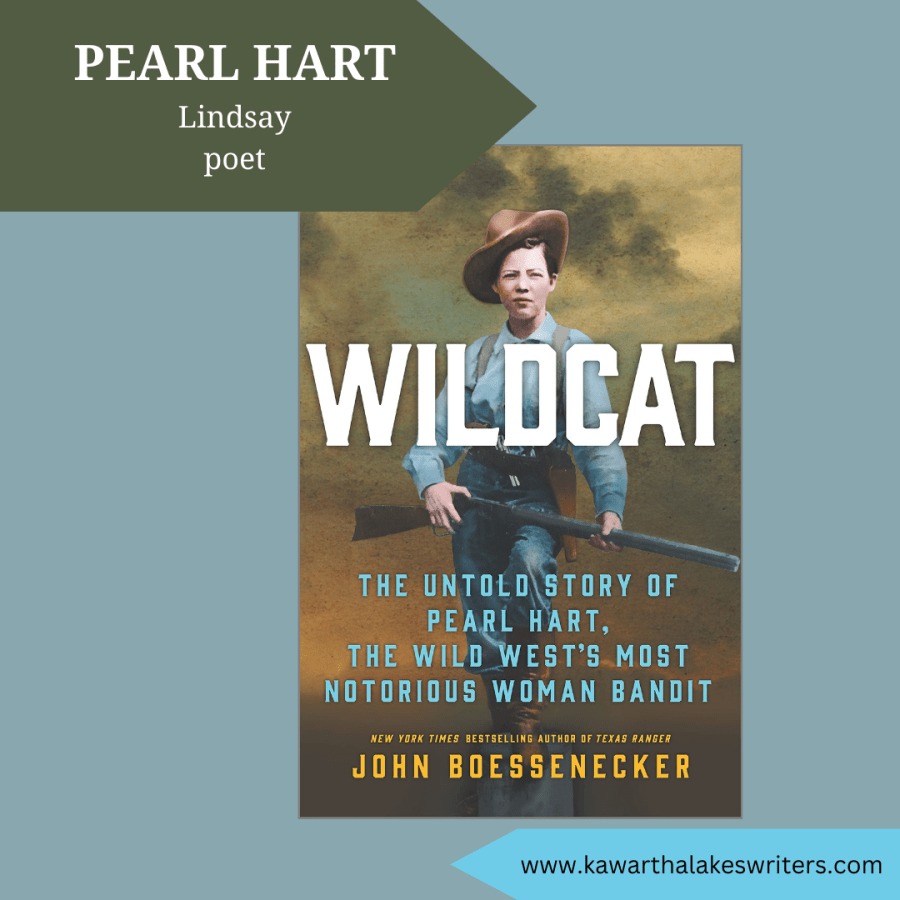
Lindsay native turned stagecoach robber, Pearl Hart (1871-1935), was also a poet.
On April 19, 1871, Lillie Naomi Davey was born in Lindsay, Ontario to parents, Albert Davey and Anna Duval. (Anna was also born in Lindsay in 1846.) She had eight siblings. Her father was a drunken lout who sexually assaulted a young girl. He was many times sentenced to jail in Lindsay for drunk and disorderly conduct, but after attempting to rape the young girl at knife point and being sentenced to a year in prison along with twelve strokes of the cat-o-nine-tails, he moved the family to Belleville, then to Orillia. It’s speculated that he sexually abused his eldest daughters, including Lillie and her sister Katy.
In her teen years, she called herself Lillie de la Valle, meaning Lillie of the Valley, and would eventually become Pearl Hart. Her upbringing was traumatic and violent. The family lived in poverty and frequently moved.
When she was 13, she and her younger sister, Katy, 11, cut their hair, dressed in their brother’s clothes, and stowed away aboard a lake steamer. They ended up in Buffalo, New York, where they found jobs in a local factory. It was two months before their mother found them.
After the family moved to Rochester, the Notorious Davey girls, Lillie and Katy, continued their charade as boys and thieved their way across the American mid-west, making headlines and telling their stories to reporters. They were arrested many times, and eventually Lillie was placed at Mercer Reformatory in Toronto.
After completing her term at Mercer, she rejoined Katy in Buffalo. By this time Katy had been working for a brothel and adopted the name, Minnie Hart. The brothel’s owner was named Pearl Hart, her common-law husband was Joe Hart. After she’d earned enough for Joe to open a saloon, Pearl closed her brothel. And Katy, as Minnie Hart, opened one of her own. She was only sixteen. Her sister joined her and they both worked as prostitutes.
Lillie hooked up with a young man and went west; the relationship didn’t last. While in Phoenix, Arizona, she worked as a prostitute using the name Pearl Hart. She scandalously wore men’s clothing, chain-smoked cigarettes, which she laced with opium, and became addicted to morphine. Her addicted, abusive husband found her Phoenix, she took him back, and through their tumultuous relationship, they conceived two children, a boy and a girl, which she sent to be raised by her family. When he resumed his abusive ways, she left him again. In 1898, opium use was legal, but prostitution was not, and Arizona began to crack down on its brothels, prompting Pearl to look for new work.
In 1899, she headed for a small mining settlement, set up her own tents for prostitution and learned how to shoot guns, but felt she could make more money in a larger town, so she relocated to Globe. Her abusive husband found her again, and took all her money before she kicked him out. Then Pearl received word that her mother was sick and wanted to see her before she died. Pearl said the news made her temporarily insane. She had no money to make the trip.
At that time, stagecoach robbery was becoming fashionable for criminals near Globe. So, to get enough money for a trip home, Pearl and her companion, Joe Boot, conceived the idea to rob a stagecoach.
On May 2, 1899, Pearl, dressed in a man’s clothing, and Joe robbed their first stagecoach. They made out with more than $300 and a pair of pistols, but gave back a silver dollar to each of the passengers. No one was hurt, but as soon as the coach arrived in Globe, the manhunt began.
They were captured on June 2. The woman stagecoach robber made national headlines. Reporters came from all over, and Pearl happily told her story to all of them, and even posed for photos. The sheriff let her wear men’s clothing and pose with unloaded guns.
Pearl was locked up in Tucson, where she struggled with her morphine addiction and was allowed visitors, which were frequent and included the pair of journalists who interviewed her for Cosmopolitan.
On October 11 and with the help of another prisoner, Pearl escaped, making headlines again, and this time her recently adopted feminist views were included in the stories; feminism was fast becoming fashionable at the time. Pearl’s significance as an icon was debated in the papers across the nation.
I shall never submit to be tried under the law that neither I nor my sex had a voice in making.
Pearl Hart
Nine days later, the pair were captured in New Mexico. Pearl and Joe faced trial in November, and were found guilty. He was sentenced to thirty years, while she was sentenced to five at Yuma prison.
While at Yuma, Pearl fought off her morphine addiction. She discovered she wouldn’t be able to escape this prison, but found a well-stocked library, and took up both reading and sewing.
This was also where she wrote poetry.
On June 2, 1900, the Arizona Star printed a news brief about Pearl kicking the morphine habit and taking up poetry writing, “unwinding it by the yard.” The brief said she wrote about being a girl bandit and her childhood. Two of her poems were mentioned: “The Girl Bandit” and “When She Was Young and Knew No Sin Before the Tempter Entered In.” The brief said that after the title, what followed was “a lot of doggerel of the rapid decent.”
Sounds like they weren’t fans of her poetry.
The following poem was the only one that survived. It was printed in the 31 July 1903 edition of Yuma’s Sun.
(to the tune of "The Fatal Wedding," a popular song at that time)

The sun was shining brightly on a pleasant afternoon.
My partner speaking lightly, said, "The stage will be here soon."
We saw it coming round the bend and called to them to halt.
Then to their pockets we did attend, if they got hurt, 'twas their own fault.

While the birds were sweetly singing, while the men stood up in line,
And the silver softly ringing as it touched this palm of mine.
There we took away their money, but left them enough to eat.
And the men they looked so funny as they vaulted in their seat.

Then up the road we galloped quickly, then through the canyon we did pass.
Over the mountains we went swiftly, trying tin find our horses grass.
Past the station we boldly went, then along the river side.
And our horses now being spent, of course we had to hide.

Now for five long nights we travel, in the day time we would rest.
Now we would throw ourselves on the gravel, and to sleep we try our best.
Around us now our horses stamping, looking for some hay or grain.
On the road the posse tramping, looking for us all in vain.

One more day they would not get us, but my horse got sour and thin,
And my partner was a mean cuss, so Bill Truman roped us in.
Thirty years my partner got, and I was given five.
He seems contented with his lot, and I am still alive.
The last line is a reference to Pearl’s decision to kill herself before going to jail, something she vowed at the times of her two captures.
Joe Boot managed to escape the Yuma prison in 1901, and when Pearl was interviewed, she told reporters that she planned to write “a poem extolling the virtues of Boot and his gallant escape.”
Due to a smallpox outbreak, Pearl was granted early parole and released from the prison in December 1902. She headed straight to Kansas City to live with her mother and sister Katy, and where she opened a cigar shop.
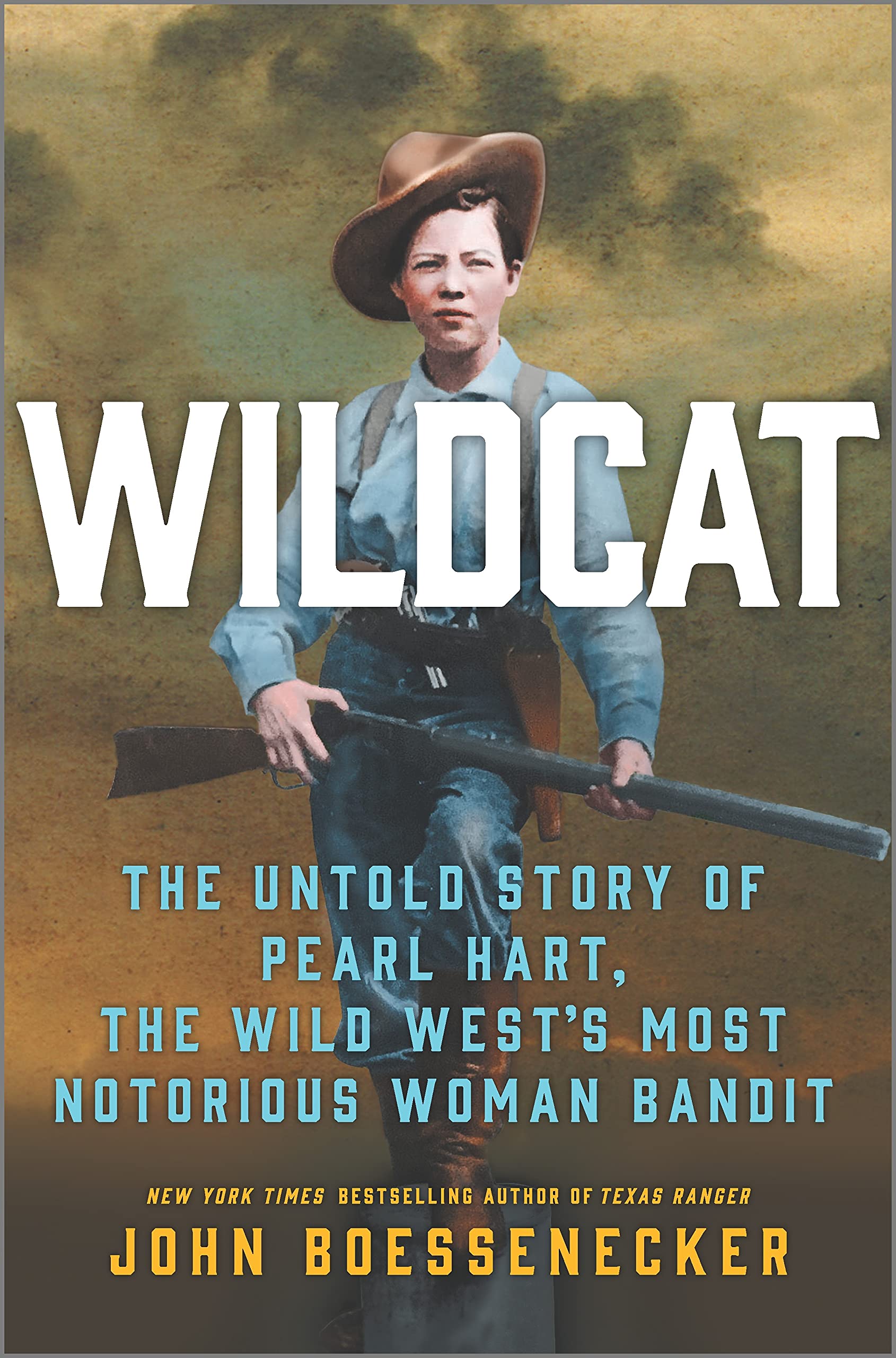
John Boessenecker’s book, Wildcat, is the most truthful and comprehensive account of Pearl Hart’s life. The level of research is remarkable. He has fact-checked Pearl’s outlandish tales told to reporters, and still presents Pearl honestly, as both victim and criminal. Over 300 pages long, the book leaves nothing out. Boessenecker also includes the fascinating stories and fates of Pearl’s family members and the lawmen that captured her, and of course, the story of her wild and traumatic childhood in Ontario and here, in Kawartha Lakes.
Further Reading:
Boessenecker, John. Wildcat: the untold story of the Canadian woman who became the West’s most notorious bandit. Hanover Square Press. 2021.
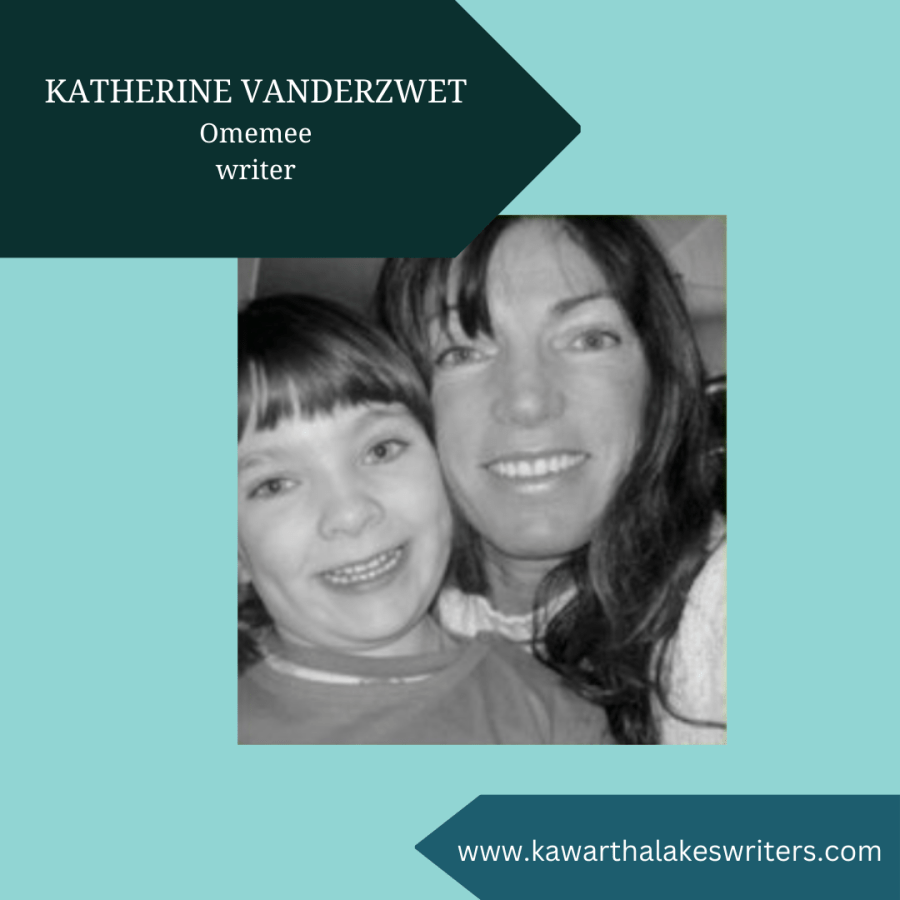
Originally from Bobcaygeon, Vanderzwet is a writer living in Omemee.
A certified lifestyle and wellness coach and personal trainer, she published her first book in 2012, Be Well: unlock the health and wellness that you deserve.
Books:
Be Well: unlock the health and wellness that you deserve (2012)
Charles Cooper at Beeton, ON end-of-steel 1999. Photo: Andrea Percy from author’s website.
Charles Louis Cooper (1933-2023) was born on 2 July 1933 in Berlin to a German father and English mother. His family hid in the Germany countryside during the Second World War. After the war, Cooper moved to England and studied at Cambridge. He moved to Canada in 1957.
He got his love for trains when lived in Europe and always wanted to work on the railway. He ended up working in insurance and trains became his pastime. He was an honorary member of the Lindsay & District Model Railroaders and had a large model train set-up in his basement.
Cooper also spent his time researching railroad history and writing books. Rails to the Lake was published by Boston Mills Press in 1980. Hamilton’s Other Railway expanded on the first book and was published in 2001.
Narrow Gauge for Us recounts the history of the Toronto-Nippissing line that partly ran through Kawartha Lakes. It was published in 1982.
After Omer Lavalleee passed away, leaving his manuscript incomplete, Cooper took on the role of seeing the book to completion, and Canadian Pacific to the East – the International of Maine Division was published in 2007. That year the book won the Canadian Railroad Historical Association’s book award.
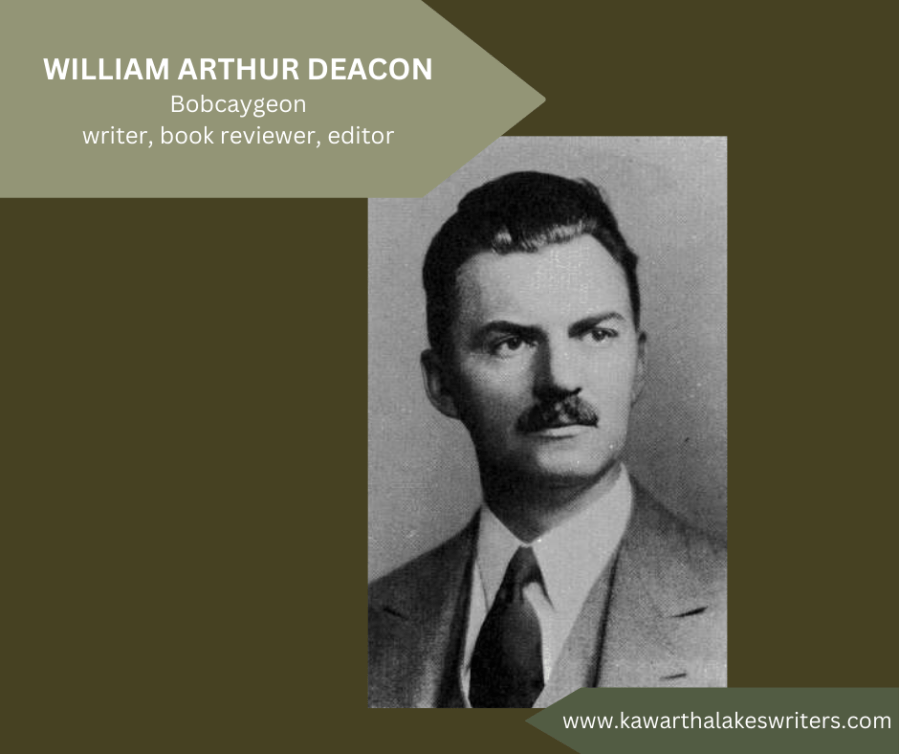
William Arthur Deacon (1890-1977) was one of the most powerful and influential writers/editors in Canada from 1922-1961. He could make or break authors’ careers. And he did.
Image source: Trent University
Born in Pembroke on 6 April 1890, the son of William Henry Deacon, a lawyer, and Sarah Ann Davies, daughter of a printer. His father died when he was very young. His mother moved in with her parents.
Deacon studied law at Stanstead College, but while there, two things happened that changed his intended career path, both literary readings, and each inspiring to Deacon. And then in 1905, he read his own first paper to the college literary society and from that moment, never lost the desire to write– or get a reaction from an audience.
In 1907, Deacon entered Victoria College in Toronto, where he met E.J. Pratt, and wrote for the campus magazine, of which Viola Whitney (future Mrs. E.J. Pratt) was the editor. He also met another life-long friend in Arthur L. Phelps, who went on to become Canada’s foremost culture critic. But Victoria College wasn’t working for Deacon, and he left during his second year.
Deacon drifted through various jobs until finally deciding to marry Gladys Coon of Weston, Ontario, and return to Dauphin, Manitoba, where he could article in law. Later in life, Deacon would look back on these years as ‘the ten lost years’ of his life, given to the law career he ended up not pursuing.
Around 1916 Deacon and Gladys discovered theosophy, and eventually founded Winnipeg’s second lodge. Deacon felt theosophy and Methodism converged nicely in their teaching responsibilities.
He truly believed that the printed word could change the world. He held as axiomatic the belief that Canadians were a vital and dynamic people who would require, demand, and produce a correspondingly dynamic literature. He came to see himself as herald, prophet, preacher, and custodian of that literature.
Clara Thomas and John Lennox. William Arthur Deacon: a Canadian literary life. (1982)
He found law boring and frustrating; theosophy convinced him that he was destined to write.
In 1921, the Manitoba Free Press employed Deacon as a contributing editor to their newly established monthly literary and book review section. They called him their ‘Honorary Literary Editor.’ This was novel; up until 1921 Canadian newspapers didn’t care about books. Only about a dozen printed book reviews.
Deacon submitted book reviews and editorials to The New York Times, The Stairway, the New York Evening Post, and The National Pictorial, to name a few.
He helped found the Winnipeg branch of the Canadian Authors’ Association.
But his big break came in 1922 when he joined Saturday Night magazine and achieved his dream of becoming ‘the first full-time, professional book reviewer that Canada had ever seen.’
It also coincided with the end of his marriage to Gladys. In 1918 he met fellow theosophist, Mrs. Sally Townsend Syme, and the two believed they were destined for each other, despite both already being married. They continued to correspond with each other until 1922 when Sally joined Deacon in Toronto.
After Deacon moved to Toronto, he and Sally became frequent guests at his friends’ cottages in Bobcaygeon. Phelps was the first to establish a cottage there, followed by Pratt in 1921. Finally, in 1925, in $400 instalments, Deacon acquired his own Bobcaygeon land, and by 1928 had built a cabin on it.
Phelps helped Deacon make connections in their literary circles. He helped Deacon get the job with Saturday Night magazine. He introduced Deacon to Lorne Pierce of Ryerson Publishing, who then picked up Deacon’s books, Pens and Pirates and Peter McArthur. Phelps took Deacon to the Arts and Letters Club, bringing him to a wider literary network.
Deacon gave up his Bobcaygeon cottage by 1932, when he heard about the Canadian Institute on Economics and Politics held annually at Geneva Park, Lake Couchiching, and began spending summer vacations at Wilson’s Point, Orillia, merely four miles from Geneva Park– he gave up the Bobcaygeon cottage to continue to pursue his belief that he could change the world.
Deacon and Pratt family in Bobcaygeon. c 1930.
Deacon was now professionally placed where he could make or break an author’s career.
His friend, Arthur Phelps wrote to him: “I’ve backed three horses, Deacon, Pratt, and Grove. Place ’em in Canadian Literature, will you?” (William Arthur Deacon, page 67)
His reviews of Pratt’s work was favourable.
And same for Grove. When Grove’s book, Settlers of the Marsh, became the subject of a book ban and the author poise to go bankrupt, Phelps asked Deacon to find speaking engagements for Grove in Toronto. Two years later, Deacon sent Grove on a speaking tour across the country, using his contacts with the Canadian Club and the publicity department for the Canadian National Railway.
Grove is just one example of a Deacon-made career. But not all authors got the white glove treatment.
Deacon had a particular problem with Lucy Maud Montgomery. Jealousy, likely. His books sold only a few hundred copies, while hers were being translated and sold around the world. In his essay on Canadian literature in his book, Poteen, he says, “As for the ‘girls’ sugary stories begun with Anne of Green Gables... Canadian fiction was to go no lower.” He had a set idea of what Canadian literature should be and Montgomery was not it.
Lucy Maud Montgomery received a similarly misogynist response when she was running for the executive of the Toronto Branch. Montgomery’s biographer Mary Henley Rubio notes that “The Canadian Authors Association had been very important to Maud after [her] move to Toronto. The CAA was a lifeline, in fact, that pulled her out of her personal stress at home” (p. 529). On April 8, 1938, however, at an election for a new executive, Montgomery was pushed out by Deacon. She writes in her journal: “The election of a new executive was held and I was elbowed out. It is not worthwhile going into details. Deacon had it all planned very astutely and things went exactly as he had foreseen. I at once withdrew my name from the list of candidates” [Mary Henley Rubino, Lucy Maud Montgomery: the gift of wings. 2008. p. 530]. …. If this is the treatment received by authors of their stature, one can only imagine the treatment accorded to amateur writers in the association
Christopher M. Doody. “A Union of the inkpot: the Canadian Authors’ Association, 1921-1960.” 2016.
Deacon was completely dedicated to his non-commercial, literary and democratic principles.
He played a primary role in the establishment of the Governor General’s Awards for Literature and had influence over the judges and titles selected. His friend E.J. Pratt won three times. His friend Fredrick Philip Grove won once. E.K. Brown, another of the Bobcaygeon Boys’ visitors, won once. Arthur R.M. Lower, who was Arthur L. Phelps’s biographer, won a couple times. Laura Salverson, who corresponded with Deacon for years, won once. His personal friend Stephen Leacock won in 1937. Bertram Booker, Franklin Davey McDowell– the list goes on of Deacon’s friends who took home Canada’s top literary prize.
Deacon loved leadership and the feeling of power to influence events; he also loved to be seen to be leading.
He recruited his friends to write book reviews, including his wife writing as Sally Townsend, E.J. Pratt, Viola Pratt, Arthur Phelps and many others.
His review philosophy was solid and many of today’s reviewers could stand to learn a thing or two:
But NEVER put on a [heading] which will keep readers from reading your article. The chief function of man may be to glorify God; but the chief function and aim of a writer is to get himself read. Put on a [heading] which will entice your reader, rouse his curiosity, tempt him to plunge into the text below. Don’t drive him away by proclaiming that the whole thing is a bore. You break that gently to him later.
William Arthur Deacon, page 220.
In 1967, Sally was diagnosed with Parkinson’s Disease. She passed away two years later. Deacon was unable to do any serious writing after Sally’s illness, even withdrawing his centennial grant application. Over the next years, he suffered small strokes until he passed away in August 1977.
Editor:
Saturday Night (1922-1928)
Toronto Mail and Empire (1928-1936)
The Globe and Mail (1936-1961)
Books:
Pens and Pirates (1923)
Poteen and other essays (1926)
The Four Jameses (1927)
My Vision of Canada (1933)
Further Reading:
William Arthur Deacon: a Canadian literary life. Clara Thomas and John Lennox. University of Toronto Press. 1982.
E.J. Pratt: the truant years. David Pitt.
photo source of Deacon and Pratt family: Trent University:





















 kawarthalakeswriters.com