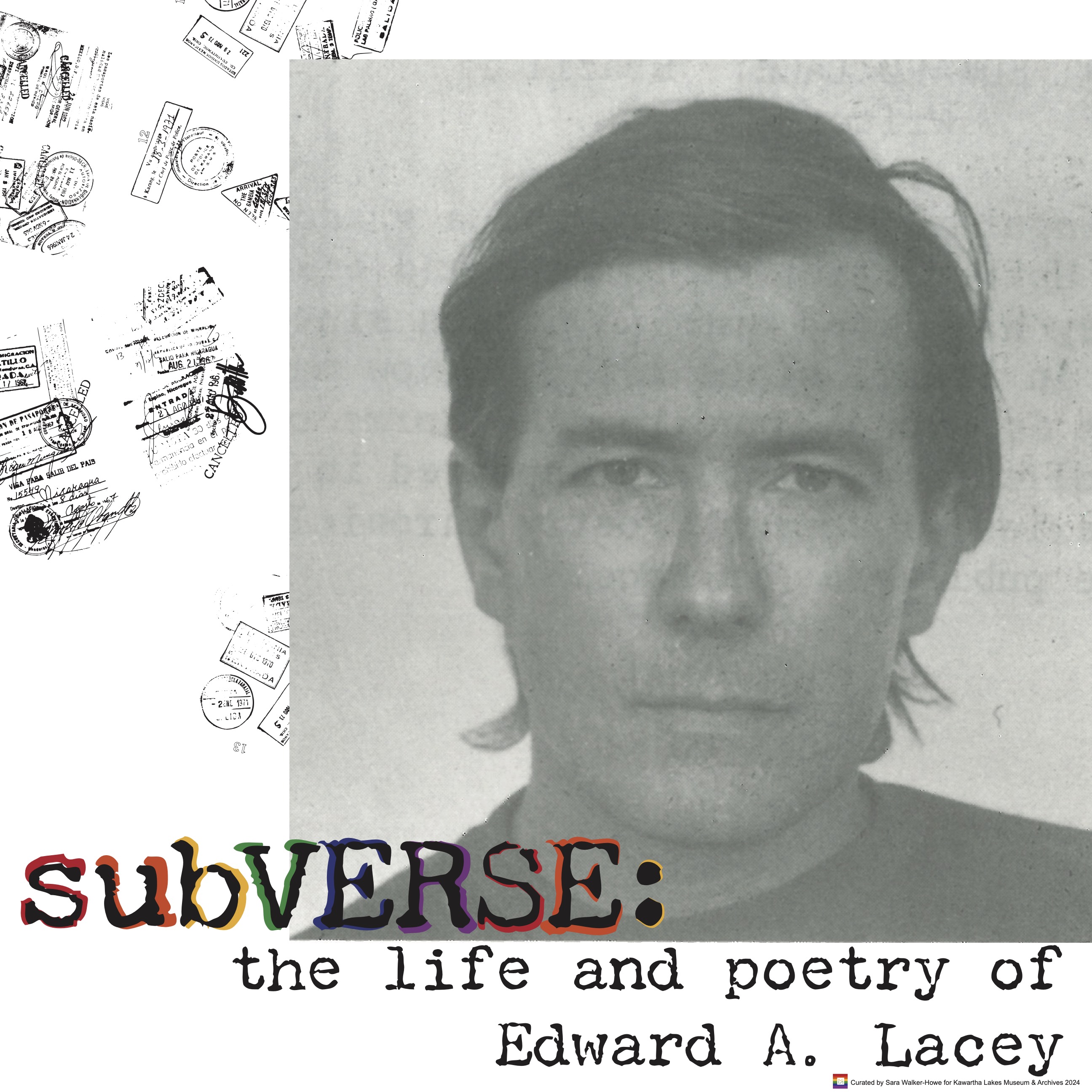
Exhibition: subVERSE: the life and poetry of Edward A. Lacey

Edward A. Lacey (1937-1995) wrote and published what is known as the first openly gay poetry collection in English-speaking Canada. The book, The Forms of Loss, was sponsored by Dennis Lee and Margaret Atwood.

Edward A. Lacey was born and raised in Lindsay, Ontario, the only child to parents with prominent community connections: his grandfather was Dr. Fabian Blanchard; his father’s business partner was I.E. Weldon. Many of his cousins became priests or nuns, and it was expected Edward would also join the clergy if he didn’t become a doctor or a lawyer.

Even as a child, Edward knew he was different. In his teens, he knew he wasn’t like his hockey-playing friends. He possessed a keen mind for linguistics that won him scholarships to the University of Toronto and the University of Texas.

As primed for success as he was, Edward wore a path of self-destruction around the globe. He operated on the principle that “homosexuality was intrinsically subversive, individualistic, anti-family, anti-regimentation.” Multiple times, he was nearly expelled from university. He frequently spent time in jail. He got himself banned from entering the United States. For most of his life he slummed through third-world countries, working as a professor or tutor, or living a life of leisure, while penning the occasional poem or translating one from another language. 

In 1995 Edward’s self-destruction fulfilled its ultimate conclusion, while his body of work attained barely a whisper in the landscape of Canadian literature despite its brilliance. When Fraser Sutherland published his biography of Edward Lacey, the Malahat Review said “many academic readers will no doubt be interested in what amounts to a very well-researched and entertaining biography of a heretofore neglected Canadian poet.” 

subVERSE: the life and work of Edward A. Lacey is an exhibition that spotlights the body of work that Lacey left behind and his complicated connection to his much-hated hometown.  

On exhibit at Kawartha Lakes Museum & Archives, located at 150 Victoria Avenue North. 705-324-3404, info@klmuseumarchives.ca. Admission is $5/adult, $3/child(6-18). Admission is free for children under 6 and for members of the Kawartha Lakes Museum & Archives. Visit https://www.klmuseumarchives.ca/ for more information.

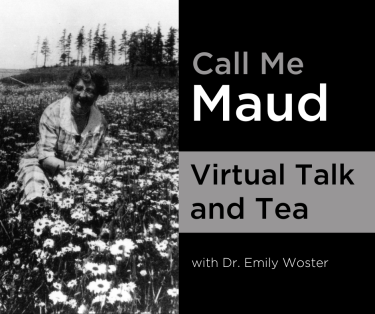
Event: Call Me Maud

2024 marks the 150th anniversary of the birth and legacy of author Lucy Maud Montgomery. Canadians coast to coast will gather in various ways to celebrate and honour the beloved Canadian author.

Kawartha Lakes Economic Development, with support from the Kirkfield and District Historical Society and Museum, invites you to join them on Sunday, August 18 at 1:30pm for – ‘Call Me Maud – a Kirkfield Connection to Lucy Maud Montgomery’ virtual talk and in-person tea event.

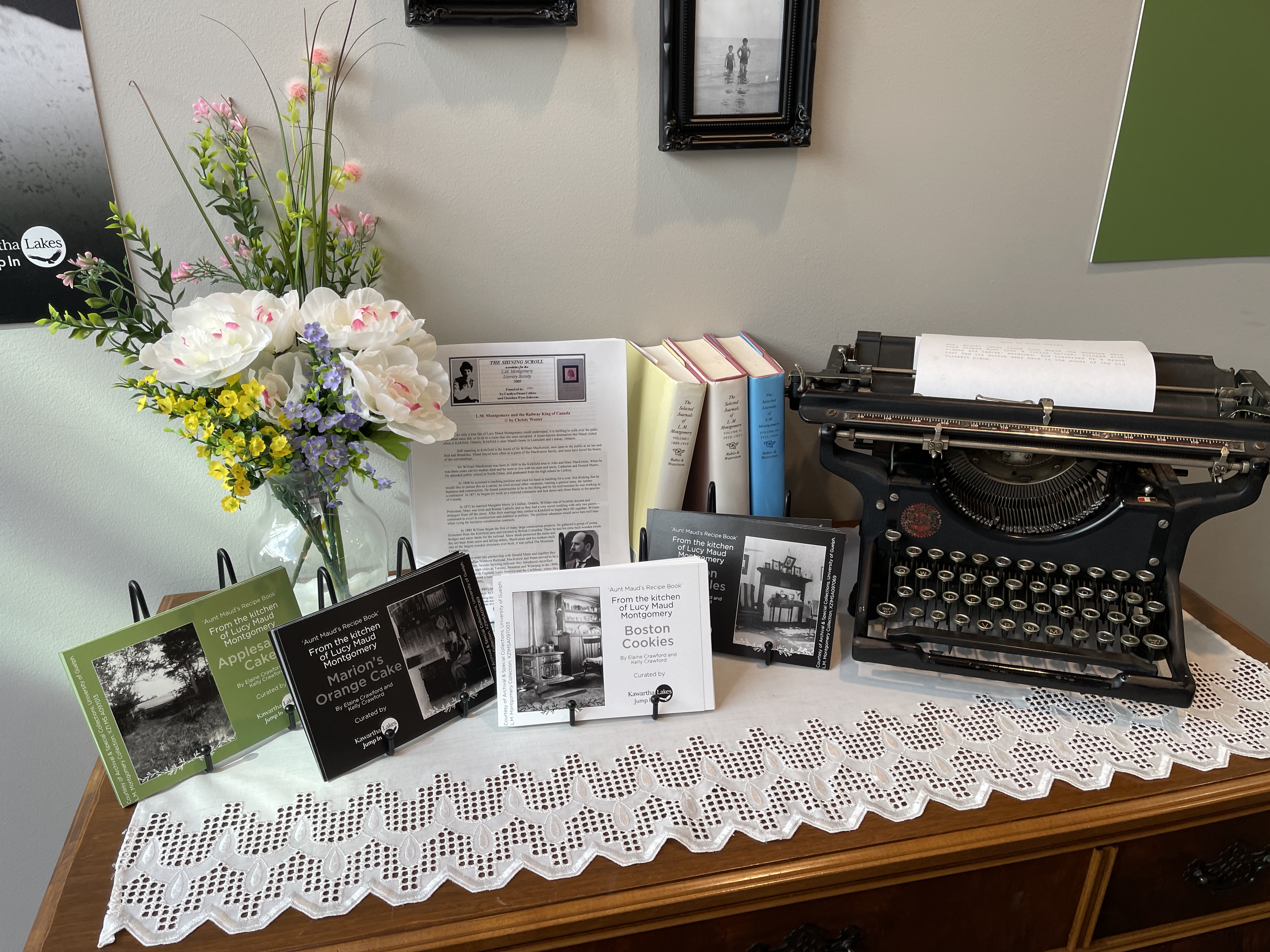
The fun and interactive event will feature refreshments served from Maud’s personal recipe book and welcome virtual keynote speaker, Dr. Emily Woster as she discusses the Lucy ‘Maud’ Montgomery connection to Kawartha Lakes and Maud’s years in Ontario.

Dr. Emily Woster, a former Visiting Scholar at the University of Prince Edward Island’s L.M. Montgomery Institute,now serves as an assistant professor at the University of Minnesota Duluth. She received her Ph.D. in English Studies from Illinois State University. Emily’s research mainly focuses on the books and life of L.M. Montgomery, and she has contributed to books like L.M. Montgomery’s Rainbow Valleys: The Ontario Years, 1911-1942. Her interests also include women’s autobiographical writing, children’s literature, and English Studies. Emily is the Managing Editor of a/b: Auto/Biography Studies.

The Virtual Tea event will take place at the Kirkfield and District Historical Society Museum located at 992 Portage Road, Kirkfield. Tickets must be purchased in advance for this event and will be available for purchase until August 11 for the cost of $25 per person. To purchase tickets please contact Denise at events@theoldekirk.ca or call 705-438-5454

RELATED POSTS:

Exhibition: Call Me Maud

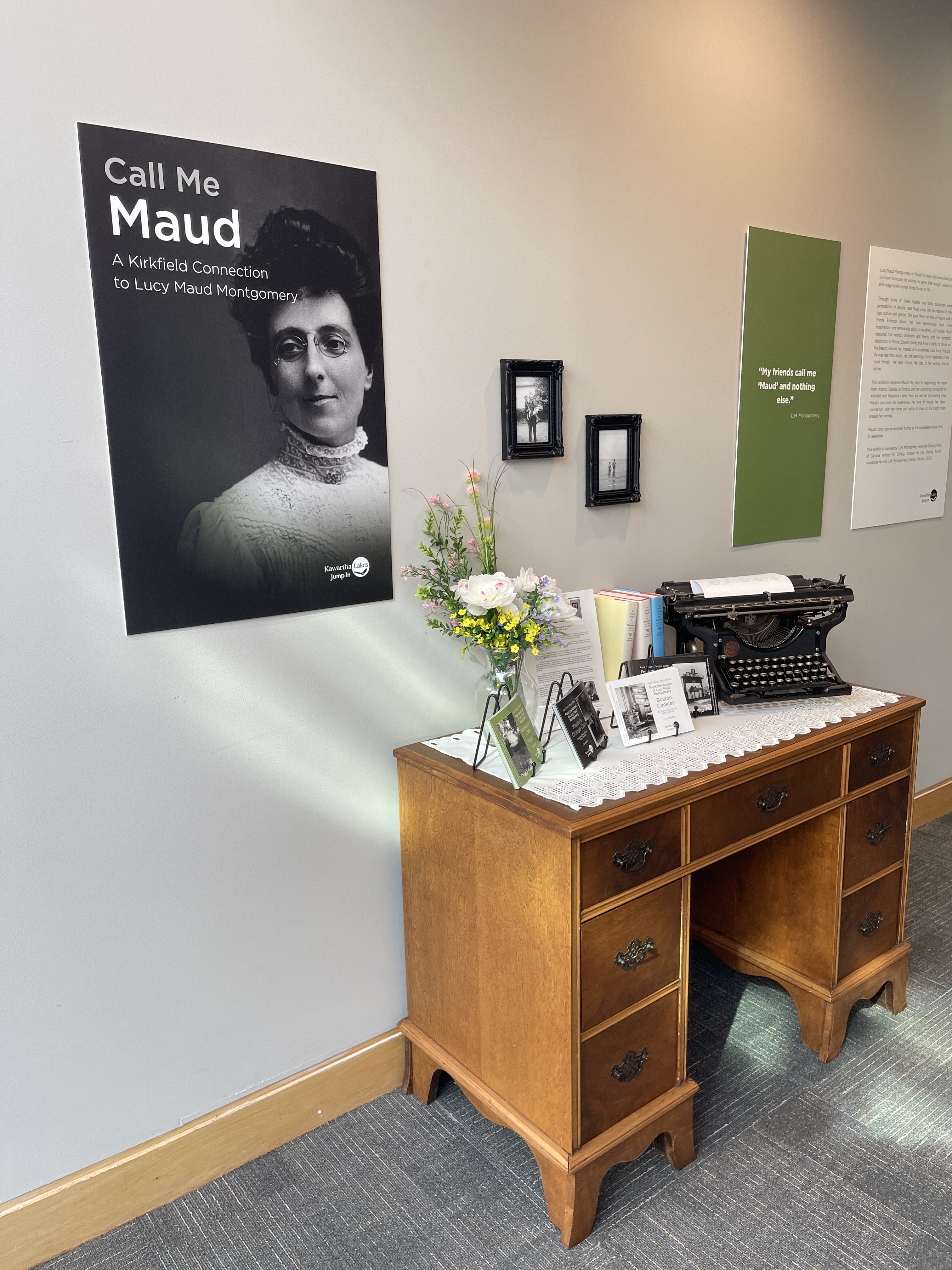
Discover the connection between Canadian literary icon, Lucy Maud Montgomery and Kawartha Lakes this summer. In commemoration of the 150th anniversary of the birth and lasting legacy of Lucy Maud Montgomery, Kawartha Lakes Economic Development – Curatorial Services proudly presents the ‘Call Me Maud’ exhibit. The exhibit is housed on the second floor of City…

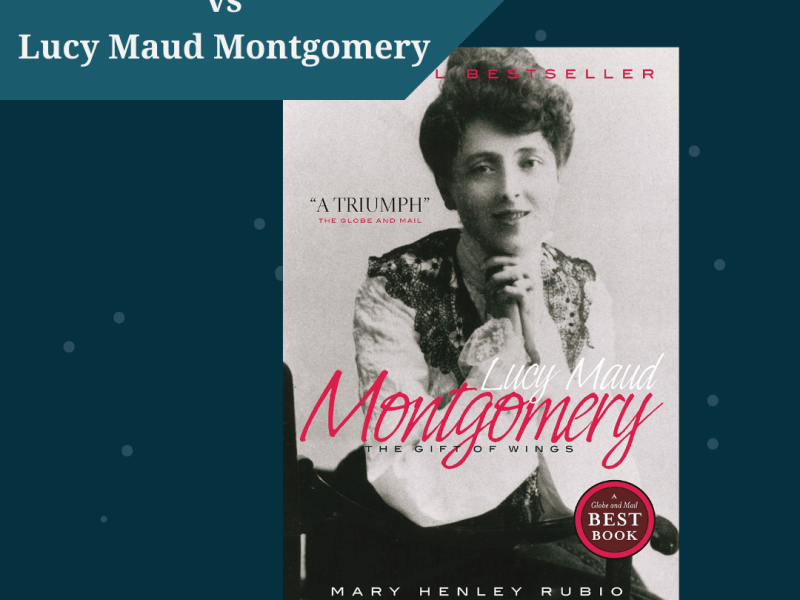
The Bobcaygeon Boys vs. L.M. Montgomery

In the 1920s in Bobcaygeon, there arose a constellation of writers, including some of Canada’s most decorated poets and influential newspaper editors. At the heart of this constellation was a group of men who cottaged together and were at the forefront of defining Canadian culture. And they seemed to have a hate on for Lucy…

Exhibition: Call Me Maud

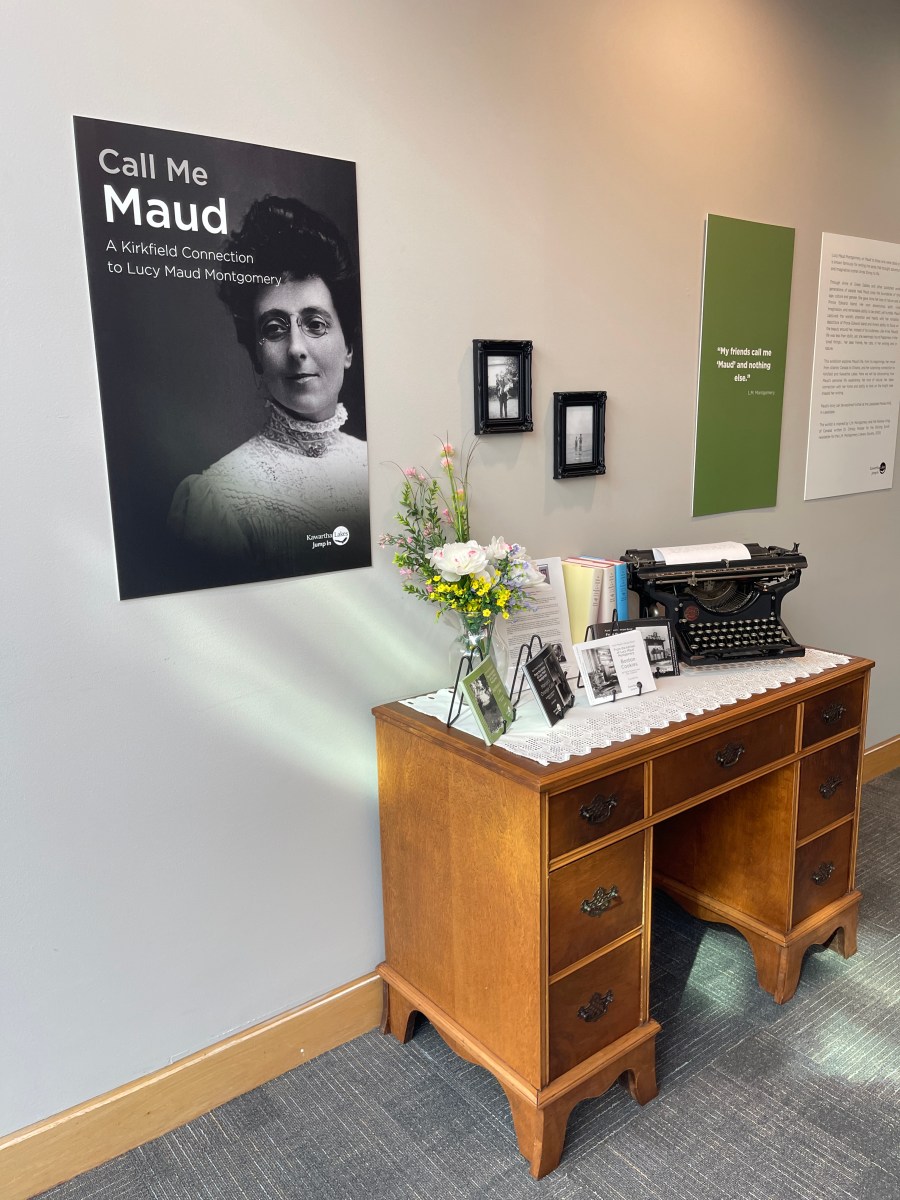
Discover the connection between Canadian literary icon, Lucy Maud Montgomery and Kawartha Lakes this summer. In commemoration of the 150th anniversary of the birth and lasting legacy of Lucy Maud Montgomery, Kawartha Lakes Economic Development – Curatorial Services proudly presents the ‘Call Me Maud’ exhibit.

The exhibit is housed on the second floor of City Hall located at 26 Francis Street in Lindsay starting July 23 and running through until November 29, 2024. Hours of operation are 8:30am to 4:30pm, Monday through Friday. Admission to the exhibit is free of charge.

You are invited to trace Montgomery’s remarkable journey from her early years in Atlantic Canada to her surprising connection to Kawartha Lakes. Discover the spirit of Montgomery’s life and literary contributions in this unique showcase, set to captivate audiences of all ages.

Famous for her writings and the impact they’ve had, particularly through her beloved character Anne of Green Gables and other published works, Montgomery’s influence goes beyond time, age, culture, and gender. The exhibition explores how Montgomery infused Anne with her love for nature and Prince Edward Island, her adventurous spirit, vivid imagination, and her remarkable ability to find beauty amidst life’s challenges.  Like Anne, Maud found happiness in the things that were dear to her: her cats, her writing, in nature, the dear people in her life that became her kindred spirits and in the places that she would visit.

The ‘Call Me Maud’ exhibit takes inspiration from Dr. Christy Woster’s article in the Shining Scroll newsletter of the L.M. Montgomery Literary Society from 2005, titled ‘L.M. Montgomery and the Railway King of Canada’. In her article, Woster expressed the excitement of experiencing places and rooms that Lucy Maud Montgomery once knew well. One such place was Kirkfield, Ontario, a lesser-known but visited destination by Maud.

RELATED POSTS:

Event: Call Me Maud

2024 marks the 150th anniversary of the birth and legacy of author Lucy Maud Montgomery. Canadians coast to coast will gather in various ways to celebrate and honour the beloved Canadian author. Kawartha Lakes Economic Development, with support from the Kirkfield and District Historical Society and Museum, invites you to join them on Sunday, August 18…

Keep reading

The Bobcaygeon Boys vs. L.M. Montgomery

In the 1920s in Bobcaygeon, there arose a constellation of writers, including some of Canada’s most decorated poets and influential newspaper editors. At the heart of this constellation was a group of men who cottaged together and were at the forefront of defining Canadian culture. And they seemed to have a hate on for Lucy…

Keep reading

Mary Milloy Harrington

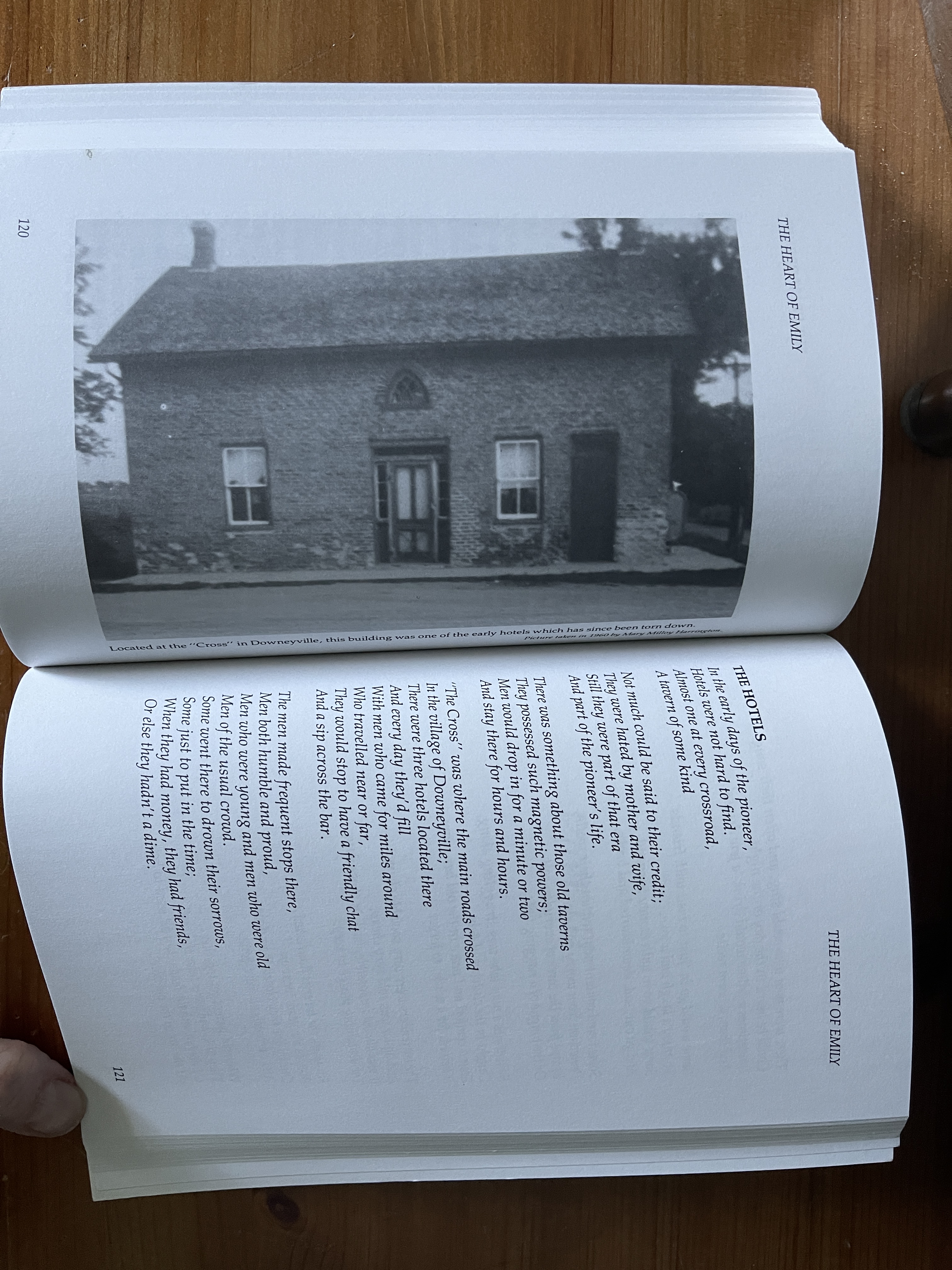
Mary Milloy Harrington (1903-1982) was a poet from Downeyville. Her works were collected in the volume, The Heart of Emily: a history of Downeyville in poetry 1825-1960, with the first edition published in 1986 and the second in June 2000 by Shamrock Publishers.

Technically, this book has a second author, Marie Titus. As stated on the copyright page, “This book was published posthumously by the author’s daughter, Marie Titus, in memory of her parents Mary Milloy Harrington and Leo Harrington.” Mary Milloy Harrington was born in Downeyville in 1903. She was a fourth generation descendent of Patrick Milloy, an Irish immigrant who settled in Downeyville.

Also, technically, this isn’t strictly a poetry book. Although there are about 35 lengthy poems contained in the 200 pages, the book also presents a lot of history of the Downeyville area. The author’s note is dated 1 December 1960, and the book may have been intended to be part of the area’s history publications for the country’s centennial. It’s a shame it wasn’t published at that time.

Mary Milloy Harrington says, “The Heart of Emily is a history of that part of Emily Township which makes up the Downeyville district, a history of St. Luke’s parish, and a story of the first pioneers who came from Ireland and settled in this new land.” Among her sources, she thanks, “Honorable Leslie M. Frost, Prime Minister of Ontario, for his assistance in giving the names of the original Grantees in the Downeyville district, and also Dr. Watson Kirkconnell, President of Acadia University, Wolfville, Nova Scotia, for his kindness in allowing me to use all information concerning Downeyville pioneers contained in his book Victoria County Centennial History.” She also thanks her neighbours for allowing use of their books, Crown deeds, and photos.

The local history comes alive through poems such as “The Great Fire” that tells the story of the summer of 1874 when “the earth was parched by the burning sun,/ The meadows seared and dry.” The lines describe a haze in the western sky, a fog that became billowing smoke; dark clouds riding on a strong wind; flames that crackled as they ate everything in their path; and the final tally of destruction.

There are also poems about “Grandma and her Quilting Bee” and other notable events. There are poems about individuals, such as “Judy” and “The Runaway.”

Although the book recounts much history of Downeyville, technically, part of the book is also fiction. As the author states, “Regarding Part III, the life of the O’Grady Family, all names used are fictitious.” This part of the book tells the story of an Irish family arriving in Canada and setting up life in Downeyville through a series of poems about characters Jack, Alice, and Father Tim.

Works:

The Heart of Emily (1986)

Tinker’s Plague in Janetville

Sci fi/fantasy author Stephen B. Pearl is from Hamilton, ON, but his novel, Tinker’s Plague, contains a brief mention of our own Janetville:

Dan tossed a piece of wood on the fire then leaned back and watched the stars appear overhead.

“Where did you grow up?”

“Little place called Janetville, just a few klicks outside the Otonabee province of Novo Gaia.”

“You’re not Novo Gaian?”

“Not hardly. A tinker recommended me for the basic skills training program. Spent two years learning me trade, and a few other things then they kitted me out and sent me to wander. Checked in once a year ’till I paid off me cart and loans. Haven’t been back since.”

Tinker’s Plague is a post-apocalypse story entwined with environmental/climate fiction and a dash of a plague outbreak. (You might think was written in 2020, but Tinker’s Plague was published in 2016.)

The story is set in southern Ontario, now known as Novo Gaia, in a world where the oil reserves were depleted, which caused society to collapse. A few places were able to keep modern technology, but everyone else has to rely on the Tinkers.

This story follows Brad Cooper on his route to Guelph when he finds himself at the epicentre of a plague outbreak.

Stephen B. Pearl’s writings focus heavily on the consequences of the worlds he crafts. In writing the Tinker series of books, he has, among other factors, drawn on his training as an Emergency Medical Care Assistant, a SCUBA diver, his long-standing interest in environmental technologies, and his first-hand knowledge of the Guelph area.

Tinker’s Plague (2016)

John Wyre

John Harvey Wyre was born and raised in Philadelphia, he passed away in Newfoundland, but for a while, he lived in Norland.

Wyre was a founding member of the production ensemble NEXUS, formed in 1971. He was a former timpanist of both the Toronto Symphony and Boston Symphony Orchestras. He organized and directed World Drum Festivals. The World Drum Festival of 1986 brought together 250 drummers for Vancouver’s Expo ’86, including tribal drummers from Africa and Indonesian gamelan orchestras. The event was documented in a film of the same name available from the National Film Board (NFB 113C-0187-117). The National Film Board also has a 1991 half-hour documentary on John Wyre called “Drawing On Sound”.  Barry Dove and the Percussive Arts Society’s World Music Committee produced a DVD tribute to John entitled “I’ll Be With You In Apple Blossoms” and is available from the NEXUS website. In 1999, he was inducted to the Percussive Arts Society’s Hall of Fame with the other members of NEXUS, and that same year, Wyre received a music touring grant in the amount of $50,000 from the Canada Council for the Arts.

“Every summer from the time I was six my family had retreated to a cabin in south central Ontario on the Trent River, where we fished, explored the wilderness, and simply found a solitude. I was seduced completely by the tranquility of living close to nature, so in the early 1970s I began looking for rural property and purchased some land in 1972, where I resided with my wife, Jean, until we moved to Newfoundland in 2002.” (Wyre. Touched by Sound: a dummer’s journey, page 49.)

The property was in the Norland area. He named the land Bellwood, and kept a recording studio, “Butternut Studios.” Under the Umbrella, an album by Jo Kondo, was recorded at Butternut Studios. The album notes “Under the Umbrella was recorded August 18, 1980, in the Norland, Ontario, Canada, geodesic-dome home of John Wyre. Each movement was recorded in one take, without edits. The recording was made using one microphone, Nexus having constructed a pentagonal rack, from each section of which hung each player’s five “almglocken”.”

Peggy Feltmate remembers “their unusual geodesic home; the mossy rock walls that John built meditatively, stone by stone; the meandering “dry ditch”, a dry streambed they had created and filled with smooth river stones that would create a rippling music in the spring runoff. In the trees hung lovely sounds: bells, of all sizes and shapes. And in the midst of the quiet, there was always laughter. During one evening visit, shortly after they had added a handsome house addition, there was much puzzlement – and laughter – as we discovered the new bathroom’s toilet was full of steaming hot water. It had been plumbed to the wrong water line! “It’s a challenge we must rise to,” nodded John in his best contemplative manner.”

About the unusual shape of the home, Wyre explains, “Influenced by the insights and technology of R. Buckminster Fuller and the sublime thoughts of Native North Americans– which I’d read about in T.C. McLuhan’s Touch the Earth, I decided that I wanted to live in a round, open space. So in 1972 I began a nest by building a four-phase geodesic dome, a hemisphere forty-feet in diameter. A third of the ground floor was for the kitchen, bathroom and a small study. Over these next three areas spread a sleeping loft. The rest of the space was for music.” (Wyre. Touched by Sound: a dummer’s journey, page 52.)

He hung “hundreds of bells from the curved arc of the hemisphere. They were suspended from long strings, and when set in motion the natural pendulum action would continue for quite some time. … Eventually the bells evolved into a nightly lullaby lasting from twenty to thirty minutes at bedtime as we drifted off into dreamland. It was wonderful to have an instrument that played itself into oblivion.” (Wyre. Touched by Sound: a dummer’s journey, page 53.)

The land itself provided Wyre with sources of sound. “Every spring four varieties of frogs join the orchestre de la pond, bringing to the band a passion, intensity, and decibel level that can only come from a force as old as the universe … I’ve played duets with woodpeckers on the cedar posts around the garden. The woodlands of my home have stretched me from the intimacy of the music of insects to the vastness of infinity for a ceiling.”

In 2002, Wyre retired from NEXUS and moved with his wife to Newfoundland. He recorded his memoirs and published them in Touched by Sound: a dummer’s journey. The book includes prose recordings of his recollections as well as his own poetry. He contracted cancer of the jaw and passed away in 2006.

Listen to some of John Wyre’s music on Spotify.

Books:

Touched by Sound: a drummer’s journey (2002) – available at SteveWeissmusic.com

Resources:

Obituary: https://www.legacy.com/ca/obituaries/theglobeandmail/name/john-wyre-obituary?id=41713590

In Memoriam: https://www.nexuspercussion.com/2006/12/in-memoriam-john-wyre-may-17-1941-october-31-2006/

Stewart Hoffman remembers John Wyre: https://www.nexuspercussion.com/2010/08/blog-bits-stewart-hoffman-remembers-john-wyre/

Vernon LeCraw

Photo: Coboconk, Norland & Area Chamber of Commerce

Francis Vernon Le Craw was born on December 21, 1921 in Buffalo, New York, while his mother was visiting there. His parents were Edwin Francis Le Craw (born 23 November 1876 Argyle, Ontario - 13 November 1943 Lindsay, Ontario) and Mary. In October 1953 he married Eleanor Currie in Norland, who was appointed librarian for the Norland branch in 1967. In November 1977, he married Phyllis Greig in Coboconk.

In 1944, Vernon LeCraw finished his last university exam and immediately enlisted for World War II as an engineer. His father passed away while Vernon was at training camp. He went overseas and returned to the Norland area in 1946, where he put his energy into serving his community. Among his accomplishments: the Coboconk cenotaph and the creation of Norland volunteer fire department. He worked as clerk for the united townships of Laxton, Digby and Longford, as a firefighter, and ran the community water works. He served on the Norland cemetery board, the horticulture society, and seniors groups.

For the country’s centennial, LeCraw recorded the history of the northern townships in the book, The Land Between. The research archive he amassed was donated to the Kawartha Lakes Public Library.

The Vernon LeCraw Historic Forest Reserve was named in his honour in 2010.

LeCraw passed away 21 September 2012 in Lindsay, Ontario at the age of 90. He was posthumously awarded the Governor General’s Fire Services Exemplary Service Medal in 2013.

Books:

The Land Between (1967)

Sources:

https://www.thepeterboroughexaminer.com/life/norland-loses-its-mayor/article_b2ac7348-853a-5b70-92c4-5c70912f8fcb.html

https://gardenontario.org/wp-content/uploads/2012AnnualReport.pdf

2023 in Review

Many thanks to everyone for stopping in and reading! Wishing you all the best for 2024!

Most popular post: Kawartha Lakes Writers Festival 2023

Top 5 articles:

  1. Ernest Thompson Seton and his father
  2. Ernest Thompson Seton and the kingbirds of Kawartha Lakes
  3. Nature Faker: the war of the naturalists
  4. The Bobcaygeon Boys vs L.M. Montgomery
  5. An Afternoon with Hollay Ghadery

Top 10 author pages:

  1. Ernest Thompson Seton
  2. Thomas Phillips Thompson
  3. Dorthe Comber
  4. William Arthur Deacon
  5. Claire Pratt
  6. Pearl Hart
  7. Flos Jewell Williams
  8. Russell Roy Merifield
  9. Dennis T. Patrick Sears
  10. Dorothy Lenore Thompson

Jasmine Fogwell

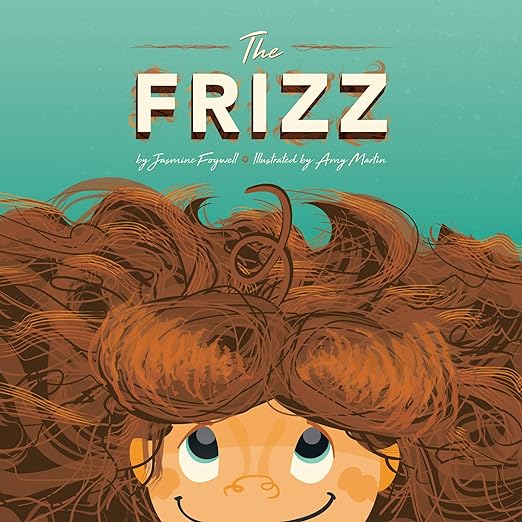
Jasmine Fogwell grew up in Norland, Ontario. The Frizz was inspired by her friend Jeannie who has very curly hair. Jasmine is also the author of the middle-grade fiction series, The Fidori Trilogy. She now lives in Edmonton, Alberta.

Author website: http://www.jasminefogwell.com/

Books:

An Unlikely Friendship (2016)

The Purple Flower (2016)

The Journey to the Top of the Trees (2016)

The Frizz (2018)

The Quest for the Golden Bracelet (2019)

The Glowing Ice (2022)

The Calling (2023)

Truest Reflections (2023)