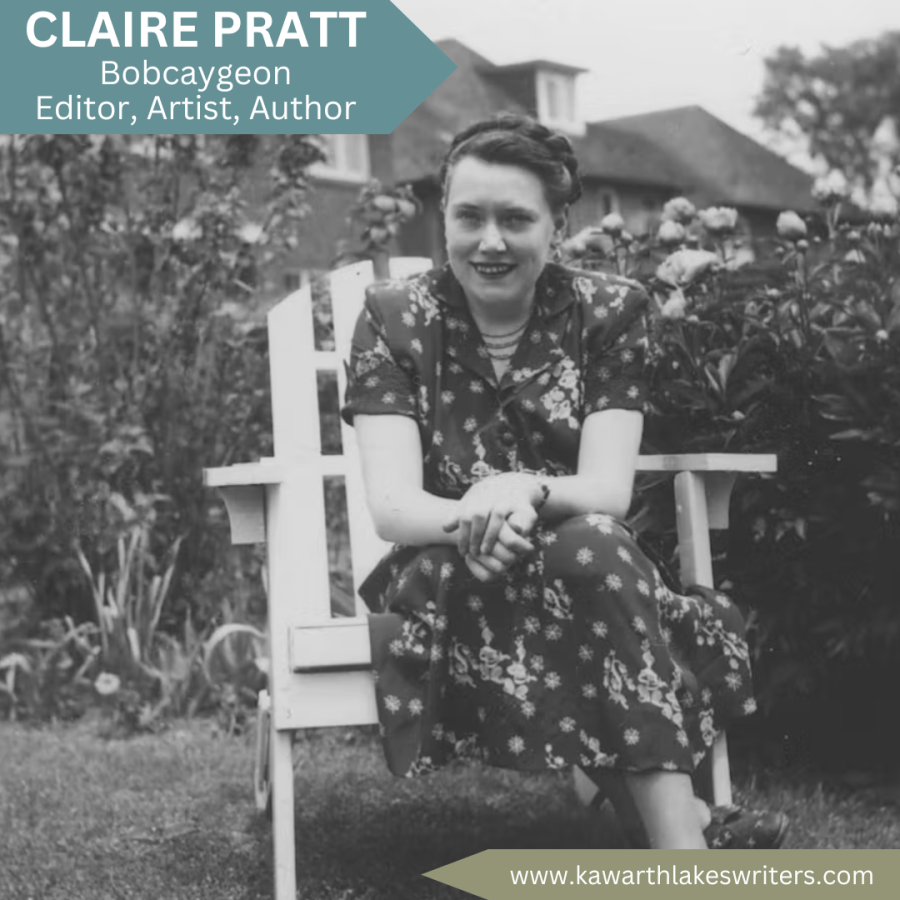
Born Mildred Claire Pratt (1921-1995), daughter of two writers/editors, E.J. Pratt and Viola Whitney Pratt, Claire became a “vanguard of mid-twentieth century Canadian publishing.”
At age four, Claire contracted polio in her right leg. For the next 11 years, she wore a leg brace and underwent operations to try to straighten it. When she was eight, one of these operations resulted in a staphylococcus infection and osteomyelitis. At the time, antibiotics were unheard of and she barely survived the winter. Within the year, the osteomyelitis travelled to her left arm and left hip. Numerous operations and infections followed, leaving Claire with a truncated hip.
By 1944, Claire had undergone over 40 operations.
From 1920 to 1936, Pratt’s parents kept a cottage in Bobcaygeon on Sturgeon Lake, where the family spent their summers.
After graduating from the University of Toronto, Pratt pursued graduate work at Columbia University. She returned to Toronto, where she, and Olive Smith, started the Claire Pratt Book Service. Their company was a “specialized book shipping and addressing service.”
As a child, Claire was around prominent writers, including those who she saw every summer when they returned to their cottages, the Bobcaygeon Boys (Arthur L. Phelps, Frederick Philip Grove, William Arthur Deacon) and many others.
Also among her parents’ friends were famous artists.
Frederick Varley, one of the founding members of the Group of Seven, was the artist for E.J. Pratt’s Newfoundland Verse (1923). When Varley and his family were evicted from their Toronto house, Pratt let Varley, his wife Maud and their four children camp in a tent on the lot next to the Pratt’s cottage.
Claire would have been two at the time, but when art became her pastime, this wasn’t her last encounter with Varley or other members of the Group of Seven.
The Pratts owned at least four pieces of Varley’s art. All now housed at the McMichael Gallery.
Claire Pratt, 1950. Box 46, file 8, MCP fonds, Special Collections, E.J. Pratt Library, Victoria University in the University of Toronto.
In 1952 Claire became an editor for Harvard University Press, but the need for further surgeries forced her to leave the position in 1954– the year she was forced to make the toughest decision of her life: to have the experimental spinal fusion surgery or die.
The surgery was performed in New York at the Hospital for Special Surgery, where John F. Kennedy was a patient in the next room, Jackie Kennedy walked the corridors, movie stars arrived for cosmetic surgery, and one of her surgeons had a stroke in the middle of her operation.
She spent two years in a body cast fighting pain, depression and despair. Turning to art for refuge.
Following her recovery, Claire joined McClelland and Stewart as an editor, where she took on major responsibilities. She travelled out of town to meet authors, and regularly worked through evenings and weekends to meet publishing deadlines.
Claire worked alongside Jack McClelland and Malcolm Ross for the development of the New Canadian Library. This line of paperbacks reissued the works of notable Canadian authors with introductions by contemporary notable authors. The series launched in 1958 and continues today.
The Bobcaygeon Boys were well represented. NCL printed many of the works of Frederick Philip Grove, the biography line included a volume on Claire’s father, E.J. Pratt. But not all of her father’s friends were so easy to work with. Claire “performed a near feat of magic when she managed to expand W.H. Drummond’s Habitant Poems to 110 pages. When editor Arthur J. Phelps stubbornly refused to include more than twenty-two judiciously selected poems, [Claire] Pratt devised to spread out the verse and pad the slender 1960 NCL edition with indexes.” (Toronto Trailblazers. page 117.)
Other notable writers that Claire worked closely with during her time at McClelland & Stewart: Leonard Cohen, Peter C. Newman, Margaret Laurence, and Irving Layton.
The following note Claire wrote to Margaret Laurence shows Claire’s editing style and handling of writers. As a result of this note, Claire won Laurence’s trust and Laurence sent her work-in-progress, The Stone Angel, which went on to launch Laurence’s career.
One of the best things that has happened to me in a long time is your manuscript of short stories. I wish there were some way in which I could put across to you you how really enthusiastic I feel about them, Margaret. Depth of compassion and insight, combined with stylistic beauty and the use of the word or phrase that is exactly right, make each of them a pure gem, a true union of the artist and the craftsman. In short they are marvellous.
Claire Pratt to Margaret Laurence, 20 February 1963, series Cae, box 12, file 7, M&S fonds, Mills Memorial Library, MU. (Toronto Trailblazers, Ruth Panofsky, 2019. p. 123.)
Layton’s work, under Claire’s editorialship, won the Governor General’s award in 1959.
In 1970, Claire received a Canada Council grant to support her genealogical research of her father’s ancestry. The result landed on Jack McClelland’s desk and the manuscript was published the following year as The Silent Ancestors: the forebears of E.J. Pratt.
Books:
The Silent Ancestors: the forebears of E.J. Pratt (1971)
Further Reading:
“Claire Pratt: Art and Adversity.” The Devil’s Artisan: A journal of the printing arts, issue 46. Robert C. Brandeis. (2000) (This article contains many examples of Claire’s art.)
Born on November 4, 1924, Hendrikus van Oudenaren (1924-2020) emigrated to Canada from the Netherlands in October 1950 after serving for two years in a forced labour camp in Stettin, where he worked as a tool and die maker and built boats. For 17 years Harry worked at Pogues Garage on Boyd Street, learning the auto-repair trade. He returned briefly to the Netherlands, long enough to get married, and came back to Canada. The family settled in Bobcaygeon where Harry set up an auto repair garage in an old schoolhouse, while establishing his home with his wife Johanna and six children across the street. For a while, his son Pieter ran the garage until he decided to take up cheesemaking.
The former Rokeby School at 35 North Street in Bobcaygeon. Image from Kawartha Settlers’ Village.
Google image captured May 2018.
Harry began to collect archival and historic information and images about Bobcaygeon. His family formed a friendship with another Bobcaygeon historian and author, Dorothe Comber. She and Harry shared information and upon her death, she left her collection to Harry.
The school that housed the garage business was the former Rokeby School, or Verulam School Section (S.S.) No. 6 at 35 North Street in Bobcaygeon. The northern section of Bobcaygeon was originally called Rokeby when it was first founded, but when it joined with the southern neighbouring areas to form a town, the name Rokeby was lost in favour of Bobcaygeon.
Harry also collected objects of historical interest, which can be found in the Harry van Oudenaren Museum at Kawartha Settlers’ Village, established in 2018. Harry’s son, Pieter, gives a tour of the museum on YouTube. When his collection became too great to stay in his basement, Harry had a building constructed and moved to the Village property.
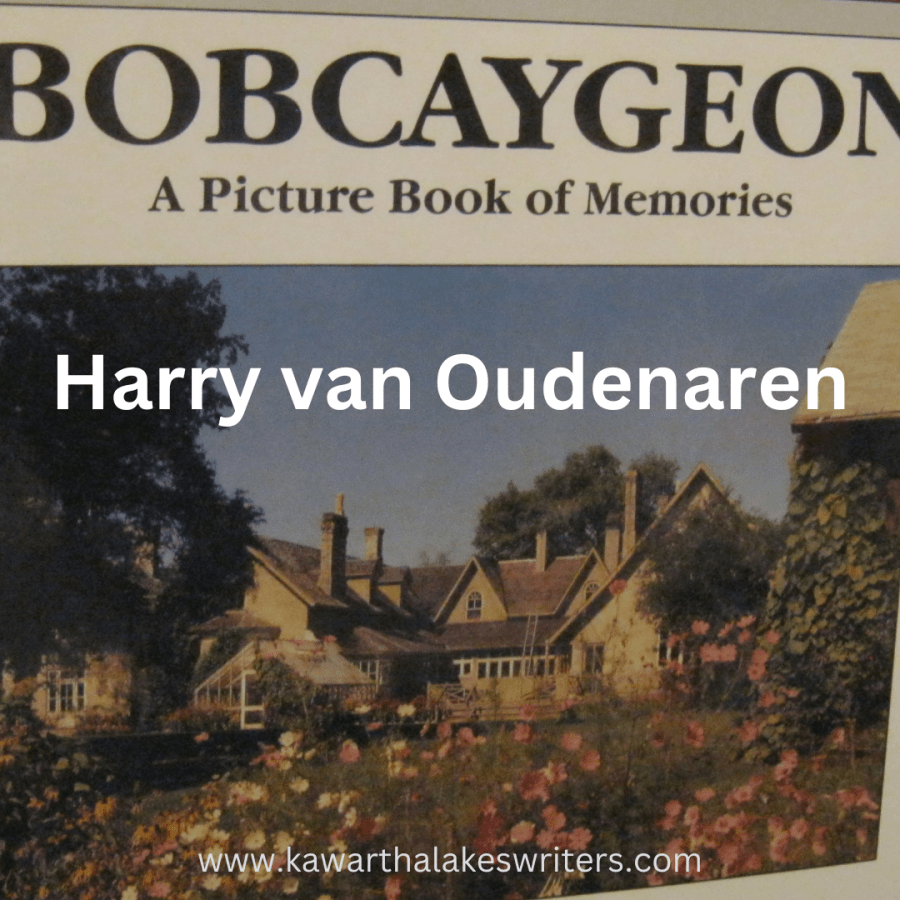
In 1992, Harry published some of his collection in a book, Bobcaygeon: a picture book of memories.
Harry passed away at his home in 2020 with his family by his side. His collection of items relating to the Boyd family went to the Boyd Museum and his items went to Kawartha Settlers’ Village.
In 2008, M. Eleanor McGrath published the book, A Story to be Told: personal reflections on the Irish immigration experience in Canada. The book collects the stories of Canadians who immigrated from Ireland. In the introduction, McGrath says, “Hours of taped interviews based on a standard questionnaire have become transcribed first-person accounts in this book. I have maintained true to the tone, speech patterns a nd individuality of the interviews.”
Several Kawartha Lakes residents were interviewed for the project and the stories of their immigration to Canada are included in the book, including that of local writer, Tom Crowe.
Russell Roy Merifield (1916-2005) is the author of From County Trust to National Trust (1988), a book that documents the history of the National Trust, which has roots in Kawartha Lakes (then known as Victoria County.)
Born in Chatham, Ontario, Merifield graduated from McGill University and served in the Royal Canadian Navy during World War Two. He practiced law in Montreal and became a senior officer at Shawinigan Water and Power Company. He was Vice-President and Secretary of the Royal Trust Company of Canada. In 1967, he moved to Toronto as Vice-President and General Manager of Victoria and Grey Trust Company until his retirement, at which time National Trust commissioned him to write From County Trust to National Trust.
Here’s a brief timeline from Victoria Loan and Savings Company to Scotiabank:
Victoria.
The Victoria Loan and Savings Company was founded in 1895, under local management and officially incorporated on September 4, 1897. It was located at 85-87 Kent Street West in Lindsay.
By Letters Patent of Ontario, dated November 11, 1898, the Company was relieved from restrictions which confined its operations to Victoria County.

By Special Act (Ontario), dated October 1, 1923, the Company was granted the powers of a trust company and the name was changed to The Victoria Trust and Savings Company.

By 1950, the Victoria Trust and Savings Company had branches in Lindsay, Belleville and Cannington.

Grey.

Around the same time, the Grey-Bruce area was establishing their own banks.

Incorporated on April 1, 1889, under the name of The Owen Sound Building and Savings Society.

On May 10, 1889 The Owen Sound, Grey and Bruce Loan and Savings Company was in-
corporated under the same Act by declaration filed with the Clerk of the Peace for the County
of Grey. The name was changed to The Grey and Bruce Loan Company by Order-in-Council
(Ontario) dated September 15, 1897.

By Special Act 16, George V, c. 123 dated May 1, 1926 the amalgamation of The Grey and
Bruce Loan Company and The Owen Sound Loan and Savings Company was confirmed under
the name of The Grey and Bruce Trust and Savings Company and empowered to carry on the
business of a trust company under The Loan and Trust Corporations Act.

By 1950, the Grey and Bruce Trust and Savings Company had branches in Owen Sound and Peterborough.

Victoria and Grey Trust Company.

By Order-in-Council dated November 9, 1950, the amalgamation of The Victoria Trust and
Savings Company and The Grey and Bruce Trust and Savings Company was confirmed under
the name of Victoria and Grey Trust Company and empowered to carry on the business of a trust
company under The Loan and Trust Corporations Act.

The head office of the Victoria and Grey Trust Company was located in Lindsay with branches in Belleville and Cannington.

By Order-in-Council, dated September 16, 1965, the Lieutenant Governor gave assent to an
agreement dated July 27, 1965, whereunder Victoria and Grey Trust Company and British Mortgage
and Trust Company agreed to amalgamate under the terms and subject to the conditions therein
set out, the amalgamated company to be called Victoria and Grey Trust Company.

This amalgamation brought 15 additional branches to Victoria and Grey Trust Company. The purchase of Lambton Trust Company in 1969 brought 6 more branches. The Company continued to grow, merging with more companies, opening more branches and expanding into Western Canada.

By 1982, the Company had 88 branches across 5 provinces.

National Trust.

In 1984, the Company merged with National Trust Company to form the National Victoria and Grey Trustco.

The name, National Victoria and Grey Trustco, was deemed too cumbersome, and was subsequently changed to the National Trust Company on June 03, 1985.

On August 14, 1997 Scotiabank purchased the National Trust Company.

Today, Scotiabank maintains a branch located on the same site as the very last Victoria and Grey/National Trust building in Lindsay.
The original Victoria Loan Building located at 85-87 Kent Street West, Lindsay. Image: Google, captured Nov 2022.The newly constructed Victoria and Grey Trust Company building in 1977 at 165 Kent Street West, Lindsay, the former site of Fee Motors. Image: digital archive of Kawartha Lakes Public Library. Scotiabank building at 165 Kent Street West, Lindsay with additional floor. Image: Google, captured Nov 2022.
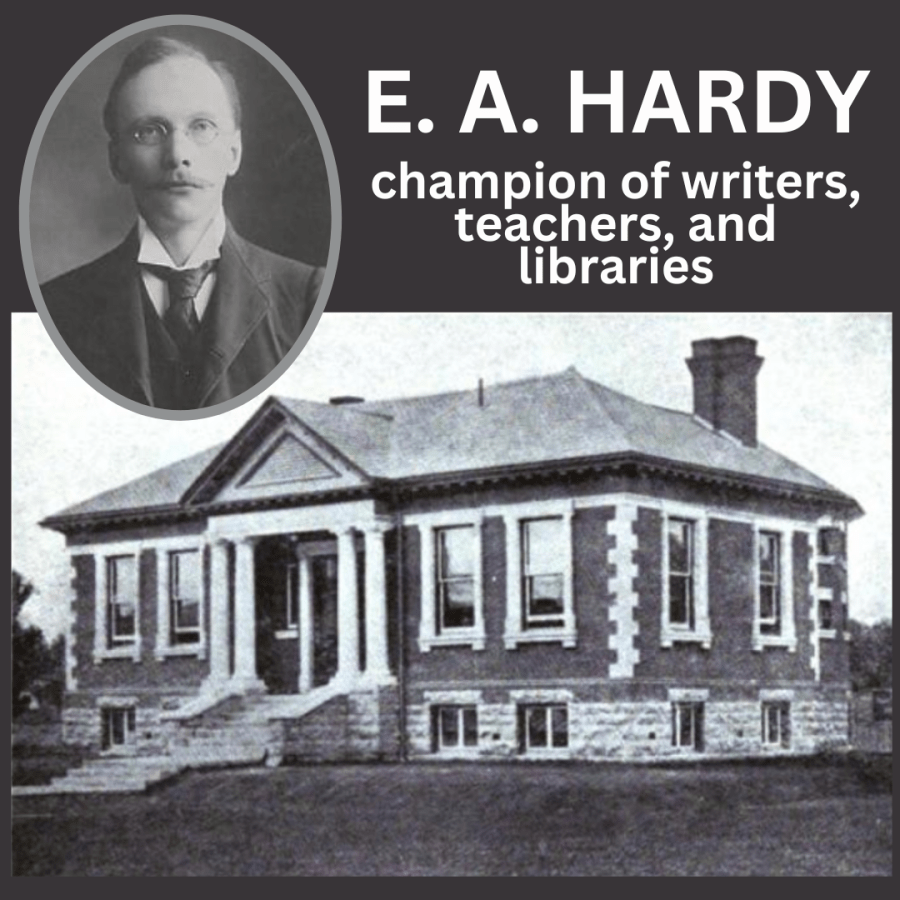
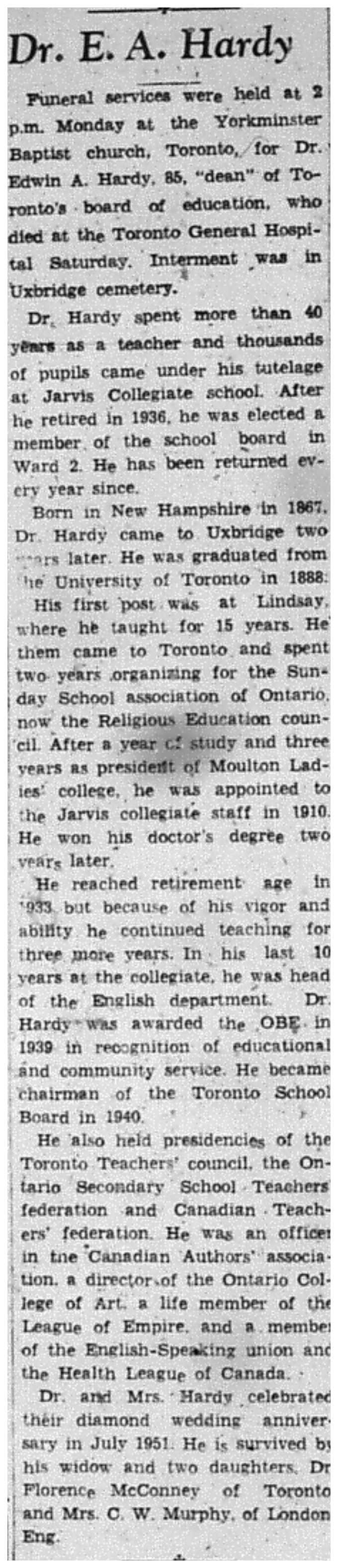
E.A. Hardy, detail from Twenty Club portrait, Kawartha Lakes Museum & Archive
E. A. Hardy (1868 – 1952) was an educator and secretary of both the Ontario Library Association and Canadian Authors Association. In 1935, for services to education in Canada, Hardy was awarded Officer Order of the British Empire.
Library
While he lived in Lindsay, he campaigned for the town to start a public library and pass the by-law that brought free library access to Lindsay. In 1898, Hardy’s letters to the Canadian Post pointed out that adding a library to a town was attractive to new citizens and “that many a family has passed by one town and gone to another on account of its schools or some other excellent feature.” He appealed to Lindsay’s sense of family:
It is a serious problem to train up a family, and our streets at night afford only too good evidence that the problem is not being solved in many a home. No doubt home is not as attractive in many cases as it might be, and a large supply of good books, free of access to all members of the family, would go far to make home decidedly more attractive. In more than one case, if a boy had his choice between the streets and a good book he would take the book.
Canadian Post, 1898
Hardy’s passion for public libraries and success with bringing a library to Lindsay became well known, inspiring other municipalities across Ontario. His championship has been written about extensively by Lorne Bruce in Free Books for All: the public library movement in Ontario 1850-1930 (1994) and in Hardy’s own book, The Public Library: its place in our education system (1912).
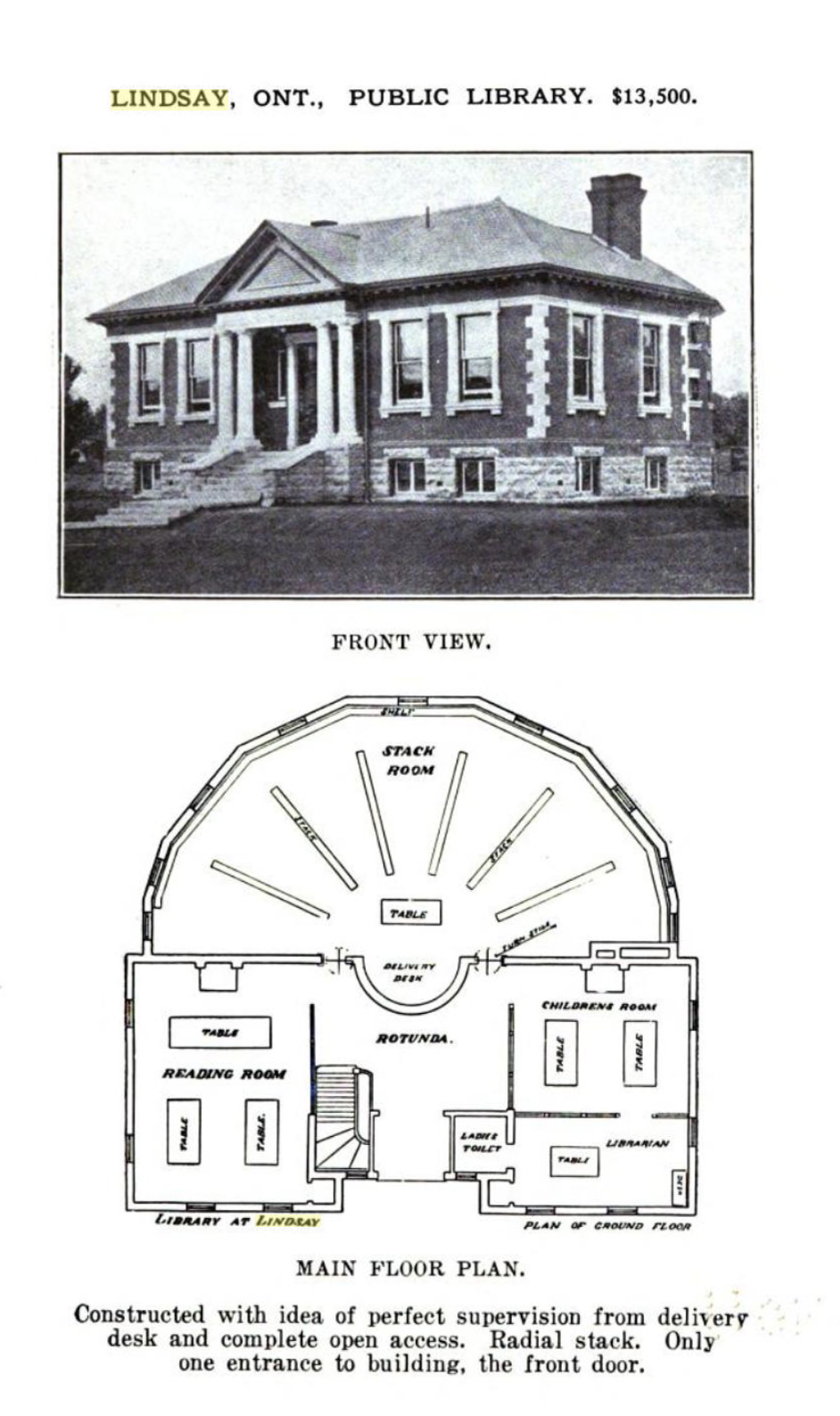
Hardy, The Public Library: its place in our education system (1912)
Although Hardy believed this to be ideal layout for a public library, James Bertram, who was personal secretary to Andrew Carnegie, did not. Bertram deemed the round rooms to be a waste of space. Lindsay’s half-circle design was one of the last with a rounded room and is one of the few such buildings still standing.
Hardy’s passion for libraries didn’t stop with Lindsay. Hardy is credited for the idea of what became the Ontario Library Association, a network of libraries across the province for the purpose of educating library workers. He served as president of the organization in 1925-26.
Poetry
Hardy’s work for the creation of Selections from the Canadian Poets (1909) is held at the Thomas Fisher Rare Library at the University of Toronto, including correspondence with Lucy Maud Montgomery:
The [Thomas Fisher Rare Library] holds a wonderful Montgomery letter within the Edwin Austin Hardy Papers. Hardy was an Ontario teacher and school administrator, and secretary of the Canadian Authors’Association. His collection consists primarily of correspondence pertaining to an anthology of Canadian poetry he was editing – Selections from the Canadian Poets, published in 1906 – and his secretarial duties for the Association. In what appears to be a response to a letter Hardy wrote to Montgomery – most likely after the publication of Anne of Avonlea (1909), given Montgomery’s letter is dated late September 1909 – she writes that a novel of ‘Anne the College girl’ will most likely never materialize. For one, Montgomery claims she does not have the ‘sufficient experience of college life’ to write about it. More to the point, she also writes that ‘after thinking and writingAnne for over three years I’m actually sick of her.’
“Strength in Numbers: the CanLit community” by Natalya Rattan and John Shoesmith, 2020
Of course Montgomery did go on to write more about Anne, but it’s worth noting that she felt what many writers feel, especially those who write long series, and it’s interesting that she confessed this feeling to Hardy.
In 1935, the Montreal branch of the Canadian Authors Association had been running a successful annual poetry contest. They appointed a committee to see if publishing a periodical would be financially feasible. Disappointed by the results, they decided to not go through with the project. Hardy heard about this and urged the national executive to take on the project as a means of doing something for the entire membership. They agreed and the first issue of Canadian Poetry magazine was published in 1936. Bobcaygeon cottager, E. J. Pratt was appointed editor. The magazine continued to be published until 1968 when it merged with Canadian Author and Bookman. (“A Union of the Inkpot: the Canadian Authors Association, 1921-1960” by Christopher M. Doody, 2016)
Biography
The following is from the book Hardy and Hardie: past and present (1887), in which Claude H. Hardy recorded the history of the extended family and gives a thorough biography of E.A. Hardy:
Edwin Austin, b. at Laconia, N. PI., 30 Aug. 1867 ; m. 6 Jul. 1891, Annie Florence Everett.
Hardy was a small boy of three years when he moved with his parents to Guelph, Ont., Canada, where he started on his educational career as a youngster at school. From the very first day of attendance upon instruction it was apparent that this lad would make a name for himself educationally, for books and everything literary appealed to him. But he was destined to be more than a scholar. His love of people and his genius for leadership and organization have made him a “man among men” and one of Canada’s leading educators.
For sixteen years he was English Master at the Lindsay Collegiate Institute at Lindsay, Ont. Since 1910 he has been on the faculty of the Jarvis Collegiate Institute at Toronto, and is Head of the Department of English. Although he has given more than forty years of his life to educational work, and has earned retirement from active service, he is looked upon by his associates as one of the most vigorous and dynamic personalities of the profession today. He has been honored on many occasions, as will be seen in a summary of his career below. He recently retired as editor of The Bulletin, the official publication of the Ontario Secondary School Teachers’ Federation, and the following tribute was paid to him in the February, 1935, issue :
After eight years as editor of the Bulletin , Dr. Hardy retired. At the December Meeting of the Federation he was unanimously and enthusiastically made Honorary Life Member on the Executive. No honor was ever more deserved. No man in Ontario has done more during the past forty years to raise the status of the teacher with the public and to give teachers increased respect for their own profession. He was one of the first to obtain the doctor’s degree in Pedagogy. He was one of the first to realize the value of organized co-operative effort. He was one of the founders of the Toronto Teachers’ Council of our own Federation and of the Canadian Teachers’ Federation. Of each of these organizations he became president. He has become known far beyond our own Dominion and since 1927 has been Treasurer of the World Federation of Education Associations. In every province and in many countries he has represented the teachers of Ontario with a dignity and a charm that reflected most favorably on his own province. At all times he has wisely advocated the closest co-operation between teachers and trustees and the Department of Education. The Fireside Conference of last winter was a unique and successful demonstration of his resourcefulness in this direction.
His wide interests have indirectly helped the profession, no less effectively perhaps, than his more direct activities. He has been Secretary and President of the Ontario Library Association, National Secretary of the Canadian Authors’ Association, and President of the Toronto Branch of that association, President of the Ontario Sunday School Association, and Chairman of the Council of the Ontario College of Art. A few days ago Yorkminster Baptist Church where he has been active as associate S. S. Superintendent for more than 25 years elected him a life deacon.
In all his work his method has been “suaviter in modo, fortiter in re.” His courtesy in debate has not diminished his resolution in the advocacy of policies he approves. He has done much in the past but he always presses on towards a higher mark. For the profession he has a fair vision which it would be well for us all to capture : a Headquarters Building, a professional library, a Travel Bureau, a monthly Bulletin, higher qualifications for secondary teachers, a full-time secretary for our federation. How he has survived his many duties is a source of wonder to those who know best what hard work some of these duties involve. May he long continue to give inspiration to his fellow teachers. May the new editors catch something of his fine spirit.
Dr. Hardy, in addition to his keen interest and active participation in educational and religious affairs, has found time to become actively engaged in other worthwhile pursuits. He is an author and literary critic. He has written several articles for magazines and periodicals in Canada, Great Britain and the United States. He is editor of Selections from Wordsworth and Tennyson. For ten years he was educational editor of the Toronto Globe. He is a member of the Incorporated Society of Authors, Playwrights and Composers of Great Britain. He is a member of the Arts and Letters Club of Toronto, vice-president of the Ontario Branch of the English-Speaking Union, vice-president of the Canadian Branch of the League of the Empire, vice-president of the Community Welfare Council of Ontario, member of the Magna Carta Association, member of the I. O. O. F., and vice-president of the Hardy Family Association.
Mrs. Hardy graduated from Moulton’s Ladies’ College at Toronto, and before marriage was a teacher. She has been actively engaged in Girl Guide work, in women’s work of various kinds, social and political, and is devoted to gardening.
Children, born at Lindsay, Ontario : i. Florence Spaulding, b. 20 Sept. 1894. She attended the University of Toronto, and graduated in arts and medicine. In 1917 she married Mr. Garnet E. McConney, a member of a family resident in the Barbados for centuries, and of Scottish descent. Dr. McConney practices medicine, and is on the staff of the Women’s College Hospital at Toronto. She is actively engaged in educational and religious work. Children : Allan Mary Robert Theila. ii. Dorothy Stanton, b. 26 Dec. 1898. She is a graduate in arts from the University of Toronto and from Oxford University, London, Somerville, College. In 1924 she married Clarence Walford Murphy, Flight Lieut., R. N., and resides in Putney, London, England.
Hardy’s impact on education in Lindsay was so profound that after Hardy left Lindsay parents sent their girls to the Moulton Ladies College.
Hardy was one of the founders of the Twenty Club, an exclusive organization in Lindsay consisting of only twenty members at a time, each of whom would take turns researching, writing and presenting an educational article. The Twenty Club was established in 1892 and remains active today.
From the Cambridge Street Baptist Church history:
In 1904 Mr. E. A. Hardy severed his connection with the Lindsay Collegiate (and the Lindsay Baptist Church), to become the Principal of Moulton College for girls. Such was his reputation in Lindsay – relates Mrs. Fred Bruce – that her mother, a staunch Methodist, sent her to Moulton, the Baptist School, because the well-known Mr. Hardy was principal. He shortly left there and became eminent in collegiate circles in Toronto. For his great educational services, he was awarded the O.B.E. in the Queen’s Honour List.
Dr. Hardy returned to Lindsay as speaker for the 50th Anniversary of the Twenty Club, which he had founded. As a former Deacon and Sunday School superintendent here, he spoke on the 75th Church Anniversary to combined Morning Congregation and Sunday School.
Ernest Thompson Seton (1860-1946), author, wildlife artist, founder of the Woodcraft Indians (later renamed the Woodcraft League of America) and one of the founding pioneers of the Boy Scouts of America, spent only a few years in Kawartha Lakes, but his pioneer experiences here defined his career path and the man he became. In his own words, “As I look back on the experiences of that place, I rate them among the very best of my life-training.”
Seton won several awards for his books and contributions to the science community and Scouting movement. In fact, Seton is much better known outside of Kawartha Lakes, despite this being the location that inspired him most:
Japanese creators have turned Seton’s books into anime and manga, and some of these productions have been dubbed with other languages and shown around the world. The Philmont Scout Ranch in Santa Fe is home to the Seton Memorial Library and Museum. The Seton Legacy Project organized an exhibition at the New Mexico History Museum. Greenwich, Conneticut is home to the Ernest Thompson Seton Scout Reservation. In Toronto, there’s the E.T. Seton Park and plaque on the family home at 6 Aberdeen Avenue. Carberry, Manitoba has dedicated an entire museum, art gallery and gift shop to honour the time Seton spent there.
In her book, Survival: a thematic guide to Canadian literature (1972), Margaret Atwood poses the question, “What have been the central preoccupations of our poetry and fiction?” Her answer is “survival and victims” and in her pursuit for an answer, she identifies a distinct genre of stories: “the “realistic” animal story, as invented and developed by Ernest Thompson Seton and Sir Charles G. D. Roberts, is not, as Alec Lucas would have it in A Literary History of Canada, “a rather isolated and minor kind of literature,” but a genre which provides a key to an important facet of the Canadian psyche. Those looking for something “distinctively Canadian” in literature might well start right here.” Atwood then goes on to list numerous authors following in this genre, including Farley Mowat. Characteristics of the genre include the theme of survival, animals as victims, and tragic endings. Characteristics that mirror Seton’s life.
Seton was a pioneer on the lands of Kawartha Lakes and his time here propelled him into a pioneer of Canadian literature.
“The fact that these stories are true is the reason why all are tragic. The life of a wild animal always has a tragic end.”
Seton, Wild Animals I Have Known (1898)
Arrival in Kawartha Lakes
Born Ernest Evan Thompson in 1860 at Number 6 Wellington Terrace in South Shields, England to Joseph and Alice Thompson, Seton was one of twelve boys. At the time of Seton’s birth, Joseph was a wealthy shipowner, but after financial loss, Joseph decided to take the family to Canada in 1866 to set up life as a gentleman farmer on a large tract of land.
July and August of 1866 we spent in Lindsay town. I can visualize it now—wooden sidewalks, huge pine-stumps everywhere with vigorous young cedars growing about their roots; barefooted, bare-headed boys and girls scoffing at our un-Canadian accent. Apple-trees laden with fruit to which we soon learned to help ourselves; tall rank weeds, with swarms of grasshoppers everywhere; the coffee-coloured river with its screaming roaring, sawmills; cows and pigs on the main street; great, hulking, heaving oxen drawing loads of hay, with heavy breathings that were wonderfully meadow-like and fragrant; and over and above all, in memory as in place, the far-pervading, sweet, sanctifying smell of new-cut boards of pine.
Father came prepared for the life of an English country gentleman. He proposed to take a huge tract of virgin forest, with a lake in it, build a castle on the lake, and live the life; so brought his library, his scientific instruments and a dozen different sporting guns.
We had come to live, at least in part, the lives of hunters. I think Mayne Reid and Swiss Family Robinson were the principal guide-books that my father had consulted, but Robinson Crusoe was not overlooked.
Yet we were doomed to continual disappointment; the hunter-dream faded slowly but surely.
Mother’s instinct was to go slow, to try it first in a little place, to make sure that this was what we wished to do. Mother’s views had no weight whatever, but the opinions and advice of sundry businessmen in Lindsay had. So we bought a partly cleared hundred-acre farm on Stony Creek, only three or four miles east of the town, but in the virgin woods.
The whole family went to see it and had a picnic. Down in the glorious woods by the creek, in a superb “beaver meadow,” surrounded by tall elms making Gothic aisles around us, we lighted our camp-fire, the first of my life.
Trail of an Artist-Naturalist: The Autobiography of Ernest Thompson Seton (1940)
Sketch by Seton’s brother, John Enoch Thompson, sent to G.W. Beall in 1925, depicting “The Elms” farm in Ops township as it was in 1866. Image is from the Beall Scrapbook, courtesy of Kawartha Lakes Museum & Archives, digitized by Kawartha Lakes Public Library. The date “1857” is carved in the log above the door.
We moved out to our backwoods farm that September. It had a small house—the usual pioneer log shanty—and a few ramshackle outbuildings, the handiwork of Bill McKenna, who had first staked the claim.
The house was very small for us, very badly prepared for winter, and swarming with rats.
Trail of an Artist-Naturalist: The Autobiography of Ernest Thompson Seton (1940)
Fortunately, the Thompsons didn’t have to suffer living in the log cabin for too long.
Mother had been used to an ample house and a staff of competent servants. Now she and my cousin Polly were doing all the housework, as well as milking some of the cows; and the whole of us roughing it in one log shanty, composed of a big living-room, with a little box-room for Father and Mother in a corner, one for my cousin in another; and the rest of us in hammocks, or upstairs in a big loft through which the wind and weather romped as out of doors, and snow drifted across our bed-clothes.
Father had planned to build a convenient house with part of his remaining capital. “It must be roomy; is it not to be our home for life?” was the oft-repeated phrase.
The new house, a plain, substantial, two-story, eleven-room brick barn, forty by sixty feet, was begun in August, 1866, and finished in January, 1867, for the amazing sum of a thousand dollars. Yes, that was how we reckoned in those days. Seventy-five dollars per room, for a plain-built house. But labourers worked from 7 A.M. till 6 P.M., and got seventy-five cents; skilled labour, a dollar and twenty-five cents for a ten-hour day. Butter was ten cents a pound; eggs, six to eight cents a dozen; pork, four cents, and the best beef, eight to ten cents a pound. Board and lodging was a dollar and fifty cents a week. A good hired man got ten dollars a month and his keep; he worked from dawn until after dark—and was happy. We have changed things now, and have not improved them much, except in shortening the hours.
We moved into this brick barn in January, 1867. Every stick and brick in its building is bright in my memory. Every smell of lime, lumber, or dank, chill room is strong in my consciousness today.
Trail of an Artist-Naturalist: The Autobiography of Ernest Thompson Seton (1940)
Seton’s sketch of “The Elms” house and log cabin. Part of the Seton Museum’s collection.
Where in Kawartha Lakes was this place that so heavily influenced Seton?
In his autobiography he mentions the property was on Stony Creek and originally Bill McKenna “had first staked the claim.”
A search through the land records for Ops township revealed the Thompsons were on the west half of lot 15 on concession 10, right about the south-west corner of Tracey’s Hill and Settlers Roads. Seton also says his father sold the land to William Blackwell in 1870, when Joseph Thompson decided farming wasn’t profitable and moved the family to Toronto where he worked as an accountant.
Land records of Victoria County, 1822-1954
The original land patent went to Samuel McConnell in 1837, and after passing through a number of transactions, ended up in the hands of Patrick McKenna by 1865. The “1857” carved above the cabin door had to have been made during McConnell’s, Proudfoot’s or Keenan’s time on the property because McKenna didn’t have the property until 1859.
The land records also shows the $1000 mortgage used to construct the brick house (mentioned in Seton’s autobiography, excerpted above) and that Joseph Thompson did have trouble making the farm financially viable.
The following table is a transcription of the above page from the land records.
No. of INSTRUMENT
NATURE of INSTRUMENT
ITS DATE
DATE OF REGISTRY, HOUR
DATE OF REGISTRY, DAY
GRANTOR
GRANTEE
CONSIDERATION
LAND___ AND REMARKS
Patent
10 April 1837
The Crown
Samuel McConnell
W1/2 100 acres
136
Deed
12 Dec 1856
11
16 Dec 1856
William Proudfoot etux
Thomas Keenan
sells whol lot 200 acres
808
Deed
24 April 1857
11
18 Sept 1857
Samuel McConnell by his atty Jas. Henderson
William Proudfoot
sells whol lot 200 acres (see power of atty attached)
1822
B & I
4 Feb 1859
10.15
5 Feb 1859
Thomas Keenan etux
Patrick McKenna
sells W1/2 100 acres
1840
mortgage
4 Feb 1859
10
9 Feb 1859
Patrick McKenna etux
Henry K. Meredith
mortgage W1/2 100 acres
1840
Dis Mort
22 May 1860
Henry K. Meredith
Patrick McKenna
Dis of nesN above Mort
2940
Mortgage
10 May 1860
11
14 May 1860
Patrick McKenna etux
Trust & Loan Company
$800+
Mortgages W1/2 100 acres
7102
B & I
13 April 1864
2
13 April 1864
Patrick McKenna etux
Francis McKenna
N1/2 of W1/2 50 acres
7103
B & S
13 April 1864
2.15
13 April 1864
Patrick McKenna etux
Patrick McKenna
S1/2 of W1/2 50 acres
7740
Lis Pendens
9 Jan 1865
2
9 Jan 1865
Peter Murtha vs
Patrick McKenna
W1/2 100 acres
9853
Mortgage
8 Sept 1866
2
15 Sept 1866
Joseph Logan Thompson + wife
Trust & Loan Company
$1000
W1/2 100 acres
12520
B & S
10 Aug 1866
12
4 May 1868
Trust and Loan Company
Joseph Thompson
W1/2 100 acres Under power of sale
13560
B & S
26 Aug 1868
10
26 Jan 1869
Joseph Logan Thompson + w
George Molyneaux Roche
$3443
W1/2 100 acres Subject & Mortgage
13561
B & S
26 Aug 1868
10.5
26 Jan 1869
George Molyneaux Roche
Alice Thompson wife of J L Thompson
$3443
W1/2 100 acres Subject & Mortgage
156
B & S
30 Mar 1870
2.30
30 Mar 1870
Joseph L Thompson + Alice his wife
William Blackwell
$3000
W1/2
157
Mortgage
30 Mar 1870
2.35
30 Mar 1870
William Blackwell etux
Alice Thompson
$1600
W1/2
174
Dis Mort
7 April 1870
2.30
14 Apr 1870
Trust & Loan Company
Joseph Logan Thompson
Discharge of 9853
710
Assignt
15 May 1872
11.10
25 May 1872
Alice & Joseph L Thompson
John Paterson
W1/2 Assignt of 157
766
Dis Mort
10 Oct 1872
12.45
10 Oct 1872
John Paterson
William Blackwell
W1/2 Dis of 157
After the Blackwells the property went to the Callaghan family, who had the adjoining property to the south and according to a farm sign, the property remains in the hands of the Callaghan family today. (Note: this is the same Callaghan family for which Jack Callaghan Public School is named.)
Note the above table includes the Latin words and abbreviations used in the original document. “etux” is Latin meaning “and wife”; “Lis Pendens” is Latin meaning “pending lawsuit”; “B & I” is likely “Bank & Insurance”; “B & S” is abbreviated from “Bargain & Sale”; “Dis Mort” is abbreviated from “Discharge of Mortgage”; “atty” is abbreviated from “attorney”; “whol” is abbreviated from “whole”; and “assignt” is “assignment.” As for “Dis of nesN,” the first part is “Discharge of” but the last part is a mystery.
Moving to Toronto but returning to Kawartha Lakes
For four years I had seen only the big woods all about me. To the eastward the forest was solid and unbroken. It was inconceivable that there should be anything beyond that. My childish fancy made that the end—the rim of things. I knew there was nothing that way, no clearing, nothing but woods and woods and woods.
Then came the great change. We were not very successful as farmers. The work was far too hard; my big brothers had quit, one by one.
Mother told me we were going to Toronto to live. At my side of the schoolhouse wall hung the map of Europe, and on the lower part I made out “Otranto.” This I proudly pointed out as the new home we were headed for. Father, now nearly fifty years of age, was quite unfitted for farm life, but he was an expert accountant of modern training, and expected to get a position as such in our new home city.
On April 12, 1870, we said good-bye to the woods. The rough little cordwood railway train left Lindsay for Port Hope, forty long miles away; and with incredible speed, in half a day landed us there at noon. We stopped at a small hotel on the hill for midday meal. I stepped out on the back porch and got a marvellous thrill, for there was a great, wonderful mountain—not high, but enormously long and gloriously blue.
As I wondered about its name, and fitted it into the fairy tales of my woods life, I noticed beautiful white gulls flying about, and then a sail-boat crossing it; and slowly it dawned on me that this was no mountain —it was Lake Ontario. I was seeing it from a high hill, which, to my untrained eye, made it seem high. It was wonderful, beautiful, but puzzling. This was one of those moments of supreme joy, fraught with the happy sense that fairies are real, after all.
Trail of an Artist-Naturalist: The Autobiography of Ernest Thompson Seton (1940)
Although, his older brothers found work and his father did well as an accountant in Toronto, Seton longed to return to nature. He found refuge in the wilds of the Don Valley, but it wasn’t enough. The family moved around Toronto, resulting in Seton needing to change schools, and he encountered bullies at every turn.
In 1875 we were living at 17 South Pembroke Street. I had been three years in Toronto, becoming more and more immersed in school studies, and very plainly showed a run-down condition at the end of the term in July.
When we had left Lindsay our farm had been bought by a highly respectable family named Blackwell. William Blackwell was a son of the pioneer of the region—Blackwell’s Settlement it was originally. His wife came of a good local family. While persons above the common run of farmers, they were eminently practical, industrious folk; and were making a success of life on the farm that we had failed on.
Acting on the doctor’s orders, Mother wrote to these people, and asked if “Ernest might visit them for a month this summer”; for she realized that food doesn’t count on a farm which produces everything; and, in this case, housed in the big house built by my father, there was plenty of room.
A cordial letter from Mrs. Blackwell resulted in my landing in Lindsay the next week. At the station I was met by George Blackwell, the son. He was three years older than myself, a picture of rugged health. He took me home in the democrat, out to the old farm, where I was kindly greeted by the big, bluff, hearty Mr. Blackwell and his gentle, motherly wife.
It was after sundown when we arrived. I was sad and silent. I took little interest in the supper. It was the first time I had been away from home and Mother. I subsided into myself, felt an overwhelm of hopeless gloom and heartsickness.
The motherly eye of Mrs. Blackwell made a quick and accurate appraisal of my condition. “He’s homesick,” she whispered to her husband. She called me, led me upstairs and helped me to bed; then tucked me in, kissed my tear-wet cheek, and left me.
How it came, about, I know not; but in the morning that black horrific cloud had rolled away. My life and interest in life were renewed, so that at once I took my place in the little world that hummed around me.
Three girls and three boys there were, all near my age; besides a hired man, a hired girl, and the father and mother of the family.
Then a new epoch was opened for me. Fresh food, fresh air, fresh life in abundance; plenty to do in the way of chores, but plenty of time for fun. The activities, exploits, and adventures of that time I have set down so fully in the Two Little Savages that it seems unnecessary to repeat them here.
Trail of an Artist-Naturalist: The Autobiography of Ernest Thompson Seton (1940)
Blackwell’s Settlement School (SS No 10 Salem School)
Seton returned to stay with the Blackwells for several summers, becoming friends with their son, Sam, and wishing William Blackwell was his father. (Note: architect William Blackwell, who designed the Academy Theatre in Lindsay, is not this William Blackwell, but is related to this family.)
Seton even had a hand in influencing the construction of a new school nearby.
A curious friendship sprang up between us. He seemed profoundly impressed by my scholarship; which, translated into terms of local life, made clear the fact that, being in the upper form at college, I was entitled to a second-class teacher’s certificate, but must wait till I was sixteen before I could avail myself of it.
He, as school trustee, had to hire a new teacher from time to time. Usually a third-class diploma was all they could command, and the idea of this small boy being a grade too high was awe-inspiring. He used to ask me the most abstruse and difficult questions—so it seemed to him—such as:
“Airnest, this room is twenty-one feet by fifteen. How much carpet would it take to cover the whole floor?”
“Thirty-five yards,” I replied, almost without pause.
He was staggered. All of the household joined in by various methods to check up the result, and found it quite correct.
On another occasion he took me to a meeting of the school board. They were discussing a new brick school-house to replace the old log building. According to law, the Government would face half the cost if the schoolroom was adequately heated and ventilated and had a minimum of one hundred cubic feet of air per scholar when every seat was full. The heating and ventilating were easily settled; but how in the world to find out how much air, was beyond these horny-handed trustees. They could not trust the architect or the contractor—they belonged to the enemy.
Then it occurred to my burly friend that puny little “I” might prove a tower of strength in this extremity.
They spread the plans on the table, pawed over them with mighty finger-stabs, discussed and made sarcastic remarks. Then Blackwell turned to me, and said:
“Airnest, this yer schoolroom is thirty by twenty by ten feet high. How many feet of air is that?”
Without using pencil or paper, I at once replied: “Six thousand cubic feet.”
They were aghast, and still more impressed when they found it correct.
“Now how much does that give each pupil?”
“How many seats are there?” I rejoined.
“Forty-eight.”
“Does the teacher count?” I asked.
“He sure does; he’s as bad as two, and counts for two.” And many rude jests were bandied on the teacher’s need for air.
“That is fifty persons. That gives one hundred and twenty cubic feet of air for each.”
“There!” exclaimed Blackwell. “I told you they were doing us. Just a put-up job!” For the Government demanded only one hundred cubic feet of air apiece; and he was rejoiced to find that he had detected the swindle before it had slipped through.
“Hold on!” I exclaimed. “There’s a lobby inside the room, that must come off.” The lobby was ten feet by ten feet by ten feet. This gave one thousand cubic feet. “Take that from the six thousand, equals five thousand; divided by fifty gives exactly one hundred cubic feet per person,” the Government minimum. The plans were all right; and in the burly committee, I felt a certain sense of disappointment that they had not been able to convict the architect of trapping them into a loss.
Trail of an Artist-Naturalist: The Autobiography of Ernest Thompson Seton (1940)
The school in question was School Section (S.S.) No. 10, known as the Salem school when “Blackwell’s Settlement” became known as Salem. The book, Ops: Land of Plenty (1968) says, “We have no date concerning the first school built in this section. An entry in an old school register states “In the summer of 1876 the first school of S.S. No. 10, situated on the north half of lot 18, concession 10 was torn down.” In the same summer, the south half of lot 19 was purchased and added to the original property (on the Hugh Moore farm). Mr. Fell of Lindsay was the builder and it is noted that the red bricks from the old school were used for the inside wall of the new one.” From Seton’s autobiography, it’s clear this was the school.
Lifelong Impressions
In all his years in Kawartha Lakes, Seton met a number of characters who left an impression on him. To name a few: the Sanger Witch (from whom he studied the medicinal uses of plants), Old Tom aka “Old Tobacco Creek”, and Cracked Jimmy Hussey. All of these people were so very good to him. A stark contrast to the bullying he received in Toronto and the abuse he got from his own father. Many of these characters make an appearance in the book, Two Little Savages (1903), autobiography thinly disguised as fiction.
Perhaps the biggest influence on Seton was the abundance of birds in Kawartha Lakes. He wanted to learn the names of every one and wished he had a book he could consult. Imagine his delight when he learned about the taxidermied birds in Lindsay.
Then I heard that a man named Charlie Foley, a hardware-man in town, had a collection of stuffed birds. Much scheming and many pleadings it cost before I was taken to town to see the great man. Into his room over the store I followed, awe-silenced, and there on a few board shelves were forty or fifty birds stuffed by himself. He talked little with me, as a sporting friend was present who discoursed volubly on his dogs. But he told me the names of many—the tanager, the wood duck, the blue crane, the gull, the barn swallow.
Trail of an Artist-Naturalist: The Autobiography of Ernest Thompson Seton (1940)
The Seton Name
His father would not let him become a naturalist and insisted Seton study art instead. Seton went on to become a world-renown artist. Among his accomplishments, he won awards for his art and illustrated Emily Dickinson’s volume of poetry, A Bird Came Down the Walk.
Seton broke his relationship with his father, when upon turning 21, his father presented him with a bill, itemized with all expenses related to Seton’s existence, including his birth. It was around this time when he decided to change his last name to Seton, the family name of Joseph’s mother, likely an attempt to please his father. He ultimately moved to Manitoba to live on his brother’s farm.
My ancestors on the paternal side were Scottish. During the turbulent days of the Jacobite risings in 1715 and 1745, they had sided with the Stuarts. After the fatal battle of Culloden, 1746, in which the Highlanders were scattered in flight by the troops supporting King George, many of the clansmen sought hiding in England; among them, Alan Cameron, a brother or a cousin of the Cameron of Lochiel. He was a man of importance, so a price of one thousand pounds was set on his head.
Among the shipyards of South Shields he took refuge. He assumed the name of “Thompson”; and, being a man of education, he spoke English well enough to complete his disguise. His grandson was my father.In the earlier rising, our great-grandfather, Lord Seton, the Earl of Winton, had taken part, and lost everything, fleeing for his life to Italy, where he died. His only grandson, and his lawful heir, was George Seton, of Bellingham, Northumberland, my father’s first cousin.
In 1823, after the general amnesty, this George Seton appeared before the Bailies of Cannongate, the highest tribunal in Scotland; and proved himself the only grandson and lawful heir of George Seton, Earl of Winton. The bailies acknowledged the validity of the claim, and George Seton was served with the title of Earl of Winton.
He died without issue, but named my father as his heir and the lawful successor to the title, as he was the only male survivor of the line.
My father’s grandmother was Ann Seton. She never ceased to urge our people to make a stand for their rights. My father always meant to do so; but his natural indolence effectually stopped all action.
On her deathbed, his grandmother, in these, her last words, enjoined him: “Never forget, Joseph, you are the heir. You are Seton, the Earl of Winton. You must stand up for your rights.”According to the law of Scotland, and under the original grant of the title, the Earldom should be transmitted through a female when a male heir was lacking; said female was to carry the surname Seton as though a male. Therefore, though lineally Cameron, my father’s legal surname was Seton.
These facts were common knowledge in our family; and frequently Father said that he felt it his duty to take his real name and assert his rights.
Trail of an Artist-Naturalist: The Autobiography of Ernest Thompson Seton (1940)
Eventually, Seton was able to study wildlife as he wanted to, and in 1891, he was appointed Provincial Naturalist by the government of Manitoba.
I found joy in all these possibilities, and stirred by memory of Charlie Foley’s bird-room, I resolved on having a museum of my own, a stuffed collection of all the birds I knew. At the time I thought this would comprise some twenty or thirty birds; in the years long after, when my dream came true, the list exceeded a thousand. And thus early I realized the need of money to establish my laboratory and museum.
Trail of an Artist-Naturalist: The Autobiography of Ernest Thompson Seton (1940)
The End of Seton in Kawartha Lakes
Seton returned to the area later as part of his lecture series, performing at the Academy Theatre. At that time, he was a household name in Kawartha Lakes and the locals were quite proud of their connection to Seton.
For the longest time, the only indication that Seton was ever in the Kawartha Lakes was an Ontario historical plaque. The plaque was originally located at Lindsay’s museum, when it was located on Kent Street West (near the current location of Pizza Hut.) The ceremony for the unveiling of the plaque at this site was held in 1963.
Left to right: Mr. J.B. Childs, warden of Victoria County (now Kawartha Lakes); Mr W.H. Cranston, chairman of the province’s historical sites board; Mr. Arthur Burridge, member of Victoria County Historical Society; Mr. D. McQuarrie, President of the V.C.H.S. ; Rev O.G. Locke, Minister of st. Andrew’s Presbyterian Church, Lindsay; Hon. Leslie Frost Q.C., M.P.P.; and Mr Lloyd Found, Reeve of Lindsay. Photo part of the Kawartha Lakes Museum & Archives collection.
When the museum was removed from this location, so too was the plaque. In 2011, the plaque was unveiled in its new location on the property of Fleming College, where it remains today. The Fleming College article about Seton is not correct: Seton didn’t spend his childhood in Lindsay. In fact, he spent no more than two months in Lindsay when the family first arrived from England. His happiest days, indeed the days that most influenced the artist and naturalist that he became, occurred over the next four years in Ops township, or as stated on the plaque, “near Lindsay.”
Text on the plaque reads, “Ernest Evan Thompson, who later adopted his ancestral name of Seton, was born in England and in 1866 emigrated with his family to a farm near Lindsay. There and in the Toronto region, where he lived 1870-79, he developed a consuming interest in nature. After illustrating a number of other writers works on natural history, he combined his observation to produce many books of his own. “Two Little Savages” and “Wild Animals I Have Known” are probably the publications for which he is best remembered. His writings did much to further popular interest in wildlife and the identification of birds and animals.”
From 1988 to 1999, the Kawartha Art Gallery (then the Lindsay Art Gallery) hosted 206 pieces of Seton’s art on loan from one of his descendants. One piece of art remains in the Gallery’s permanent collection. It’s oil on paper, untitled, and thought to have been made around 1895.
Portrayed is a cow in a snowy field with hills in the distance while a dog looks on from the ridge in the foreground. Likely this is a scene from Seton’s life in Manitoba, and the dog is one of the ranch’s dogs, perhaps the collie or shepherd he wrote about in Wild Animals I Have Known (1898).
“Untitled” by Ernest Thompson Seton. Courtesy of Kawartha Art Gallery.
These days when the name Ernest Thompson Seton is uttered, the response is always, “Who’s that?” Hardly surprising since the greatest effort made by Kawartha Lakes to recognize Seton was to reduce his formative years here to 110 words on a plaque that’s forgotten somewhere within the woods of a college campus. A mere few of his books remain on the shelves of the public library. One piece of art exists in the public art gallery.
There are many, many more stories about Seton’s time in Kawartha Lakes contained within the pages of his books. Many more than have been excerpted here. But one thing is apparent: his time in Kawartha Lakes made the biggest impact on his life. His legacy here should be much bigger than it is.
When we left the farm and big backwoods it seemed that I had left behind all the loved world of the wild things, the king-birds in the orchard, the robins by the barn, the swallows in the stable, the phœbes in the cowshed, the flicker on the dead tree, the peetweet tipping up his tail on the logs that crossed the creek, as well as the great blue crane (heron) that rose on mighty wings and squawked as he made away. But I was slowly learning this great truth—the things you love are begotten inside you.
Trail of an Artist-Naturalist: The Autobiography of Ernest Thompson Seton (1940)
Ernest Thompson Seton, image from Wikimedia Commons, photo by G.G. Bain, Library of Congress
Books:
Mammals of Manitoba (1886)
Birds of Manitoba, Foster (1891)
How to Catch Wolves (1894)
Studies in the Art Anatomy of Animals (1896)
Wild Animals I Have Known (1898)
The Trail of the Sandhill Stag (1899)
The Wild Animal Play for Children (musical) (1900)
The Biography of a Grizzly (1900)
Tito: The Story of the Coyote That Learned How (1900)
Bird Portraits (1901)
Lives of the Hunted (1901)
Twelve Pictures of Wild Animals (1901)
Krag and Johnny Bear (1902)
How to Play Indian (1903)
Two Little Savages (1903)
How to Make a Real Indian Teepee (1903)
How Boys Can Form a Band of Indians (1903)
The Red Book (1904)
Monarch, the Big Bear of Tallac (1904)
Woodmyth & Fable (1905)
Animal Heroes (1905)
The Birchbark Roll of the Woodcraft Indians (1906)
The Natural History of the Ten Commandments (1907)
Fauna of Manitoba, British Assoc. Handbook (1909)
Biography of a Silver Fox (1909)
Life-Histories of Northern Animals (two volumes) (1909)
Boy Scouts of America: Official Handbook, with General Sir Baden-Powell (1910)
The Forester’s Manual (1910)
The Arctic Prairies (1911)
Rolf in the Woods (1911)
The Book of Woodcraft and Indian Lore (1912)
The Red Lodge (1912)
Wild Animals at Home (1913)
The Slum Cat (1915)
Legend of the White Reindeer (1915)
The Manual of the Woodcraft Indians (1915)
Wild Animal Ways (1916)
Woodcraft Manual for Girls (1916)
The Preacher of Cedar Mountain (1917)
Woodcraft Manual for Boys; the Sixteenth Birch Bark Roll (1917)
The Woodcraft Manual for Boys; the Seventeenth Birch Bark Roll (1918)
The Woodcraft Manual for Girls; the Eighteenth Birch Bark Roll (1918)
Sign Talk of the Indians (1918)
The Laws and Honors of the Little Lodge of Woodcraft (1919)
The Brownie Wigwam: The Rules of the Brownies (1921)
The Buffalo Wind (1921)
Woodland Tales (1921)
The Book of Woodcraft (1921)
The Book of Woodcraft and Indian Lore (1922)
Bannertail: The Story of a Gray Squirrel (1922)
Manual of the Brownies, 6th edition (1922)
The Ten Commandments in the Animal World (1923)
Animals (1926)
Animals Worth Knowing (1928)
Lives of Game Animals (four volumes) (1925–1928)
Blazes on the Trail (1928)
Krag, the Kootenay Ram and Other Stories (1929)
Billy the Dog That Made Good (1930)
Cute Coyote and Other Stories (1930)
Lobo, Bingo, The Pacing Mustang (1930)
Famous Animal Stories (1932)
Animals Worth Knowing (1934)
Johnny Bear, Lobo and Other Stories (1935)
The Gospel of the Redman, with Julia Seton (1936)
Biography of An Arctic Fox (1937)
Great Historic Animals (1937)
Mainly about Wolves (1937)
Pictographs of the Old Southwest (1937)
Buffalo Wind (1938)
Trail and Camp-Fire Stories (1940)
Trail of an Artist-Naturalist: The Autobiography of Ernest Thompson Seton (1940)
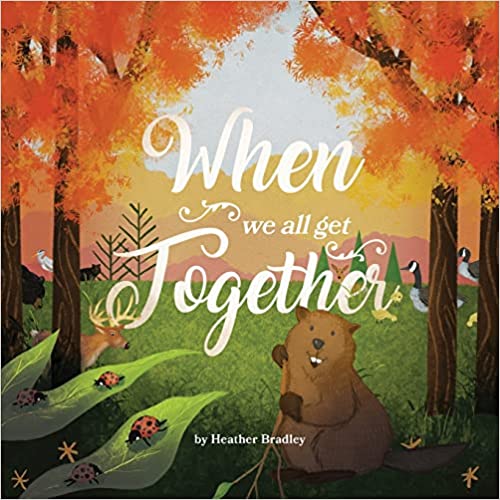
Cameron-area author of When We All Get Together, Bradley is a retired elementary teacher, who has also worked for the Ontario Science Centre. In 1994, she was awarded the William C. McMaster Award from Scholastic Canada for her essay about children’s literature.
When We All Get Together was the 2022 silver medal winner of the Moonbeam Children’s Book Awards.
“I found out about it [awards] through one of my writer’s groups and decided to submit it with no idea it would even be accepted, never mind win an award … I would have been pleased to get an honourable mention,” said Bradley. “Getting to the podium shows me that it was a worthwhile endeavour.”
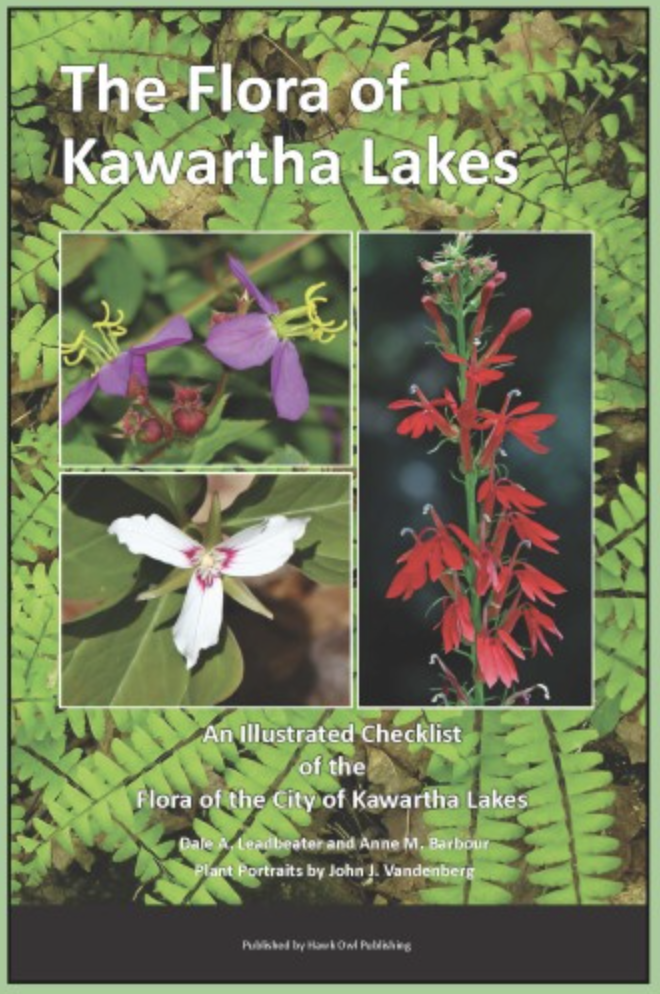
Coboconk resident and graduate of University of Windsor, Barbour is the co-author of The Flora of Kawartha Lakes.
Anne is a retired professional librarian and earned her botanical skills with the Essex County Field Naturalists, and later the Kawartha and Carden Field Naturalists. She has a long history of volunteer positions with KFN and is currently assisting Kawartha Conservation in monitoring new invasive aquatic species.
Her co-author, Dale Leadbeater, describes how the book came together:
My contributions started when we collected field data for 10 years including pressing, drying, mounting, photographing, labelling and entering data into a custom database thanks to funding from the Stewardship Council and the ROM. Over 100 volunteers from all walks of life including students from Fleming College and almost as many landowners who often provided lunch. My co-author, Anne Barbour, hosted so many mounting days and her husband, Brian, made endless gallons of soup! We could publish a cookbook with all the great meals we ate!
Then Anne and I spent countless hours combing through other published lists for CKL to update names and to determine whether they were real or errors, tracking down specimens from colleagues and those filed by historical figures such as John Macoun, the first Canadian Botanist who accompanied the Sir Sanford Fleming expedition across Canada in 1872. It was a trip not only through space but also time. Truly amazing.
Retired from consulting, Leadbeater continues to volunteer for favourite projects, including the Couchiching Conservancy Land Trust as well as Harcourt Park Incorporated. A graduate of the University of Toronto, her focus has been on mitigation of climate change effects through land acquisition and management.
Along with Anne M. Barbour, she is the co-author of The Flora of the Kawarthas: An Illustrated Checklist of the Flora of the City if Kawartha Lakes, which includes reflections on historical ecology, occupation and how the current vegetation patterns were formed. The book is comprised of 14 years of research.
Any paddler will tell you that it’s not a good idea to stand up in a canoe or kayak. But that is exactly what Dale Leadbeater did when she noticed the distinctive bladders of American Bladdernut (Staphylea trifolia) growing on the bank of the Black River where she was paddling with two friends. “It couldn’t be, could it? Have to get a specimen to be sure!” She very carefully stood up in the kayak, while her friends exclaimed “Are you crazy?” Dale had to reach over her head to clip off a fruit-bearing twig. Then she had to sit down again… nearly as risky as standing up. But with the help of sturdy Red-osier Dogwoods for balance, she did not get wet. It turned out to be the only location in the entire City for this large shrub.
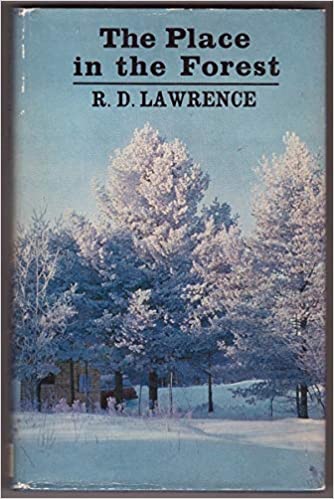
Ronald Douglas Lawrence (1921-2003) lived in many places and tried many things. Among his accomplishments he and his second wife, Joan, maintained a wilderness property, “The Place”, near Uphill (page 219, The Place in the Forest) in Kawartha Lakes (then Victoria County) where Lawrence studied the local wolf pack. He wrote about it in The Place in the Forest. Then they bought a 350-acre farm of mostly wilderness, “North Star Farm,” where they cared for orphaned and abandoned animals. He chronicled the humorous account of this time in the book, The Zoo That Never Was. Lawrence sold the property after Joan’s death.
Lawrence was a Canadian naturalist and wildlife author of over 30 books.
Born on a ship off the coast of Spain, Lawrence was raised in Spain and at age 14 lied about his age so he could fight in the Spanish Civil War. He served for two years until he found himself outnumbered in the Pyrenees and fled to France. He made his way back home just in time for the arrival of WWII. He enlisted with the British and went to war again. He participated in D-Day at Normandy where he was seriously injured.
After the war, Lawrence he enrolled at Cambridge University where he studied biology for three years but did not complete his degree. He returned to Spain where he worked as a journalist and novelist.
He moved to Canada in 1954 and became a reporter for the Toronto Star. He also worked for the Winnipeg Press and Toronto Telegram. Among his reporting duties, he went to Africa as a foreign correspondent.
Lawrence and his third wife bought property in Haliburton. Lawrence helped establish the Haliburton Forest Wolf Centre.












 kawarthalakeswriters.com