Dennis T. Patrick Sears (1925-1976)

Dennis T. Patrick Sears (1925-1976) at one time resided in Bexley Township, Kawartha Lakes. He is the author of three novels, two set in Kawartha Lakes (then known as Victoria County), The Lark in the Clear Air and Aunty High Over the Barley Mow, with the latter being published posthumously. His third book, Fair Days Along the Talbert, has been described as autobiographical tales of his early life in Saskatchewan and central Ontario, collected from his columns for the Kingston Whig-Standard.

His most famous words are the truncated and often unattributed: “Lindsay has the widest street and narrowest minds.” The full quote comes from his posthumously published novel: “Uncle Miles once said the inhabitants of Lindsay had the widest street and the narrowest minds of any town north of the Rio Grande.” (page 109, Aunty High Over the Barley Mow)

This phrase evolved into the misconception that Lindsay had the widest streets in Ontario (sometimes the claim extended for all of Canada.) While Kent and Victoria Streets are the widest in the town of Lindsay, spanning 100 feet compared to the others at 60 feet, this was actually common across many towns in Ontario. These wider streets tend to be located at the heart of town and were meant to allow “parking” for horses and buggies near the town squares. But in Kawartha Lakes, Sears’s description caught on and became a local myth.

Sears died in 1976 at age 51 of pneumonia following surgery in Kingston. Born in Vancouver in 1925, he was living in Saskatchewan until 1933, when his grandfather died and his family relocated to take over the Bexley township farm. Sears left school after Grade 8. He was a factory worker, merchant seaman, ranch hand, police officer, plainsclothes military police officer, and carpenter. He also served the Royal Canadian Navy.

In his review of Aunty High Over the Barley Mow, Bob Trotter (a journalist originating from Kawartha Lakes) said, “It is unfortunate that Dennis T. Patrick Sears will not write another novel. I love the magic of his fluent, mellow prose, ripe with the tang of earth and fresh air, right out of my childhood before the tourists came to corrupt. It is in the heart of the Kawartha Lakes, the vacationland for aliens from Toronto, Hamilton and Buffalo. That rich array of real people have been changed by the times but brought back to lusty life by Sears.” (The Last Post “Victoria Co. before the city folk came”, volume 6, number 6, January 1978, page 47.)

Books:

The Lark in the Clear Air  (1974)

Fair Days Along the Talbert (1976)
Aunty High Over the Barley Mow (1977)

Articles: 

“Bluegrass: a fan’s notes”, Harrowsmith Magazine, issue 3/36.

“The Haunted 10th”, Harrowsmith Magazine, issue 2/16.

“The Raising of Long Paddy McNaney’s Barn”, Harrowsmith Magazine, issue 1/22.

Further Reading:

Interview with McLean’s magazine, 1975

Page at New Canadian Library

Donald Jack

Lindsay resident Donald Jack (1951-2003) was a playwright, author, and three-time winner of the Stephen Leacock award for Humour.

Three Cheers For Me (1963 Leacock winner)

That’s Me In The Middle (1974 Leacock winner)

It’s Me Again

Me Bandy, You Cissie (1980 Leacock winner)

Me Too

This One’s On Me

Me So Far

Hitler vs Me

Stalin vs Me


Wikipedia page


Walter Stewart (1931-2004)

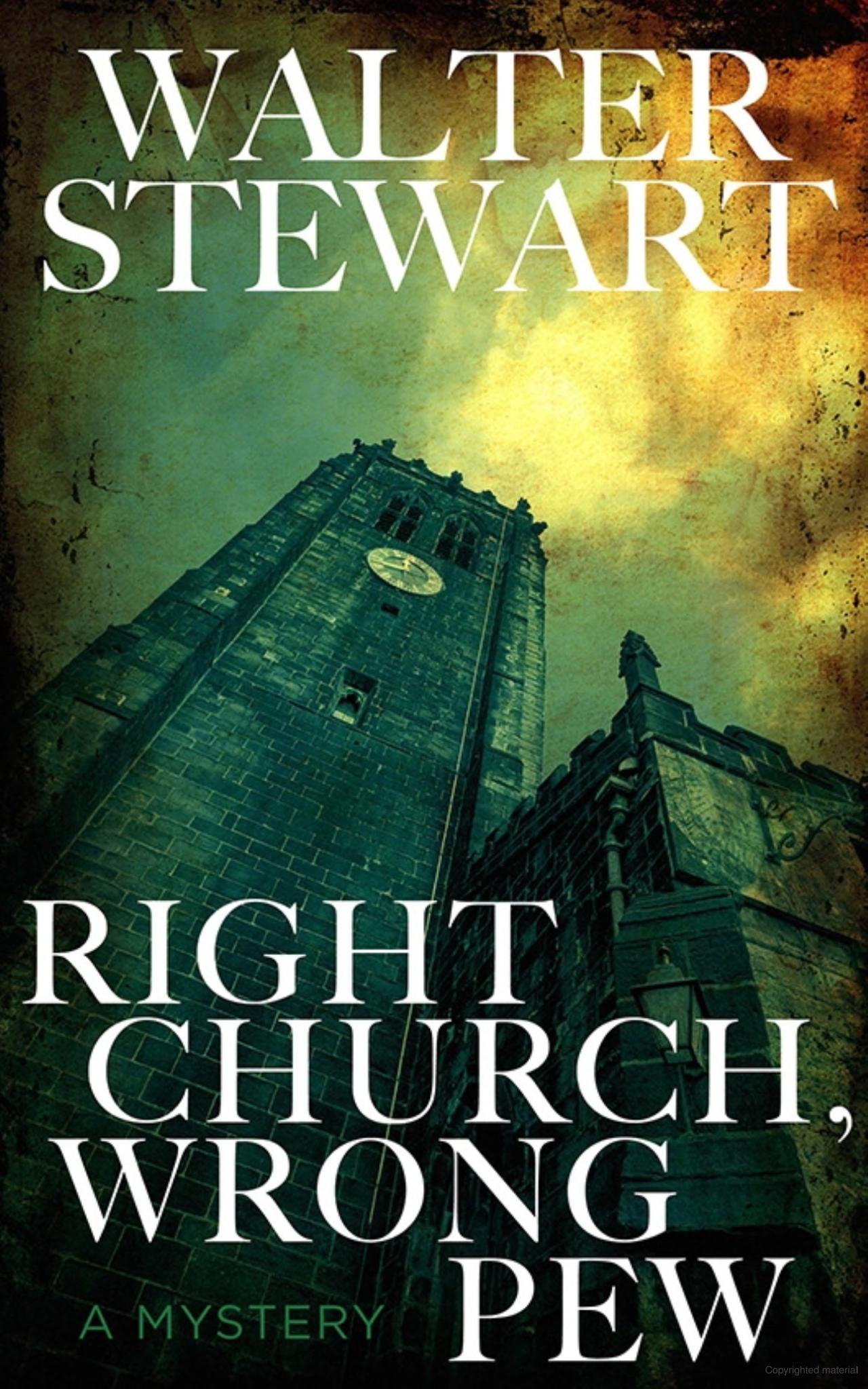
Journalist and author Walter Stewart (1931-2004) was the prolific author of non-fiction; his only two fiction works, Right Church, Wrong Pew and Hole in One are small town murder mysteries set in Kawartha Lakes, published by HarperCollins.

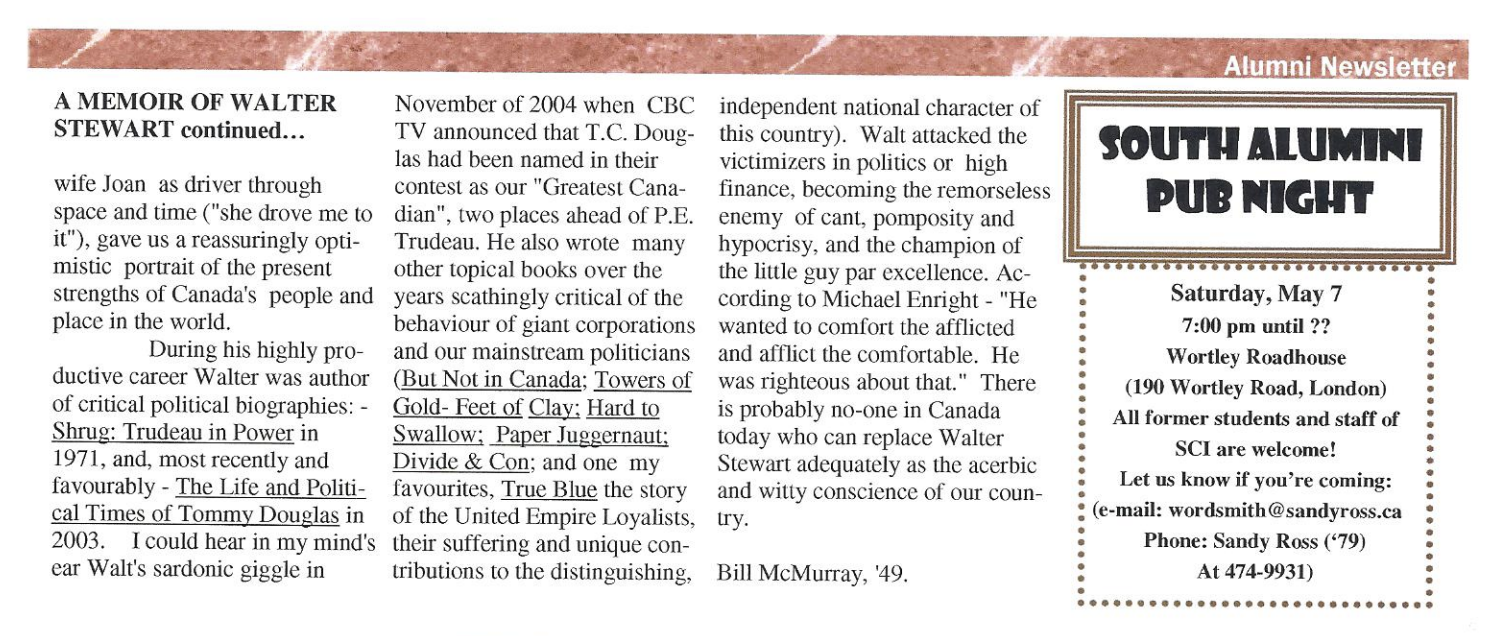
Born in Toronto, Stewart attended high school in London, graduating in 1949. Stewart once described his hobbies as “reading, writing, and arguing.” In high school, he wrote for the London Echo. An honours student in history, he quit university early and went to work for the Toronto Telegram.

Stewart did not enjoy his time at the Telegram. “What I learned about journalism there, was that it was a suspect craft, dominated by hypocrisy, exaggeration, and fakery. At the Tely, we toadied to advertisers, eschewed investigative reporting, slanted our stories gleefully to fit the party line (Conservative) and to appeal to the one man who counted – the publisher, John F. Bassett.”

Stewart went on to work for Star Weekly (the magazine published by the Toronto Star), McLean’s Magazine, where he eventually became managing editor, and among many other journalism jobs, including teaching for universities, while also penning his books.

His most famous book, The Life and Times of Tommy Douglas, resulted in Douglas being named The Greatest Canadian, while his most controversial book, The Charity Game: Greed, Waste and Fraud in Canada’s $86-Billion-a-Year Compassion Industry ended up pulled from shelves.

From his youth, his family vacationed in Sturgeon Point, where eventually Stewart settled and wrote freelance. He wrote “gently humourous portrayals of his neighbours whom he represented as mildly ironic, but sympathetic, characters” and created the fictitious Kawartha Lakes town, Bosky Dell.

Walter Stewart died of cancer at his home in Sturgeon Point on September 15, 2004. He never learned to drive.

Mysteries: 

Right Church, Wrong Pew (1990)
Hole in One (1992)

Non-Fiction:

Shrug: Trudeau in Power (1971)

Divide and Con: Canadian Politics at Work (1973)

Hard to Swallow: Why Food Prices Keep Rising and What Can Be Done About It (1974)

But Not in Canada! Smug Canadian Myths Shattered by Harsh Reality (1976)

As They See Us (1977)

Strike! (1977)

Paper Juggernaut: Big Government Gone Mad (1979)

Towers of Gold, Feet of Clay: the Canadian banks (1982)

True Blue: The Loyalist Legend (1985)

Uneasy Lies the Head: The Truth About Canada’s Crown Corporations (1987)

The Golden Fleece: Why the stock market costs you money (1992)

Too Big to Fail: Olympia & York: The story behind the headlines (1993)

Belly Up: The Spoils of Bankruptcy (1995)

The Charity Game: Greed, Waste and Fraud in Canada’s $86-Billion-a-Year Compassion Industry (1996)

Bank Heist: How our financial giants are costing you money (1997)

Dismantling the State: Downsizing to Disaster (1998)

M.J.: The Life and Times of M.J. Coldwell (2000)

My Cross-Country Checkup: Across Canada by Minivan, Through Space and Time (2000)

The Life and Political Times of Tommy Douglas (2003)

http://southalumni.ca/wp-content/uploads/2018/06/Lions-Pride-Spring-2005-newsletter.pdf

Jules Sobrian

Jules Sobrian (born January 22, 1935 in San Fernando, Trinidad and Tobago), is a medical doctor, competitive marksman and author, who immigrated to Canada at the age of 21 and resides in Omemee, Ontario. (from Wikipedia)

About the Book:
It is 1856 and Dr. Forsyth’s ambition is to save lives on the Canadian frontier. Fresh from medical school, and accompanied by Kitty, his beautiful bride and nurse, he sets up practice in a scenic village not far from an Indian nation. There he finds himself in competition with the reeve, who not only invents and sells cures for all known human and animal diseases, but exercises some mysterious control over the village council.

Much to his dismay, the public views the doctor’s every success as failure. One by one he inadvertently makes enemies among the local gentry.
When the reeve’s terrible secret is revealed Dr. Forsyth’s dream becomes his worst nightmare.
Kitty is betrayed by the law. Salvation comes from unexpected places, and she discovers that frontier justice is best served by Samuel Colt’s new invention.

White Lily


Dorothy Lenore Thompson

Dorothy Lenore Scovell was born in Toronto in 1941, the youngest of six. She attended teachers’ college, following her passion for inspiring young minds. She was a kindergarten teacher for the Toronto District School Board, a Sunday school director at her church, and at night, she taught English to new Canadians.

In 1965, Dorothy married Richard Thompson at Bedford Park United Church. They had two children.

They moved to their dream home in Lindsay in 1997 and became active members of Queen Street United Church.

In 2013, Dorothy published her book Threads from the Loom of Time, a non-fiction account of her family’s history and pioneer life in Canada. The book is connected to The Muskoka Story, written by her mother, Beatrice Scovell.

Dorothy and Richard moved into long-term care in Oshawa in 2017.

Dorothy passed away September 25, 2020.

Books:

Threads from the Loom of Time

Further Reading:

“An Evening with Dorothy Thompson.” (May 2013)

“Weaving a wonderful tale out of a family’s legacy.” Catherine Whitnall. Kawartha Lakes This Week. 17 May 2013.

Dorothy Lenore Thompson obituary

Richard Thompson obituary