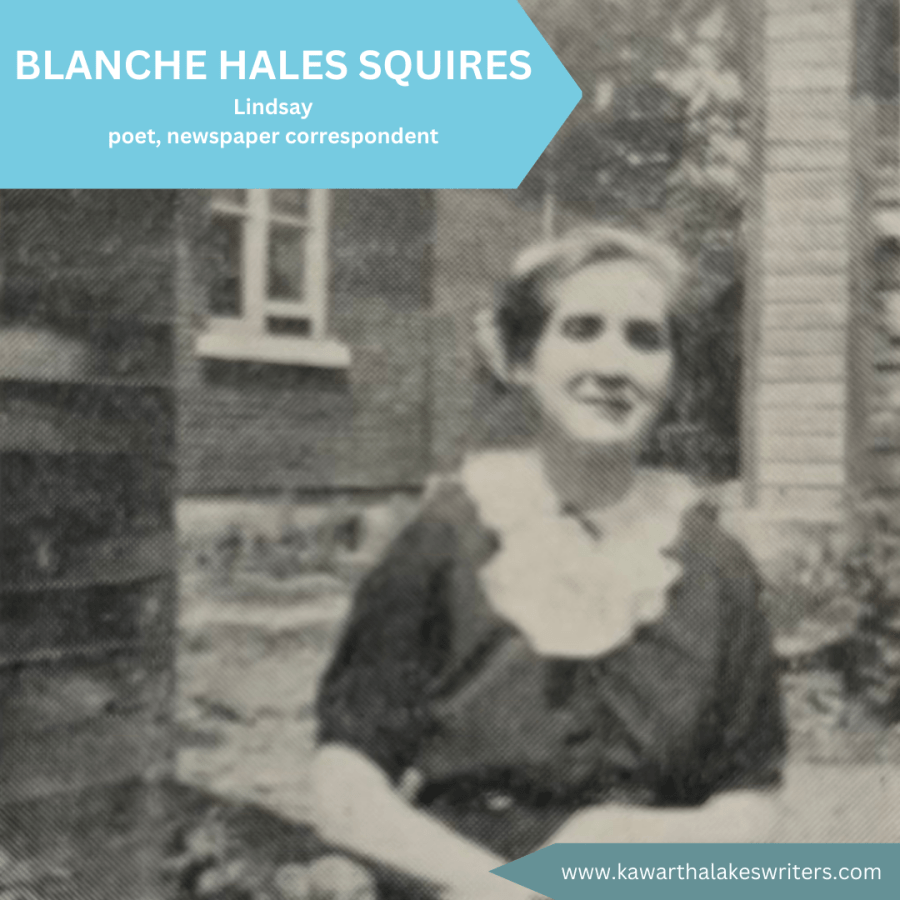
Born Mary Blanche Hales in Apsley, Ontario on 10 March 1892, at some point in her childhood, she moved to Lindsay, Ontario.
In a letter to the editor of the Canadian Statesman (Bowmanville), she remembers hearing about the newspaper “as a girl in Lindsay.”
Squires attended Lindsay Collegiate Institute. In fact, she was in the same class as Watson Kirkconnell, another Kawartha Lakes writer.
Watchman Warder, 1 July 1908, page 9.
Miss Hales was a teacher in Galway (Watchman Warder, 27 Oct 1911, p. 5) and Lindsay until 1913 when she left to take an assistant teaching position at Hampton public school (Watchman Warder, 5 Sep 1913, p.2.)
From there, she also taught in Hamilton and Parry Sound.
Blanche Hales Squires, A New Canadian Anthology, 1938.
On 6 August 1920, she married Elmer Francis Squires in Sudbury. Elmer was a telegrapher for Canadian Pacific Railway and stationed in North Bay and Algoma District in northern Ontario.
Blanche and Elmer had three children: Churchill Douglas Squires (1921-1989), Betty Squires (1923-2012) and Robert Hales Squires (1926-2002.)
Squires wrote poems and articles for the Globe and Mail, and for seven years she was a newspaper correspondent.
She died 2 June 1971 in Waterloo, Ontario.
Publications:
“The War Has Made Me Over,” The United Church Observer, 1 June 1944.
“Winter Night,” A New Canadian Anthology, edited by Alan Creighton and Hilda M. Ridley, 1938.
Watching the World Go By, edited by Robert Hales Squires, 1999.
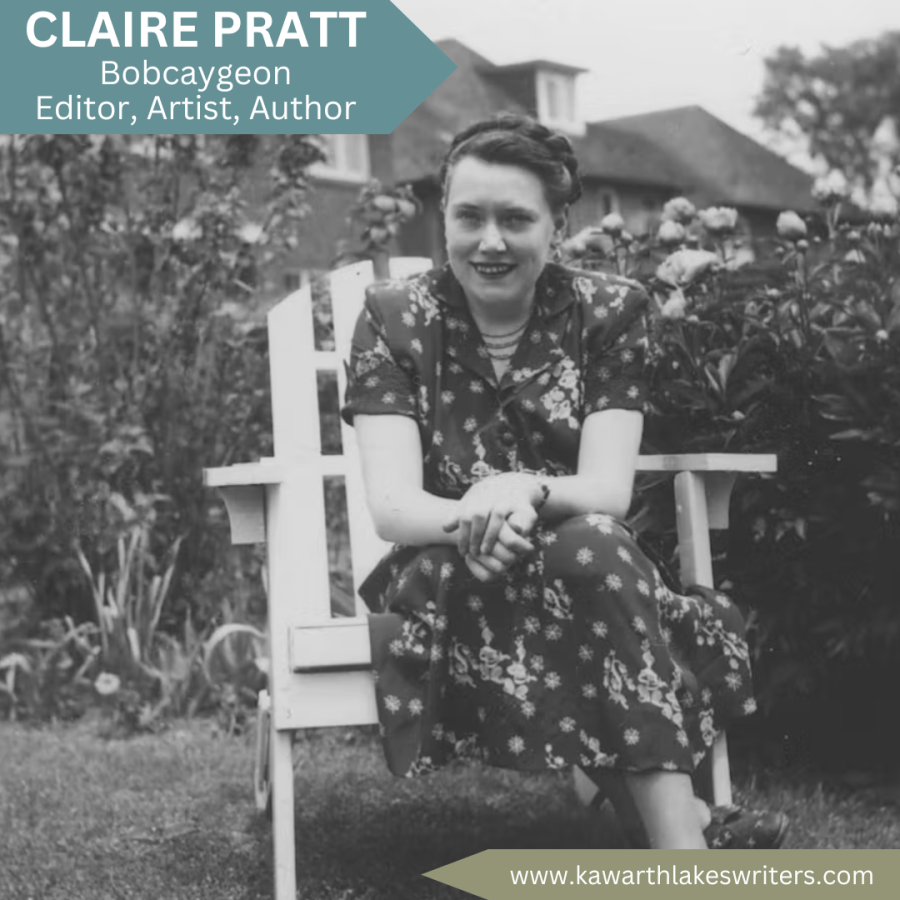
Born Mildred Claire Pratt (1921-1995), daughter of two writers/editors, E.J. Pratt and Viola Whitney Pratt, Claire became a “vanguard of mid-twentieth century Canadian publishing.”
At age four, Claire contracted polio in her right leg. For the next 11 years, she wore a leg brace and underwent operations to try to straighten it. When she was eight, one of these operations resulted in a staphylococcus infection and osteomyelitis. At the time, antibiotics were unheard of and she barely survived the winter. Within the year, the osteomyelitis travelled to her left arm and left hip. Numerous operations and infections followed, leaving Claire with a truncated hip.
By 1944, Claire had undergone over 40 operations.
From 1920 to 1936, Pratt’s parents kept a cottage in Bobcaygeon on Sturgeon Lake, where the family spent their summers.
After graduating from the University of Toronto, Pratt pursued graduate work at Columbia University. She returned to Toronto, where she, and Olive Smith, started the Claire Pratt Book Service. Their company was a “specialized book shipping and addressing service.”
As a child, Claire was around prominent writers, including those who she saw every summer when they returned to their cottages, the Bobcaygeon Boys (Arthur L. Phelps, Frederick Philip Grove, William Arthur Deacon) and many others.
Also among her parents’ friends were famous artists.
Frederick Varley, one of the founding members of the Group of Seven, was the artist for E.J. Pratt’s Newfoundland Verse (1923). When Varley and his family were evicted from their Toronto house, Pratt let Varley, his wife Maud and their four children camp in a tent on the lot next to the Pratt’s cottage.
Claire would have been two at the time, but when art became her pastime, this wasn’t her last encounter with Varley or other members of the Group of Seven.
The Pratts owned at least four pieces of Varley’s art. All now housed at the McMichael Gallery.
Claire Pratt, 1950. Box 46, file 8, MCP fonds, Special Collections, E.J. Pratt Library, Victoria University in the University of Toronto.
In 1952 Claire became an editor for Harvard University Press, but the need for further surgeries forced her to leave the position in 1954– the year she was forced to make the toughest decision of her life: to have the experimental spinal fusion surgery or die.
The surgery was performed in New York at the Hospital for Special Surgery, where John F. Kennedy was a patient in the next room, Jackie Kennedy walked the corridors, movie stars arrived for cosmetic surgery, and one of her surgeons had a stroke in the middle of her operation.
She spent two years in a body cast fighting pain, depression and despair. Turning to art for refuge.
Following her recovery, Claire joined McClelland and Stewart as an editor, where she took on major responsibilities. She travelled out of town to meet authors, and regularly worked through evenings and weekends to meet publishing deadlines.
Claire worked alongside Jack McClelland and Malcolm Ross for the development of the New Canadian Library. This line of paperbacks reissued the works of notable Canadian authors with introductions by contemporary notable authors. The series launched in 1958 and continues today.
The Bobcaygeon Boys were well represented. NCL printed many of the works of Frederick Philip Grove, the biography line included a volume on Claire’s father, E.J. Pratt. But not all of her father’s friends were so easy to work with. Claire “performed a near feat of magic when she managed to expand W.H. Drummond’s Habitant Poems to 110 pages. When editor Arthur J. Phelps stubbornly refused to include more than twenty-two judiciously selected poems, [Claire] Pratt devised to spread out the verse and pad the slender 1960 NCL edition with indexes.” (Toronto Trailblazers. page 117.)
Other notable writers that Claire worked closely with during her time at McClelland & Stewart: Leonard Cohen, Peter C. Newman, Margaret Laurence, and Irving Layton.
The following note Claire wrote to Margaret Laurence shows Claire’s editing style and handling of writers. As a result of this note, Claire won Laurence’s trust and Laurence sent her work-in-progress, The Stone Angel, which went on to launch Laurence’s career.
One of the best things that has happened to me in a long time is your manuscript of short stories. I wish there were some way in which I could put across to you you how really enthusiastic I feel about them, Margaret. Depth of compassion and insight, combined with stylistic beauty and the use of the word or phrase that is exactly right, make each of them a pure gem, a true union of the artist and the craftsman. In short they are marvellous.
Claire Pratt to Margaret Laurence, 20 February 1963, series Cae, box 12, file 7, M&S fonds, Mills Memorial Library, MU. (Toronto Trailblazers, Ruth Panofsky, 2019. p. 123.)
Layton’s work, under Claire’s editorialship, won the Governor General’s award in 1959.
In 1970, Claire received a Canada Council grant to support her genealogical research of her father’s ancestry. The result landed on Jack McClelland’s desk and the manuscript was published the following year as The Silent Ancestors: the forebears of E.J. Pratt.
Books:
The Silent Ancestors: the forebears of E.J. Pratt (1971)
Further Reading:
“Claire Pratt: Art and Adversity.” The Devil’s Artisan: A journal of the printing arts, issue 46. Robert C. Brandeis. (2000) (This article contains many examples of Claire’s art.)
Born Clara Flos Jewell (1889-1970) in Dundalk, Ontario, she completed school in Toronto, where at some point she preferred to use the name Flos as she’s listed in the newspaper honour rolls as Flos Clara Jewell.
At some point, she took a teaching position in Bobcaygeon, where she taught for at least five years.
Dorothe Comber‘s book, “Bobcaygeon History: Amy Ellen Cosh Memorial,” has this note in the section about the Rokeby School:
Miss McGuire taught in the Rokeby School. She was a lovely person and a splendid teacher. She and Mr. Simpson were united. Miss Floss [sic] Jewell was one of the assistants. About 1920, after she had gone away and married, she wrote a fiction story about Bobcaygeon which was published, “The Judgement of Solomon.” Of course the names were changed but some people thought that they recognized some of the characters.”
Bobcaygeon History: Amy Ellen Cosh memorial, Dorothe Comber with committee, 1972, page 72.
The December 3rd, 1908 edition of the Weekly Free Press notes, “Upon severing her connection with Rokeby school, Miss McGuire was presented with some valuable silverware by her pupils and ex-pupils in remembrance of her kindness and interest in their welfare.”
McGuire left in 1908. The 1911 census shows Flos single and living in Toronto.
Flos and David were married on 23 April 1915, therefore Williams must have taught at the Rokeby School between 1911 and 1915. The phrasing “gone away and married” would suggest that just like McGuire, Flos quit teaching to get married, but since she ran into E.J. Pratt, Arthur Phelps and others while she was in Bobcaygeon, and knew them well enough to characterize them into her first novel, she had to have remained living in the area until at least 1920.
The former Rokeby School. Image captured by Google May 2018.
The Rokeby School was the Verulam School Section (S.S.) No. 6 built in 1873 to move students out of the tavern lean-to where they’d been studying. (The school in the make-shift room attached to the tavern is thought to be Bobcaygeon’s oldest school.) The Rokeby School was constructed at 35 North Street, which became Pieter van Oudenaren’s Garage, an auto repair shop. Pieter took over the garage from his father, Harry van Oudenaren, a Kawartha Lakes author, until he left auto repair for cheesemaking.
By 1921, according to the 1921 census, Flos and David were living in Calgary.
After settling in Calgary, being separated from her Toronto-area friends and family, and with her salesman husband travelling, Williams took up writing. She was a member of the Canadian Authors Association, in the same Calgary chapter as Nellie McClung. In addition to writing four novels, Williams contributed a number of stories and poems to anthologies and periodicals to qualify for membership to the Canadian Womens’ Press Club.
A young woman and a brilliant one, and editors and critics who know her work prophesy that she will go far in the world  of letters. The very fact that this first book of hers was one of the runners up in the recent Hodder & Stoughton Canadian $2,500 contest, that this well established firm accepted it at once and sent it forth to the world, stamped with its approval, is no mean compliment to a young and new writer.

Mrs. Williams didn't write her book as one in search of fame, for commercial purposes, or in the beginning for the publishers. Once  the theme was conceived it was written, four thousand  words at a time, for the real enjoyment of writing, until it had developed itself into a full-length novel. It is a story that arose first in the heart and was committed to paper because of  that prime requisite of any author — the urge to write. It had never been seen by anyone. Then one day Mrs. Williams saw the advertisement of the Hodder & Stoughton contest. She submitted her manuscript, curious to see  how it  would come out. Immediately there came back a letter of warm commendation accompanied by an offer to publish it. It had been picked as one of the four runners up in the contest.

Mrs. Williams was born in Toronto [Dundalk] and educated in that city, being a graduate of the Jarvis Collegiate Institute, the old grammar school of Upper Canada, and of the Toronto Normal School.  Later she taught at Bobcaygeon in the Kawartha Lakes district, which she has woven in, as the beautiful setting of her book. Six years ago she came with her husband, David S. Williams, and her twin sons, to reside in Calgary, in which city her book was written.
“Calgary has four women authors” by Elizabeth Bailey Price; Canadian Bookman, March 1926.
The Globe review for Judgement of Solomon called the book “a well-written novel” with “a real plot, not a particularly pleasant one, handled with skill and delicacy and well sustained to the end.” (The Globe, December 5, 1925.)
The Judgment of Solomon is a work of fiction, following the story of Blake Lamon during his days as a medical student at the University of Toronto. He leaves school to run the family farm, acting on the promise he made to his dying mother. He marries Mary, the girl next door, and then has an affair with his wife’s cousin, Anne Thurston (a girl of 18 who’s living with them as their housekeeper). Anne gets pregnant, and Blake dies before his son, Blake junior, is born.
The setting for the family farm was “a four-mile drive over wretched roads, from Robson” with Robson being the pseudonym for Bobcaygeon, a place the main character, Blake Lamon does not love.
Blake hated the gossip and scandal-mongering of small villages, the almost consistent lack of charity, the eagerness with which the inhabitants put the worst construction on the actions of their neighbours. Robson was particularly disgusting in this respect. The town was situated between two lakes. A river and a canal cut through the town. On every side was unusual beauty, and the little village, with its ugly houses, with their wedding-cake verandahs jammed close to the sidewalks, buzzing from morning until night with scandal, was to Blake like a festering sore on the beautiful landscape.
The Judgment of Solomon, 1925, page 54.
By this description Robson is undoubtedly Bobcaygeon. When Blake marries, he agrees to move into his wife’s neighbouring farm, called Beehive Farm. This must be a nod at ‘The Beehive’ home to James Dunsford, built in 1839 between Bobcaygeon and Fenelon Falls, now part of Eganridge Resort, Golf and Spa.
Mary’s verandah commanded a gorgeous view of Sturgeon Lake, whose waters washed all the western boundary of the farm, its wooded shores curving around Green Bay, the favourite haunt of black bass for which the lake was famous.
The Judgment of Solomon, 1925, page 36.
Green Bay is on the Pigeon Lake side of Bobcaygeon, just off Riverside Drive, while The Beehive is on Sturgeon Lake at Hawkers Bay. Familiar territory, in any case.
After Blake’s death, Anne stays with Mary to help raise Blake Junior, whom they are raising as Mary’s child. Outside of Anne and Mary, only the doctor knows the truth. Once Junior is old enough to go away to school, Anne moves to a place of her own in Robson.
While she’s living in Robson, Anne meets some familiar characters. For anyone who knows that E.J. Pratt, Arthur Phelps, and Frederick Philip Grove spent every summer at their cottages in Bobcaygeon, they would instantly recognize them in the characters “Ned Andrews,” “Arthur Dawson,” and “George Groves.” Anne suddenly finds that “for the first time in her life this lonely woman felt that she was among her own people.” (p. 245.)
And they seem to respect her:
Ned Andrews marvelled at this women. She confessed to having lived almost entirely to herself, yet she had the appearance, the poise, of a woman of the world. She unhesitatingly acknowledged that she had been a housekeeper on a farm, yet good breeding and refinement were obvious.
The Judgment of Solomon, page 255.
Williams would have been a solitary woman, living on her own, while her salesman husband was away. Williams seems to have made herself the template for Anne.
Ned is a bachelor, whereas, E.J. Pratt was married. Nevertheless, Pratt was the template for Ned. Here’s Ned as described by another character:
“He is a Newfoundlander: a long, thin, good-looking, loose-jointed man, rather shabbily dressed. The cleverest man on the staff, with an almost uncanny ability in using his knowledge. He impresses one as living intensely every instant. He is much interested in questions of the day, and has influence in high quarters that would amaze the majority of his friends. Add to that the fact that he writes the most beautiful poetry in Canada to-day, and that he is a confirmed bachelor at forty, and you have the man.”
The characters ask to hear Ned’s poem titled, “Charlotte.” Is it coincidence that Pratt had a sister named Charlotte? Or that his first published poem had a woman’s name for the title? (Rachel, published in 1917.)
In the book, Anne and Ned fall in love, but Anne is unwilling to commit because of her history with Blake and because Blake Junior hasn’t fully accepted her as his mother.
During her time in Kawartha Lakes and as a member of the Canadian Authors Association, Williams became known to these “Bobcaygeon Boys.” Phelps, Pratt, and William Arthur Deacon had cottages where they stayed every summer, after completing their professor duties at the universities.
Two of Williams’s books were published by Graphic when Frederick Philip Grove was editor. Grove was friend to the Bobcaygeon Boys, spent time at their cottages, and corresponded with them on a regular basis. Graphic also published the words of Grove, Deacon, and Watson Kirkconnell (another Kawartha Lakes writer and Phelps’s colleague.) Deacon was a well-known book reviewer and critic for Saturday Night and the Globe and Mail, where Williams’ books were reviewed.
In 1926, Deacon asked Pratt to review Williams’s novel, New Furrows, for the Globe and Mail. In his letter to Deacon, Pratt said, “I had this review up to four hundred words but by a second pruning I managed to get it down to 335. I hope it will do though I don’t think it is ‘any great shakes,’ as I can only accomplish anything worth while when I have the impulse to let myself go.” (https://www.trentu.ca/faculty/pratt/letters/texts/260909dea.html)
His review was lukewarm at best. The review appeared in the October 16, 1926 edition and started out well with Pratt calling the book “a refreshing change from the usual run of “Western” novels.” After describing the premise of the book, Pratt says, “Beyond the love affair which develops between Marie and a handsome English “mountie,” the book has little plot. Nor are the obstacles to the courses of true love more than ordinary complexity–the war, absence, misunderstanding and hurt pride account for them.” He then goes on to say the value of her story “lies largely in the simplicity of its telling” and that “Mrs. Williams has not hesitated to make her people her mouthpiece on many vexed questions.” He ends the review not with words for the story itself, but by describing the book as “an attractive piece of book-making, done in the distinctive style of the Graphic Publishers.” Deacon was at the time editor for the Globe and Mail, and their friend Grove was editor at Graphic Publishers. Pratt’s evaluation of the novel would have carried a lot of weight.
Although he must have been flattered to be a character in Williams’s first book, he clearly reverted back to his default belief that women’s fiction wasn’t worthy, and one shudders to think what he might have said had he been able to “let himself go.” Perhaps he wasn’t flattered by Williams portrayal of him at all.
Williams was well-connected to the literary world in another way. Her salesman husband’s travelling partner was Stephen Leacock’s brother. (Butter Side Up, Gray Campbell, 1994.) No doubt she heard plenty of amusing tales.
In 1931, Williams had three books published along with short stories and poems, when her story “The Blue Bowl” was picked up for Chatelaine. The editor contacted her, asking for a photo and a brief write-up of her career to include with the story. Her response shows that imposter syndrome is not a modern construct and that for mothers, writing is a challenging career:
“Your letter fills me with despair for two reasons. First it reminds me of the time I asked an old Indian squaw to let me take her snapshot for a quarter, and she knocked the money out of my hand, saying that she wouldn’t be ugly all over Canada for a quarter! And second, because in the matter of my career- I haven’t had one!”
“I taught school in Toronto, married and have twin sons. My sons are my chief hobby as well as being my greatest creative effort. I have no convictions about anything- or rather I have to have a fresh bunch daily. To such an extent is this true that the only time I ever wrote a letter to a newspaper, I had to write an answer the next day, refuting all my arguments.”
Chatelaine, November 1931.
Her last novel, Fold Home, took second place in Ryerson’s Annual Canadian Book Contest in 1949.
Butter Side Up by Gray Campbell (1994) tells the story of the founding of his publishing company, Gray Publishing, the first publishing company in British Columbia. At the time, Williams was retired and living on her own on the waterfront a few houses down from Campbell. In his book, Campbell describes her as a “wise old owl” and “a witty raconteur, very much in tune with current literature and state affairs.” He began bringing her manuscripts to evaluate. He says “as a retired novelist, she had the ability to size up a writer’s potential by reading a few pages.” And while he acknowledges his company wouldn’t have succeeded if not for Williams, he makes no mention of paying her for her work.
Born on November 4, 1924, Hendrikus van Oudenaren (1924-2020) emigrated to Canada from the Netherlands in October 1950 after serving for two years in a forced labour camp in Stettin, where he worked as a tool and die maker and built boats. For 17 years Harry worked at Pogues Garage on Boyd Street, learning the auto-repair trade. He returned briefly to the Netherlands, long enough to get married, and came back to Canada. The family settled in Bobcaygeon where Harry set up an auto repair garage in an old schoolhouse, while establishing his home with his wife Johanna and six children across the street. For a while, his son Pieter ran the garage until he decided to take up cheesemaking.
The former Rokeby School at 35 North Street in Bobcaygeon. Image from Kawartha Settlers’ Village.
Google image captured May 2018.
Harry began to collect archival and historic information and images about Bobcaygeon. His family formed a friendship with another Bobcaygeon historian and author, Dorothe Comber. She and Harry shared information and upon her death, she left her collection to Harry.
The school that housed the garage business was the former Rokeby School, or Verulam School Section (S.S.) No. 6 at 35 North Street in Bobcaygeon. The northern section of Bobcaygeon was originally called Rokeby when it was first founded, but when it joined with the southern neighbouring areas to form a town, the name Rokeby was lost in favour of Bobcaygeon.
Harry also collected objects of historical interest, which can be found in the Harry van Oudenaren Museum at Kawartha Settlers’ Village, established in 2018. Harry’s son, Pieter, gives a tour of the museum on YouTube. When his collection became too great to stay in his basement, Harry had a building constructed and moved to the Village property.
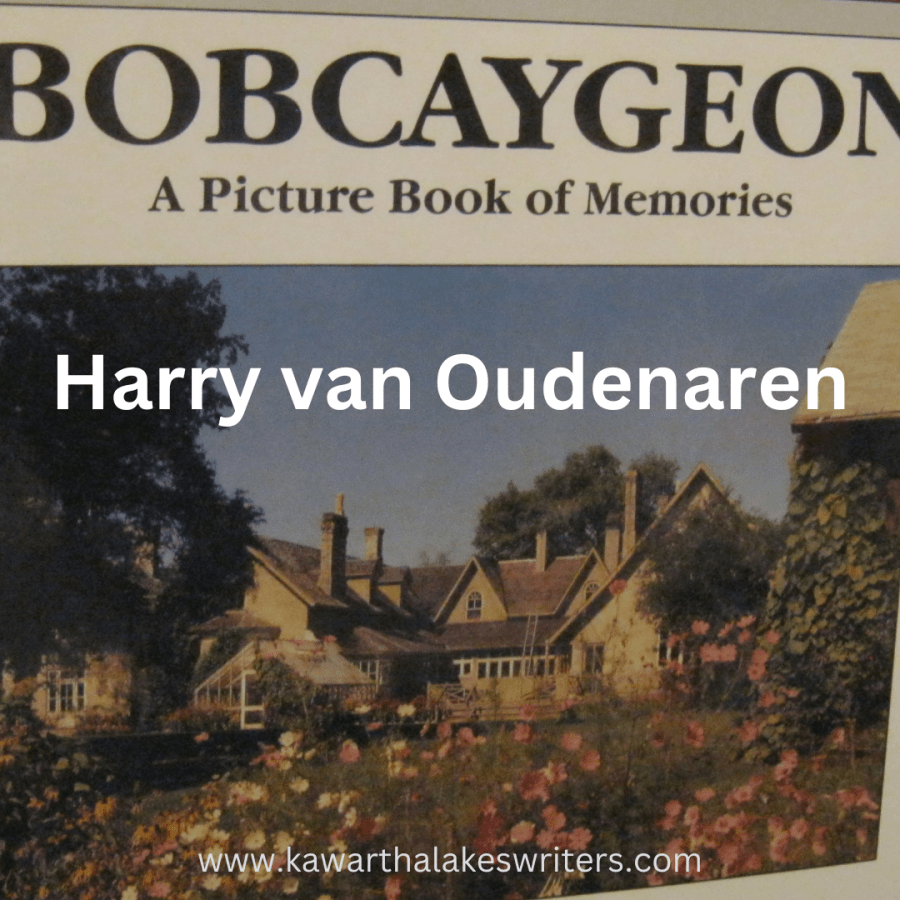
In 1992, Harry published some of his collection in a book, Bobcaygeon: a picture book of memories.
Harry passed away at his home in 2020 with his family by his side. His collection of items relating to the Boyd family went to the Boyd Museum and his items went to Kawartha Settlers’ Village.
In 2008, M. Eleanor McGrath published the book, A Story to be Told: personal reflections on the Irish immigration experience in Canada. The book collects the stories of Canadians who immigrated from Ireland. In the introduction, McGrath says, “Hours of taped interviews based on a standard questionnaire have become transcribed first-person accounts in this book. I have maintained true to the tone, speech patterns a nd individuality of the interviews.”
Several Kawartha Lakes residents were interviewed for the project and the stories of their immigration to Canada are included in the book, including that of local writer, Tom Crowe.
Russell Roy Merifield (1916-2005) is the author of From County Trust to National Trust (1988), a book that documents the history of the National Trust, which has roots in Kawartha Lakes (then known as Victoria County.)
Born in Chatham, Ontario, Merifield graduated from McGill University and served in the Royal Canadian Navy during World War Two. He practiced law in Montreal and became a senior officer at Shawinigan Water and Power Company. He was Vice-President and Secretary of the Royal Trust Company of Canada. In 1967, he moved to Toronto as Vice-President and General Manager of Victoria and Grey Trust Company until his retirement, at which time National Trust commissioned him to write From County Trust to National Trust.
Here’s a brief timeline from Victoria Loan and Savings Company to Scotiabank:
Victoria.
The Victoria Loan and Savings Company was founded in 1895, under local management and officially incorporated on September 4, 1897. It was located at 85-87 Kent Street West in Lindsay.
By Letters Patent of Ontario, dated November 11, 1898, the Company was relieved from restrictions which confined its operations to Victoria County.

By Special Act (Ontario), dated October 1, 1923, the Company was granted the powers of a trust company and the name was changed to The Victoria Trust and Savings Company.

By 1950, the Victoria Trust and Savings Company had branches in Lindsay, Belleville and Cannington.

Grey.

Around the same time, the Grey-Bruce area was establishing their own banks.

Incorporated on April 1, 1889, under the name of The Owen Sound Building and Savings Society.

On May 10, 1889 The Owen Sound, Grey and Bruce Loan and Savings Company was in-
corporated under the same Act by declaration filed with the Clerk of the Peace for the County
of Grey. The name was changed to The Grey and Bruce Loan Company by Order-in-Council
(Ontario) dated September 15, 1897.

By Special Act 16, George V, c. 123 dated May 1, 1926 the amalgamation of The Grey and
Bruce Loan Company and The Owen Sound Loan and Savings Company was confirmed under
the name of The Grey and Bruce Trust and Savings Company and empowered to carry on the
business of a trust company under The Loan and Trust Corporations Act.

By 1950, the Grey and Bruce Trust and Savings Company had branches in Owen Sound and Peterborough.

Victoria and Grey Trust Company.

By Order-in-Council dated November 9, 1950, the amalgamation of The Victoria Trust and
Savings Company and The Grey and Bruce Trust and Savings Company was confirmed under
the name of Victoria and Grey Trust Company and empowered to carry on the business of a trust
company under The Loan and Trust Corporations Act.

The head office of the Victoria and Grey Trust Company was located in Lindsay with branches in Belleville and Cannington.

By Order-in-Council, dated September 16, 1965, the Lieutenant Governor gave assent to an
agreement dated July 27, 1965, whereunder Victoria and Grey Trust Company and British Mortgage
and Trust Company agreed to amalgamate under the terms and subject to the conditions therein
set out, the amalgamated company to be called Victoria and Grey Trust Company.

This amalgamation brought 15 additional branches to Victoria and Grey Trust Company. The purchase of Lambton Trust Company in 1969 brought 6 more branches. The Company continued to grow, merging with more companies, opening more branches and expanding into Western Canada.

By 1982, the Company had 88 branches across 5 provinces.

National Trust.

In 1984, the Company merged with National Trust Company to form the National Victoria and Grey Trustco.

The name, National Victoria and Grey Trustco, was deemed too cumbersome, and was subsequently changed to the National Trust Company on June 03, 1985.

On August 14, 1997 Scotiabank purchased the National Trust Company.

Today, Scotiabank maintains a branch located on the same site as the very last Victoria and Grey/National Trust building in Lindsay.
The original Victoria Loan Building located at 85-87 Kent Street West, Lindsay. Image: Google, captured Nov 2022.The newly constructed Victoria and Grey Trust Company building in 1977 at 165 Kent Street West, Lindsay, the former site of Fee Motors. Image: digital archive of Kawartha Lakes Public Library. Scotiabank building at 165 Kent Street West, Lindsay with additional floor. Image: Google, captured Nov 2022.
The naming of houses and properties was brought over with British colonists, but didn’t gain much ground in Canada. Modern property owners might name their farms, but not their houses.
On researching local writers, I discovered two claiming “The Elms” as their home: W.G. Hardy and Ernest Thompson Seton. These can’t possibly be the same property because Hardy lived near Peniel and Seton lived north of Reaboro.
At the time, Kawartha Lakes was populated with elms, trees that could reach heights over 100′ and live over 300 years; trees of such height would have been awe-inspiring to the colonists.
On the road near our gate were two large elm-trees, relics of the forest that had once stood there. Father called them Gog and Magog, after the two giants that guarded the gate of London; and it was from these that we, in English fashion, named our farm “The Elms.” The bigger one had the shorter name, and was visible miles away as a home-beacon. We were proud of that elm.
Imagine our feelings on coming home from Lindsay one day, to find the big elm cut down, and now being reduced to firewood. The road master of the year had given his permission to its being cut, when asked by a needy and improvident neighbour. He was amazed when he learned that Father had prized that tree, and said that, had he known it, nothing would have made him let anyone touch it.
Such, in those days, was the pioneer attitude towards trees.
Trail of an Artist-Naturalist: The Autobiography of Ernest Thompson Seton (1940)
Sadly, the elms of Kawartha Lakes were lost to Dutch Elm disease.
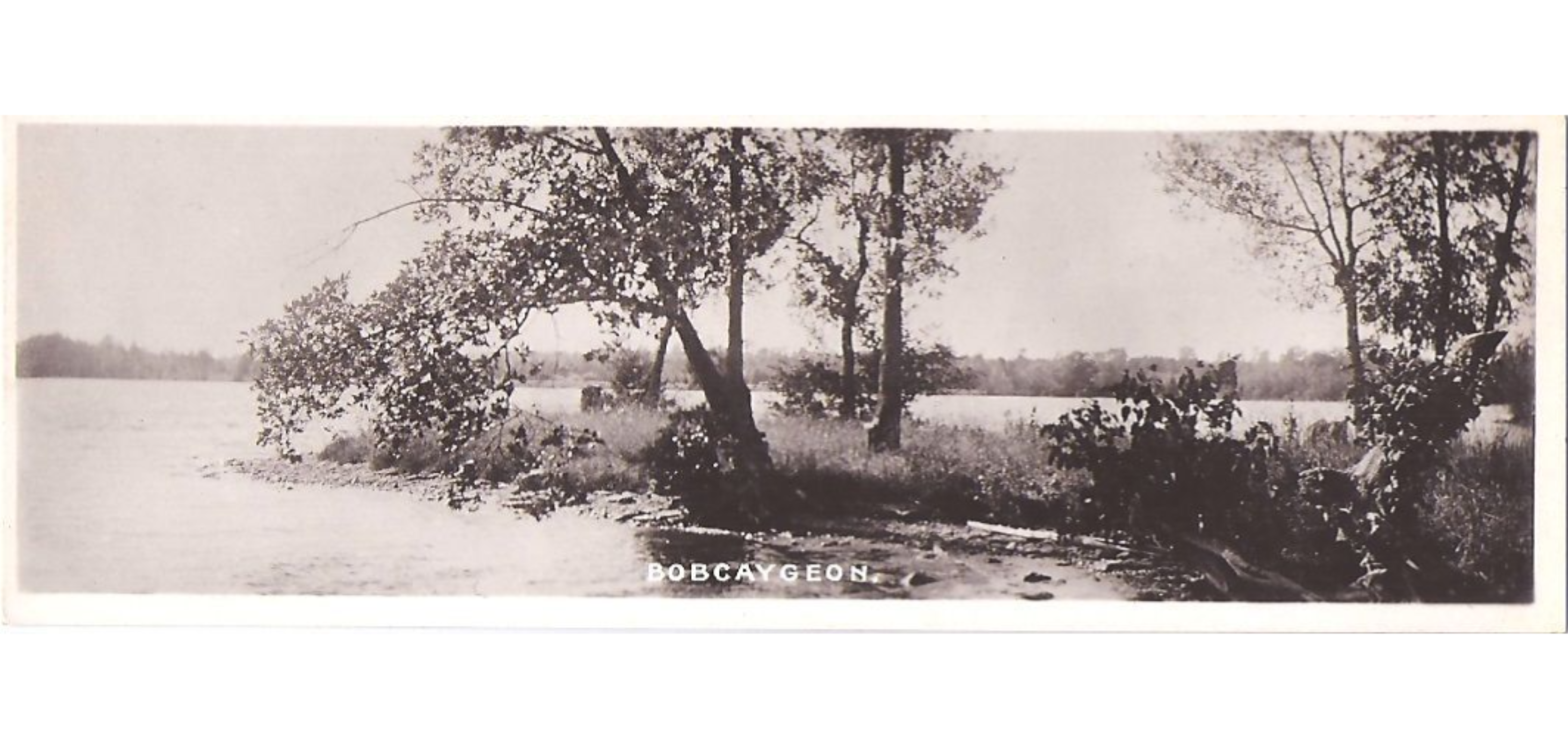
postcard, Kawartha Lakes Public Library digital collection
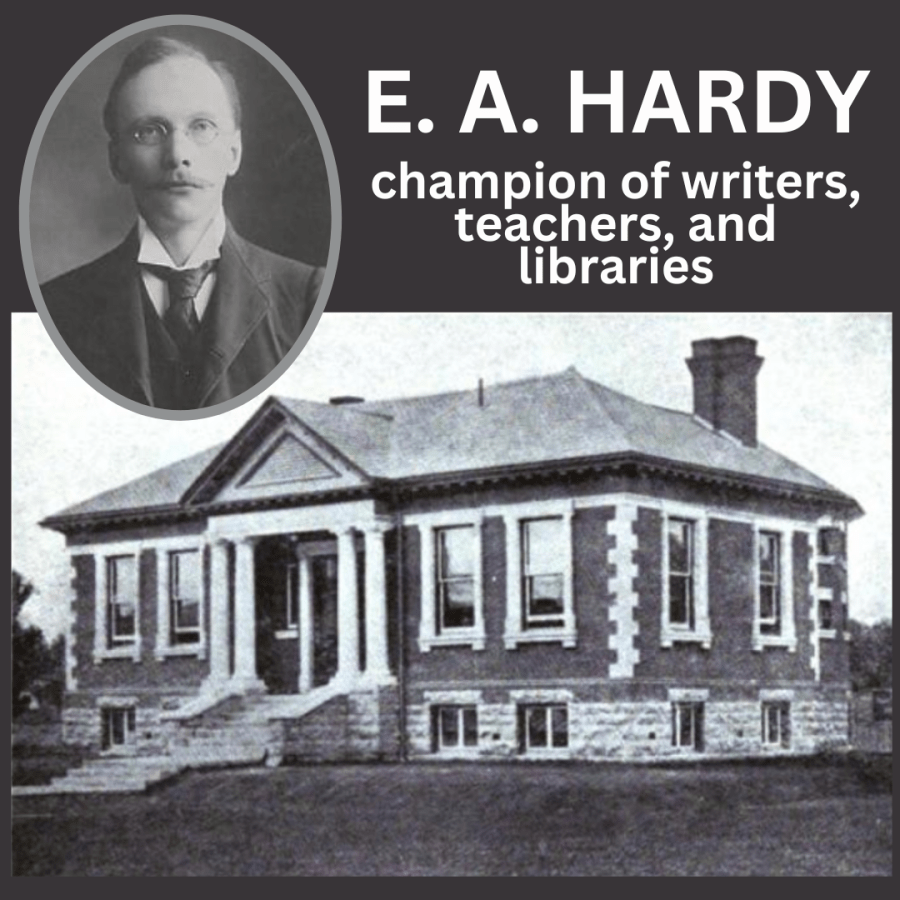
E.A. Hardy, detail from Twenty Club portrait, Kawartha Lakes Museum & Archive
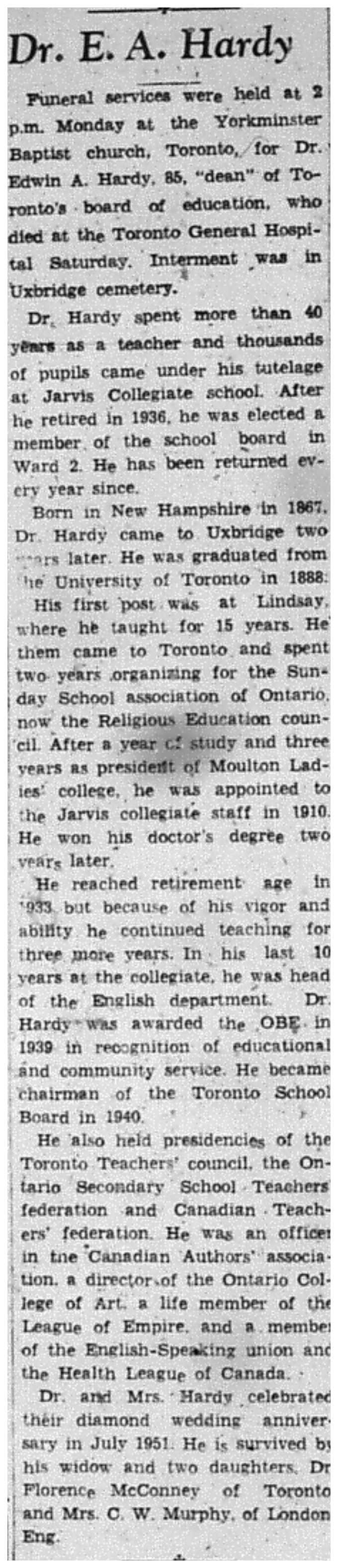
E. A. Hardy (1868 – 1952) was an educator and secretary of both the Ontario Library Association and Canadian Authors Association. In 1935, for services to education in Canada, Hardy was awarded Officer Order of the British Empire.
Library
While he lived in Lindsay, he campaigned for the town to start a public library and pass the by-law that brought free library access to Lindsay. In 1898, Hardy’s letters to the Canadian Post pointed out that adding a library to a town was attractive to new citizens and “that many a family has passed by one town and gone to another on account of its schools or some other excellent feature.” He appealed to Lindsay’s sense of family:
It is a serious problem to train up a family, and our streets at night afford only too good evidence that the problem is not being solved in many a home. No doubt home is not as attractive in many cases as it might be, and a large supply of good books, free of access to all members of the family, would go far to make home decidedly more attractive. In more than one case, if a boy had his choice between the streets and a good book he would take the book.
Canadian Post, 1898
Hardy’s passion for public libraries and success with bringing a library to Lindsay became well known, inspiring other municipalities across Ontario. His championship has been written about extensively by Lorne Bruce in Free Books for All: the public library movement in Ontario 1850-1930 (1994) and in Hardy’s own book, The Public Library: its place in our education system (1912).
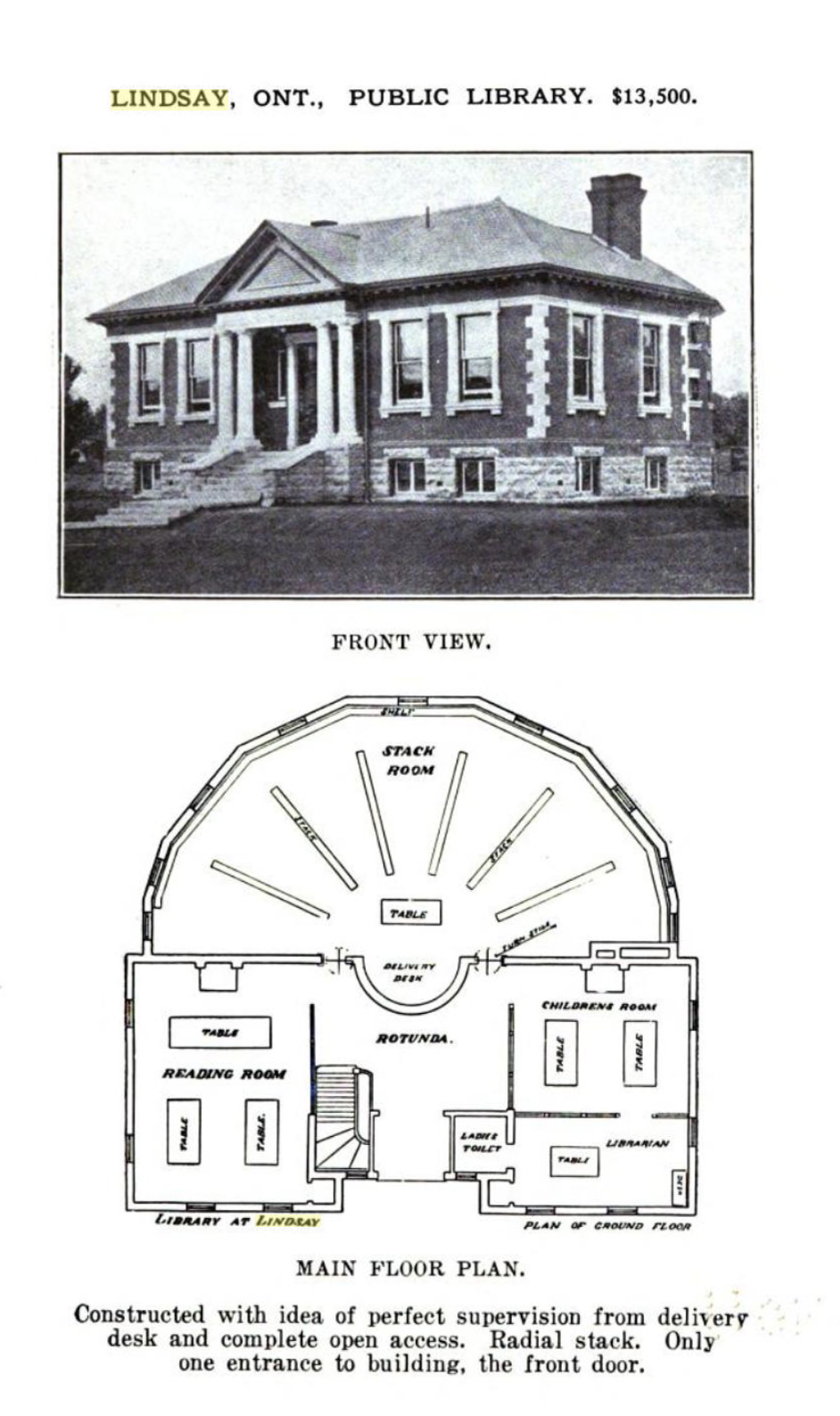
Hardy, The Public Library: its place in our education system (1912)
Although Hardy believed this to be ideal layout for a public library, James Bertram, who was personal secretary to Andrew Carnegie, did not. Bertram deemed the round rooms to be a waste of space. Lindsay’s half-circle design was one of the last with a rounded room and is one of the few such buildings still standing.
Hardy’s passion for libraries didn’t stop with Lindsay. Hardy is credited for the idea of what became the Ontario Library Association, a network of libraries across the province for the purpose of educating library workers. He served as president of the organization in 1925-26.
Poetry
Hardy’s work for the creation of Selections from the Canadian Poets (1909) is held at the Thomas Fisher Rare Library at the University of Toronto, including correspondence with Lucy Maud Montgomery:
The [Thomas Fisher Rare Library] holds a wonderful Montgomery letter within the Edwin Austin Hardy Papers. Hardy was an Ontario teacher and school administrator, and secretary of the Canadian Authors’Association. His collection consists primarily of correspondence pertaining to an anthology of Canadian poetry he was editing – Selections from the Canadian Poets, published in 1906 – and his secretarial duties for the Association. In what appears to be a response to a letter Hardy wrote to Montgomery – most likely after the publication of Anne of Avonlea (1909), given Montgomery’s letter is dated late September 1909 – she writes that a novel of ‘Anne the College girl’ will most likely never materialize. For one, Montgomery claims she does not have the ‘sufficient experience of college life’ to write about it. More to the point, she also writes that ‘after thinking and writingAnne for over three years I’m actually sick of her.’
“Strength in Numbers: the CanLit community” by Natalya Rattan and John Shoesmith, 2020
Of course Montgomery did go on to write more about Anne, but it’s worth noting that she felt what many writers feel, especially those who write long series, and it’s interesting that she confessed this feeling to Hardy.
In 1935, the Montreal branch of the Canadian Authors Association had been running a successful annual poetry contest. They appointed a committee to see if publishing a periodical would be financially feasible. Disappointed by the results, they decided to not go through with the project. Hardy heard about this and urged the national executive to take on the project as a means of doing something for the entire membership. They agreed and the first issue of Canadian Poetry magazine was published in 1936. Bobcaygeon cottager, E. J. Pratt was appointed editor. The magazine continued to be published until 1968 when it merged with Canadian Author and Bookman. (“A Union of the Inkpot: the Canadian Authors Association, 1921-1960” by Christopher M. Doody, 2016)
Biography
The following is from the book Hardy and Hardie: past and present (1887), in which Claude H. Hardy recorded the history of the extended family and gives a thorough biography of E.A. Hardy:
Edwin Austin, b. at Laconia, N. PI., 30 Aug. 1867 ; m. 6 Jul. 1891, Annie Florence Everett.
Hardy was a small boy of three years when he moved with his parents to Guelph, Ont., Canada, where he started on his educational career as a youngster at school. From the very first day of attendance upon instruction it was apparent that this lad would make a name for himself educationally, for books and everything literary appealed to him. But he was destined to be more than a scholar. His love of people and his genius for leadership and organization have made him a “man among men” and one of Canada’s leading educators.
For sixteen years he was English Master at the Lindsay Collegiate Institute at Lindsay, Ont. Since 1910 he has been on the faculty of the Jarvis Collegiate Institute at Toronto, and is Head of the Department of English. Although he has given more than forty years of his life to educational work, and has earned retirement from active service, he is looked upon by his associates as one of the most vigorous and dynamic personalities of the profession today. He has been honored on many occasions, as will be seen in a summary of his career below. He recently retired as editor of The Bulletin, the official publication of the Ontario Secondary School Teachers’ Federation, and the following tribute was paid to him in the February, 1935, issue :
After eight years as editor of the Bulletin , Dr. Hardy retired. At the December Meeting of the Federation he was unanimously and enthusiastically made Honorary Life Member on the Executive. No honor was ever more deserved. No man in Ontario has done more during the past forty years to raise the status of the teacher with the public and to give teachers increased respect for their own profession. He was one of the first to obtain the doctor’s degree in Pedagogy. He was one of the first to realize the value of organized co-operative effort. He was one of the founders of the Toronto Teachers’ Council of our own Federation and of the Canadian Teachers’ Federation. Of each of these organizations he became president. He has become known far beyond our own Dominion and since 1927 has been Treasurer of the World Federation of Education Associations. In every province and in many countries he has represented the teachers of Ontario with a dignity and a charm that reflected most favorably on his own province. At all times he has wisely advocated the closest co-operation between teachers and trustees and the Department of Education. The Fireside Conference of last winter was a unique and successful demonstration of his resourcefulness in this direction.
His wide interests have indirectly helped the profession, no less effectively perhaps, than his more direct activities. He has been Secretary and President of the Ontario Library Association, National Secretary of the Canadian Authors’ Association, and President of the Toronto Branch of that association, President of the Ontario Sunday School Association, and Chairman of the Council of the Ontario College of Art. A few days ago Yorkminster Baptist Church where he has been active as associate S. S. Superintendent for more than 25 years elected him a life deacon.
In all his work his method has been “suaviter in modo, fortiter in re.” His courtesy in debate has not diminished his resolution in the advocacy of policies he approves. He has done much in the past but he always presses on towards a higher mark. For the profession he has a fair vision which it would be well for us all to capture : a Headquarters Building, a professional library, a Travel Bureau, a monthly Bulletin, higher qualifications for secondary teachers, a full-time secretary for our federation. How he has survived his many duties is a source of wonder to those who know best what hard work some of these duties involve. May he long continue to give inspiration to his fellow teachers. May the new editors catch something of his fine spirit.
Dr. Hardy, in addition to his keen interest and active participation in educational and religious affairs, has found time to become actively engaged in other worthwhile pursuits. He is an author and literary critic. He has written several articles for magazines and periodicals in Canada, Great Britain and the United States. He is editor of Selections from Wordsworth and Tennyson. For ten years he was educational editor of the Toronto Globe. He is a member of the Incorporated Society of Authors, Playwrights and Composers of Great Britain. He is a member of the Arts and Letters Club of Toronto, vice-president of the Ontario Branch of the English-Speaking Union, vice-president of the Canadian Branch of the League of the Empire, vice-president of the Community Welfare Council of Ontario, member of the Magna Carta Association, member of the I. O. O. F., and vice-president of the Hardy Family Association.
Mrs. Hardy graduated from Moulton’s Ladies’ College at Toronto, and before marriage was a teacher. She has been actively engaged in Girl Guide work, in women’s work of various kinds, social and political, and is devoted to gardening.
Children, born at Lindsay, Ontario : i. Florence Spaulding, b. 20 Sept. 1894. She attended the University of Toronto, and graduated in arts and medicine. In 1917 she married Mr. Garnet E. McConney, a member of a family resident in the Barbados for centuries, and of Scottish descent. Dr. McConney practices medicine, and is on the staff of the Women’s College Hospital at Toronto. She is actively engaged in educational and religious work. Children : Allan Mary Robert Theila. ii. Dorothy Stanton, b. 26 Dec. 1898. She is a graduate in arts from the University of Toronto and from Oxford University, London, Somerville, College. In 1924 she married Clarence Walford Murphy, Flight Lieut., R. N., and resides in Putney, London, England.
Hardy’s impact on education in Lindsay was so profound that after Hardy left Lindsay parents sent their girls to the Moulton Ladies College.
Hardy was one of the founders of the Twenty Club, an exclusive organization in Lindsay consisting of only twenty members at a time, each of whom would take turns researching, writing and presenting an educational article. The Twenty Club was established in 1892 and remains active today.
From the Cambridge Street Baptist Church history:
In 1904 Mr. E. A. Hardy severed his connection with the Lindsay Collegiate (and the Lindsay Baptist Church), to become the Principal of Moulton College for girls. Such was his reputation in Lindsay – relates Mrs. Fred Bruce – that her mother, a staunch Methodist, sent her to Moulton, the Baptist School, because the well-known Mr. Hardy was principal. He shortly left there and became eminent in collegiate circles in Toronto. For his great educational services, he was awarded the O.B.E. in the Queen’s Honour List.
Dr. Hardy returned to Lindsay as speaker for the 50th Anniversary of the Twenty Club, which he had founded. As a former Deacon and Sunday School superintendent here, he spoke on the 75th Church Anniversary to combined Morning Congregation and Sunday School.
John Burroughs was an American naturalist, essayist and an important figure in the conservation movement.
When Seton was in London and finally got access to the nature history library at the British Museum, the librarian suggested a book to him. It was Pepacton, A Summer Voyage by John Burroughs. Seton read it and Burroughs immediately became one of the heroes he worshipped.
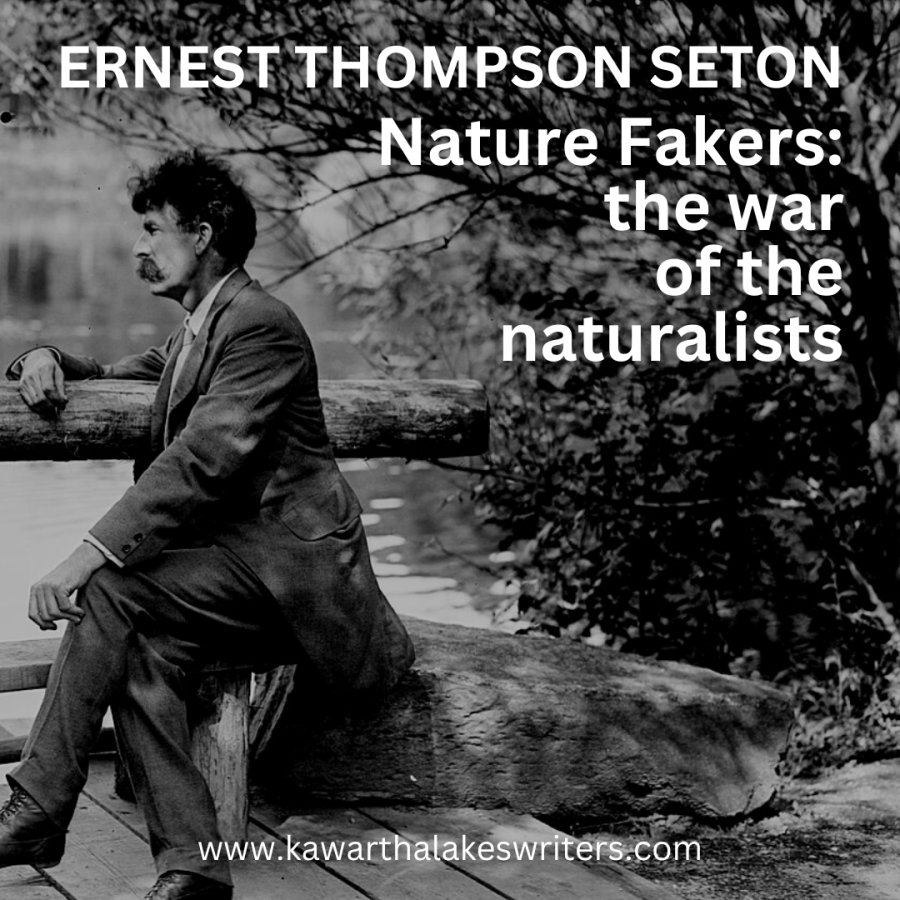
In 1903, Burroughs wrote an article for The Atlantic Monthly titled, “Real and Sham Natural History,” in which he absolutely roasted Ernest Thompson Seton and William J. Long. Seton had just published Wild Animals I Have Known, which in the opening of his article Burroughs “playfully” altered to Wild Animals I Alone Have Known.
The article got 11 pages in the journal, approximately 7700 words (11 pages, 2 columns, 50 lines per column, average 7 words per line), even after the editor sent it back to Burroughs for revisions. That he was given this much space for his scathing article shows how respected and well known he was at the time.
Burroughs begins his article with praise for a few natural history writers, including Charles G.D. Roberts. But even Roberts was not spared criticism.
Burroughs was known for believing naturalist writers should uphold the truth, but it seems what he meant was that naturalist writers shouldn’t write about experiences that Burroughs himself didn’t have. He said Roberts book was well done. “Yet I question his right to make his porcupine roll himself into a ball when attacked, as he does in his story of the panther, and then on a nudge from the panther roll down a snowy incline into the water. I have tried all sorts of tricks with the porcupine and made all sorts of assaults upon him, at different times, and I have never yet seen him take the globular form Mr. Roberts describes.” (“Real and Sham Natural History,” 1903)
Burroughs accused Seton of “romancing” natural history and of “deftly” blending fact and fiction. At this time Seton had published many volumes of non-fiction in addition to his animal stories and, in 1892, had been appointed Naturalist to the Manitoba Government. He was certainly not without credentials, and yet, this is what Burroughs has to say:
Mr. Thompson Seton says in capital letters that his stories are true, and it is this emphatic assertion that makes the judicious grieve. True as romance, true in their artistic effects, true in their power to entertain the young reader, they certainly are but true as natural history they as certainly are not. Are we to believe that Mr. Thompson Seton, in his few years roaming in the West, has penetrated farther into the secrets of animal life than all the observers who have gone before him? There are no stories of animal intelligence and cunning on record, that I am aware of, that match his.
“Real and Sham Natural History,” 1903
Burroughs’ beef with Long was that Long wrote about animals ability to learn and show intelligence. Burroughs wrote, “The crows do not train their young. They have no fortresses, or schools, or colleges, or examining boards, or diplomas, or medals of honor, or hospitals, or churches, or telephones, or postal deliveries, or anything of the sort. Indeed, the poorest backwoods hamlet has more of the appurtenances of civilization than the best organized crow or other wild animal community in the land!”
I discredit them as I do any other glaring counterfeit, or any poor imitation of an original, or as I would discredit a story of my friend that was not in keeping with what I knew of his character.
“Real and Sham Natural History,” 1903
Seton and many of the other authors in this roasting didn’t bother with writing a public reply, although many wrote to Burroughs to defend Seton’s work. They also wrote to Seton, inquiring what he was going to do about it. Seton felt nothing needed to be done, that the article “reeked of jealousy” and stood for itself. To reporters Seton gave the statement, “Nothing to say.”
Three weeks after the article was published, Seton and Burroughs met at a dinner.
The dinner was hosted by Andrew Carnegie to celebrate 50 outstanding New York writers. Among the attendants was none other than Mark Twain who witnessed the Seton-Burroughs confrontation.
In a far corner, I saw a group of three men in earnest discussion. All three had hair as white as snow. They were Mark Twain, William Dean Howells, and John Burroughs. I learned afterwards they were talking about me.
I turned to Garland and said: “Now, Hamlin, watch your uncle, and learn a lesson on ‘how to win a battle.’ ”
I walked over to the group—all old acquaintances—and said cheerily: “How do, everybody.” Howells and Mark shook hands with me cordially. Burroughs turned his back, and began to study a small picture on the wall. But I followed him up and said: “Here, Uncle John, don’t try to pull that stuff on me.”
Howells, timid and gentle, was fearful of a scene, so fled away. Mark Twain cocked up his head in a comical way, and prepared to enjoy it.
Burroughs knew he was cornered. He turned red and stammered: “Now, see here, Seton, you are not holding that up against me personally?”
“Holding what?” I said with subterfuge.
“Oh, well!” he said. “You know——”
“Know what?” I answered.
“You know I roasted you in The Atlantic Monthly.”
“You did?” I replied with an affectation of great surprise.
He went on: “There was nothing personal in it, it was purely an academic analysis.”
“You amaze me,” I answered.
TRAIL OF AN ARTIST-NATURALIST: THE AUTOBIOGRAPHY OF ERNEST THOMPSON SETON (1940)
At this point Carnegie interrupts and leads Seton away to meet some people. Seton used the opportunity to ask Carnegie to seat him next to Burroughs at dinner. Carnegie complied.
He changed the place-cards, so Burroughs and I sat side by side. And, believe me, I was conscious of the fact that every one near by was watching and listening to us.
Burroughs looked unhappy and terribly nervous, but I assumed the mastery and talked with academic aloofness. Part of our dialogue ran thus:
“Mr. Burroughs, did you ever make a special study of wolves?”
“No.”
“Did you ever hunt wolves?”
“No.”
“Did you ever photograph or draw wolves in a zoo?”
“No.”
“Did you ever skin or dissect a wolf?”
“No.”
“Did you ever live in wolf country?”
“No.”
“Did you ever see a wild wolf?”
“No.”
“Then, by what rule of logic are you equipped to judge me, who have done all of these things hundreds of times?”
Burroughs turned very red. He was much flustered, and exclaimed: “Well, there are fundamental principles of interpretation and observation that apply to all animals alike.”
One other shot I fired into him. “Of course,” I said, “it is all right to criticize me. I am used to it. I am public property. But why did you attack that innocent young child of nature, W. J. Long [whom I knew nothing about]? He is telling the truth sincerely as he sees it. Now he is crushed and broken, sitting desolate on the edge of his grave. Mr. Burroughs, if you hear of a terrible tragedy in that boy’s home in the near future, you can lay it to only one cause—the blame will be wholly yours.”
TRAIL OF AN ARTIST-NATURALIST: THE AUTOBIOGRAPHY OF ERNEST THOMPSON SETON (1940)
The confrontation at dinner resulted in Burroughs issuing a public apology to Seton in the July 1904 edition of The Atlantic Monthly. Later, Burroughs invited Seton to his home and Seton reciprocated with bringing Burroughs to his place in Connecticut.
When I showed him my library, some five thousand volumes then, my collection of two thousand photos of animals, taken by myself, my museum of one thousand mammal skins and two thousand bird skins collected and skinned by myself, one thousand drawings of birds and mammals by me; and, last of all, my journals, some thirty fat volumes, detailing my travels and observations during thirty years, he broke down and surrendered. “I had no idea—— ” “I never dreamed——,” etc. he said again and again. “I knew nothing of this, ——” etc. He, himself, never kept a journal, never made a drawing and never skinned a bird or a beast in his life. He was not a naturalist, but a fine poet with the gift of excellent English expression.
TRAIL OF AN ARTIST-NATURALIST: THE AUTOBIOGRAPHY OF ERNEST THOMPSON SETON (1940)
Not long after this, Seton and Burroughs went together at the behest of Henry Ford to meet with a pair of obstinate senators who were blocking a new bill that would protect migratory birds. Ford reasoned, “There are only two naturalists in the United States that every Senator will come out into the lobby to discuss such matters with—John Burroughs and Thompson Seton.” (Autobiography, Seton, 1940)
Although Seton and Burroughs had patched their relationship, the controversy continued to blaze. Many others writers and politicians jumped in and offered up their own opinions, including Jack London and President Roosevelt. (Wikipedia has an excellent summary of the entire controversy, which I’ve only briefly hinted at here.)
Roosevelt made a public statement in Everybody’s Magazine in 1907, in which he praised Burroughs and others, and went after Long, calling him out for being reckless with the truth, in an article titled, “Nature Fakers.”
Privately, Roosevelt told Seton, “Burroughs and the people at large don’t know how many facts you have back of your stories. You must publish your facts.” (Autobiography, Seton, 1940)
So Seton set to work writing his “masterpiece.”
I set to work to do so; and after three or four years got out my scientific work, Life Histories of Northern Animals, in two quarto volumes. This was acclaimed as a masterpiece. For this I was awarded the Camp-fire Gold Medal, for the most valuable contribution to popular natural history of the year. It was, however, merely the prodrome of my Lives of Game Animals, which came out ten years later in four large quarto volumes, and for which I got the Burroughs Medal and the Elliott Gold Medal of the National Institute of Science. This is the highest recognition offered in America, and effectively silenced all my critics. Every scientific library in America today points to Seton’s Lives, as the last word and best authority on the subject.
TRAIL OF AN ARTIST-NATURALIST: THE AUTOBIOGRAPHY OF ERNEST THOMPSON SETON (1940)
Life Histories of Northern Animals was published in 1909.
And ironically, Seton won the James Burroughs medal in 1927.
This article is one of several about Ernest Thompson Seton and his life:
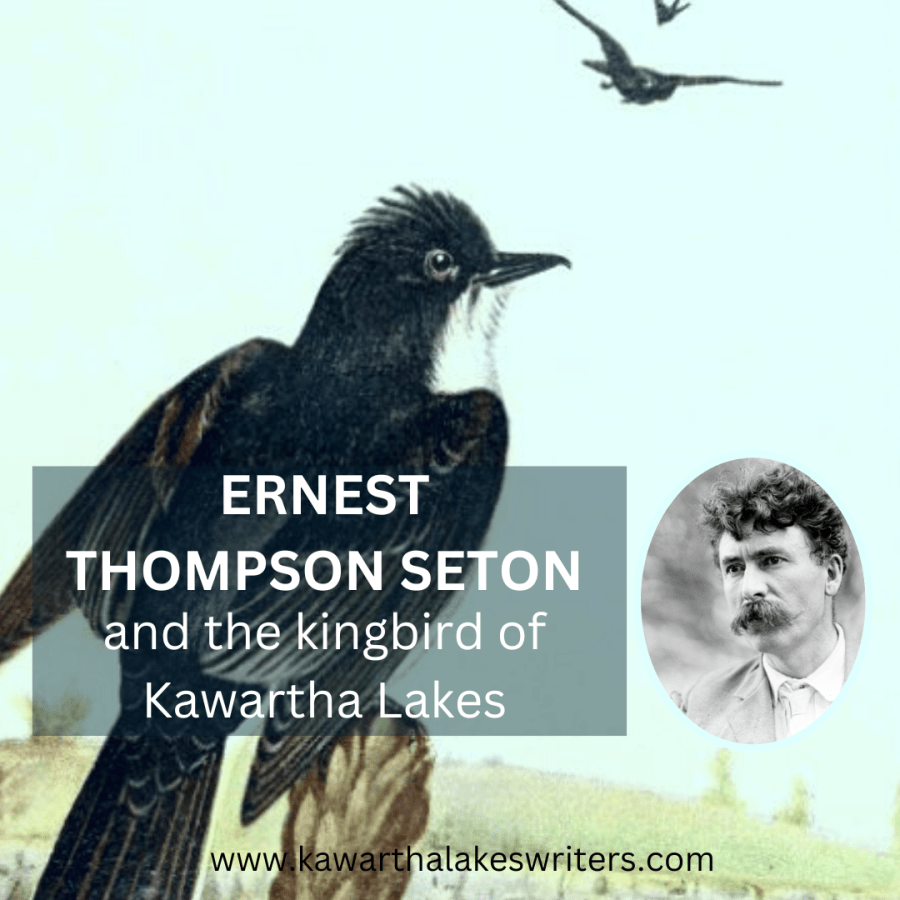
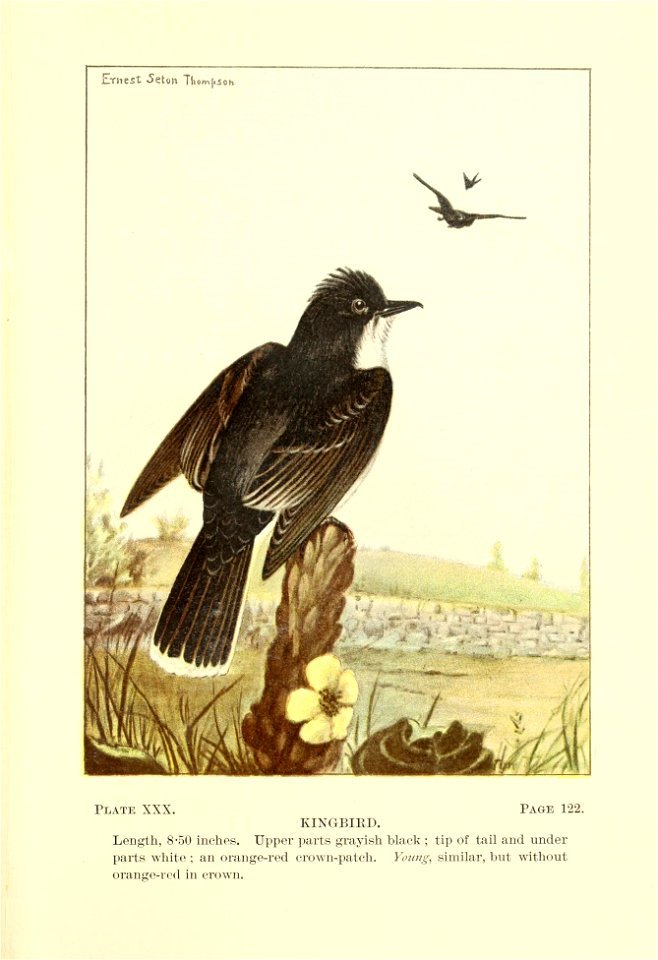
During his time in Kawartha Lakes, Seton came upon the bird that inspired him to be a wildlife writer. Sighting the little kingbird was the “beginning and foundation” of his career, but also the influence for the kind of person he became.
One of the earliest of my wild-life thrills was given by the king-bird. I had heard of the feathered monarch—his prowess, and the fact that, though little larger than a sparrow, he would assail and drive off any hawk—yes, even an eagle.But the authorities all made it so far away. The wonderful bird was found in Africa, or South America, or some vague tropical place, whose name was strange, or maybe it inhabited only “the books.”
One day, as I went for the cows with my older brother George and a neighbour, Jim Parker, a couple of crows flew high across. Then, from a low tree, there launched out a small bird that uttered a shrill war cry; and dashed first at one, then another of the big black fellows. They dodged and swooped in evident fear, and flew as fast as possible into the woods.
“What is that?” I asked eagerly.
“That’s a king-bird,” said my brother, for he had been learning from the woodsmen.
“An’ he kin lick anything that flies,” was added by the neighbour.
“A king-bird!” I gasped. Yes, and gulped a cup of joy. I had dreamed of it. I thought it a rare bird of far countries. Now I had seen it in our own land, with my own eyes; it had all become real. It lived and fought right here among our crows. The fact was glorious, stunning, in its magnitude. That man never knew how much he was giving me.
This was really a historic day for me, for the event focused my attention on the brave little king-bird. Always a hero-worshipper and a wild-life idolater, I took the king-bird into my list of nobles. Each year I learned more about him, and at last (in 1876) wrote a heroic poem, “The King-bird.”
In its final shape, I did not put it out until 1879, but in previous attempts and in illustrations I tried it on many of my friends in the years between. I consider it the beginning and foundation of all my work as a wild-animal story-writer.
TRAIL OF AN ARTIST-NATURALIST: THE AUTOBIOGRAPHY OF ERNEST THOMPSON SETON (1940)
The eastern kingbird is a large flycatcher found in open areas dotted with trees and bushes where they can perch to scout for their food. They are known for aggressively defending their territory, even against larger predators. They spend their winters in South America.
Kawartha Lakes contains a lot of open fields bordered by bushes and trees. Chances are, the kingbirds can still be found swooping from their perches.
In life, Seton was bullied as a child for being cross-eyed (the result of an early childhood accident; he eventually outgrew the condition); he was abused by his father; his career was trashed by someone he admired. Seton had plenty of reasons to become the kingbird, to fight off the bigger bullies, but he didn’t. In every instance, he took the high road.
More importantly, he looked out for those less fortunate: he financially looked after his family, including his parents (see the article, Ernest Thompson Seton and his father for more information on this), and when he finally confronted his natural history bully, James Burroughs, he didn’t speak for himself but for the younger man who was also trashed by Burroughs. (More on this in another article.) He wasn’t worried about the effect on his own career for he was already known in the industry, but the other guy was just starting out and he felt Burroughs should know the impact of his words on this man’s life.
As he says in the quote above, he was a “hero-worshipper and a wild-life idolator.” He did more than take the kingbird into his list of nobles. He became the kingbird others needed.
Such the legend of the King-bird,
Of the fearless crested King-bird;
He of fowls is the protection.
Though a sparrow he in size is,
Yet an eagle he in spirit.
excerpt from The King-Bird by Ernest Thompson Seton, TRAIL OF AN ARTIST-NATURALIST: THE AUTOBIOGRAPHY OF ERNEST THOMPSON SETON (1940)
This article is part of a series of articles about Ernest Thompson Seton.











 kawarthalakeswriters.com